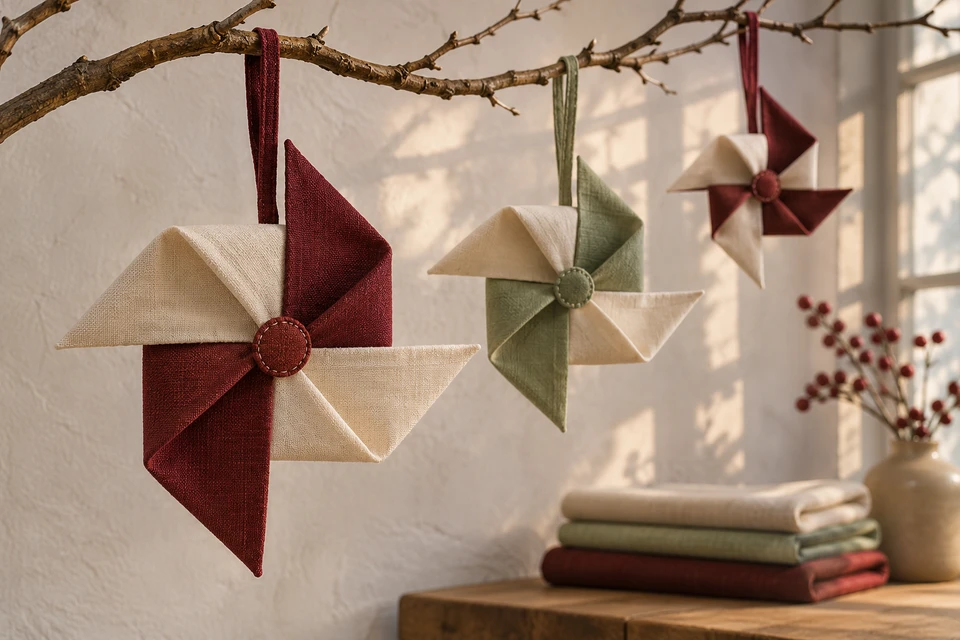
Fabric pinwheels can add movement to a Christmas display without containing a moving mechanism. That distinction belongs in the procurement brief. A static hanging ornament needs an approved folded silhouette, secure central assembly and predictable viewing direction; it should not be bought or described as a spinning toy merely because its shape resembles one.
Draw the fold sequence before choosing colours
Four blades need one intentional direction
Number the positions on an internal drawing and identify which corner of each piece turns towards the centre. Establish whether all ornaments turn visually in the same direction or whether the retail set intentionally includes mirrored versions. A photograph of a completed ornament may obscure a reversed fold, especially when the front and reverse fabrics share a similar festive shade.
Use contrasting development fabrics for the first structural sample if that helps reveal the route. Once the sequence is clear, substitute the proposed Christmas palette and review it again. A pale reverse that was obvious during development may disappear into an ivory face, while a wine-coloured reverse may become a strong new triangle. Approve those exposed surfaces as part of the design rather than treating them as hidden components.
Treat the centre as an assembly zone
Covering the join is not the same as approving it
The centre gathers several folded points into a small area. Ask for a sample showing the assembly before any decorative disc or other cover is added. Confirm how the folded points are retained, where raw edges terminate and whether a hard component is proposed. Record the component and attachment method in the bill of materials without claiming an unperformed retention test has passed.
Next inspect the finished centre from the front, side and reverse. A centre cover that is too large can obscure the blade openings; one that is too small can expose uneven folds. Compare its apparent size with the visible blade length, not simply the overall ornament diameter. Keep any assessment of small components or intended user age within a separate market-specific product review before final retail copy is approved.
Hang the ornament in the intended display
Face direction changes the buying decision
Decide whether the item will hang individually, sit in a multi-piece decoration or be attached to a display backing. For a hanging version, identify the loop position relative to the top blade and photograph the ornament without holding it straight. Observe whether the centre remains visible or the ornament naturally turns edge-on. A studio photograph supported from behind is not evidence of its unsupported presentation.
Try the intended mix of display heights and spacing on a plain background. Christmas branches and other nearby ornaments can catch on the projecting blades, so reserve enough clear space for the chosen setting. This is a layout check, not approval to place textile decorations near heat, moving equipment or accessible hazards. The packaging and merchandising team should see the same approved installation example used by the buyer.
Compare a flat pack with a protected shaped pack
Unpacking must restore the intended blade form
Folded fabric blades may arrive pressed together if the pack compresses them heavily. Trial the proposed packing method on finished ornaments with their actual centre assemblies. Record what the recipient must do after opening: separate each blade, adjust the loop or perform no shaping at all. Do not assume a retailer will steam, iron or reshape every piece unless that workflow has been explicitly agreed.
Photograph the unpacked silhouette from the same position used for the approved sample. Check the four blade tips, visible openings and the position of the centre. If the recovery is inconsistent, compare a revised fold or a different protective pack before increasing the order quantity. A more protective pack can change carton density, so request its outer dimensions and revised quotation rather than treating it as a free afterthought.
Release the assortment as a defined set
Avoid mixing structural revisions into one colour story
For a multi-colour Christmas assortment, list which colour occupies each blade position and which way the blades turn. Keep quantity ratios separate from that construction map. An inspector must be able to distinguish an intentional mirrored style from a wrongly folded unit, and a packer must be able to distinguish a colour variant from an earlier development sample that should not enter sale stock.
Send FY Bedding the static-decoration brief, proposed display route, sample photographs and intended order split for a feasibility review. Request confirmed sampling and dispatch milestones before committing the range to an event. No stock position, production method or pre-Christmas arrival is established by this guide. The purchase decision should be tied to the actual construction, intended use and evidence agreed for the project.
Approve one blade sequence, an exposed centre assembly and the freely hanging finished ornament. Keep any mirrored variant explicit, and describe the item as static unless a separately evaluated moving function is genuinely supplied.