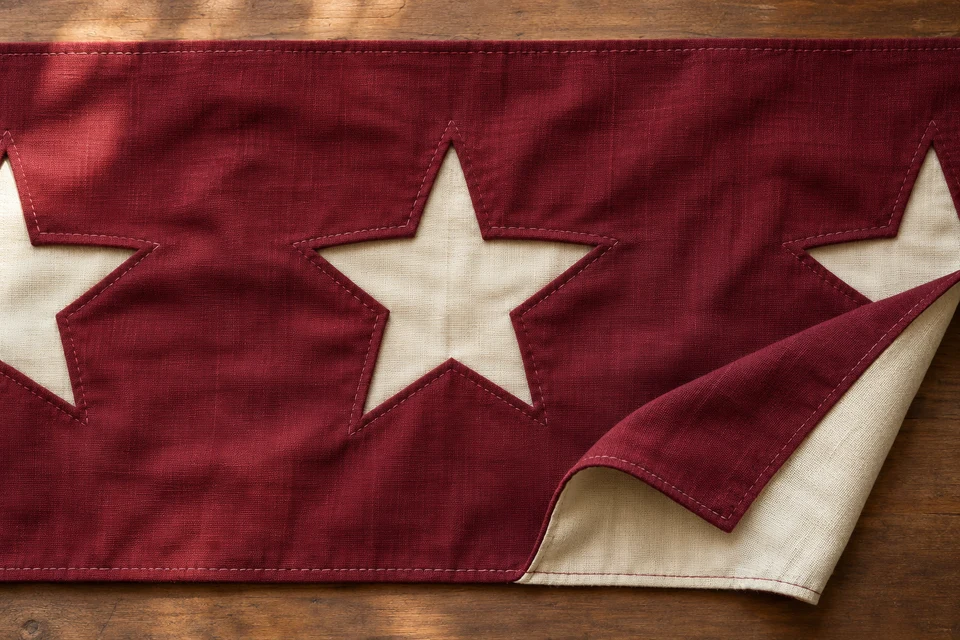
A cream star on a burgundy runner can be printed, sewn on top or revealed through an opening in an upper layer. These are different constructions even when a distant product photograph looks similar. For reverse applique, the purchasing brief needs to identify the cut-back layer and the cloth that becomes visible beneath it. Begin with that relationship before debating stitch colour or the number of stars. The sample must explain how the motif is made, not merely resemble the artwork from one angle.
Draw the layer order
Define the visible star and the surrounding field
Provide a simple section or annotated sample showing the upper fabric, exposed lower fabric and any additional backing. State whether the contrast cloth extends across the whole runner or only beneath individual motifs. These choices can change the reverse appearance and the number of components being assembled. Ask suppliers to identify their proposed version explicitly so quotations are not compared as though they describe the same product.
The Textile Research Centre describes reverse applique as a layered technique in which shapes are cut out to reveal underlying cloth. That definition distinguishes it from a separately applied star, but it does not prescribe one universal finish for a commercial runner. Ask for an actual sample of the proposed edge treatment. Record whether the edge is turned, covered by stitching or deliberately exposed, and judge that specific interpretation against the intended product positioning.
Give the star points their own review
A recognisable outline needs room at every angle
Compare the outer tips and the inward corners at full size. A narrow point may become blunt after finishing, while a crowded inward turn may show puckering or an uneven reveal of the lower layer. Photograph the same star both flat and at normal table distance. Do not approve only a large development motif if the retail runner uses smaller stars. The smallest version may be the one that determines whether the construction is suitable.
Where a point is difficult to finish, ask for a revised outline or a revised construction sample, not an undocumented workshop adjustment. Keep the star's overall character in view: a technically neat edge can still look unlike the chosen design if every tip has been shortened. Record accepted rounding and any intentional asymmetry. A controlled physical reference is more useful than a demand for sharp points without an agreed example of what that means in the selected cloth.
Check the exposed lower layer
The aperture and contrast fabric work together
Lay the runner over a representative table surface and observe the star field. Review whether the lower fabric lies flat within the opening, forms small folds or pulls differently from the upper layer. Check several motifs, including those close to the hem and those in the middle. A single attractive star crop does not show how the layered assembly behaves across the full length of the runner.
Inspect the reverse as a customer or service team would see it during unpacking and placement. Decide whether local contrast patches, joining seams or backing are acceptable for the intended offer. If the runner is promoted as reversible, both faces need their own approved presentation; otherwise avoid implying that the back is a second designed face. Record the intended top clearly in internal packing instructions without adding unapproved visible marks to the product.
Trial the runner with the intended setting
Layered decoration is not a heat-performance claim
Place the sample in its proposed decorative arrangement and check how the star areas relate to place settings and centrepieces. The raised or recessed edges may affect how an object sits if the motif falls beneath it. Use the actual arrangement rather than assuming that every decorative runner must function as a flat working surface. Record whether the star zones are intended to remain unobstructed as visual features.
Keep food-contact, heat and flame questions separate from appearance approval. A seasonal runner should not be presented as a protective trivet or a safe candle surround merely because it is layered. The responsible buyer must identify relevant use and market requirements and request evidence where needed. For the development photograph and sample review, use an unlit, non-heated setting. Decorative suitability alone does not establish protective performance under a hot object.
Lock the care-reviewed construction
Keep the quotation attached to the accepted sample
Evaluate the complete runner through its agreed care and finishing procedure. Compare the flatness of both layers, exposed star outlines, hem appearance and reverse before and afterwards. Record the preparation used for inspection so a pressed reference is not silently compared with an unpressed item. If the upper and lower materials change, review the affected behaviour again rather than carrying forward an unrelated sample approval.
Send FY Bedding the layer drawing, intended star scale, finished runner dimensions and proposed quantities when requesting a feasibility review. Ask which choices affect material preparation, sampling and minimum quantities. Retain the final full runner as well as close-up references of the most demanding corners. Confirm the actual development and delivery plan instead of assuming an accepted visual concept is immediately available for a Christmas programme. Release only the construction and scope that the supplier has confirmed.
Specify the upper layer, revealed fabric, edge finish and intended reverse, then approve the complete runner after its agreed care review.
Method references: Textile Research Centre: Reverse Appliqué.