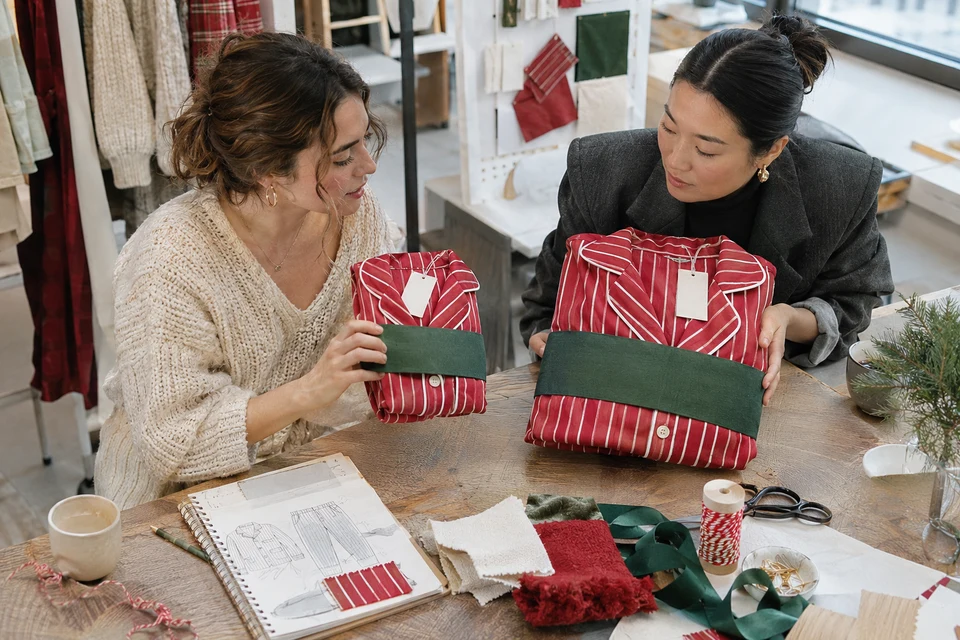
On a gift table, a coordinated family pajama range is meant to look alike. At the packing station, that very similarity can cause a child's top to travel with the wrong bottoms or a size band to migrate to the next set. The textile accessory has two separate jobs: hold one agreed fold and preserve the identity of the contents. The garment labels still do their own work. Decide whether the gift band carries a duplicate size cue or simply leaves the original identifier visible.
Measure the folded set, not the person
Choose the pack fold first
Have the buyer's packing team fold a real set as it is intended to reach the shop floor. Include the bottoms, tags and any insert actually supplied. Mark the proposed band line and measure around it without drawing the fabric tight. Then ask a different operator to make the fold. A small difference in where the collar lands can change the thickness at the band even when both packs have the same outside width. Record that range rather than commissioning a ring from one photograph.
Repeat this with adjacent sizes and the bulkiest style in the assortment. The change from one size to another may add very little bulk; a switch from a lightweight knit to brushed woven fabric can add more. Group sizes by actual folded girth if a common band is wanted. An identical band length per garment size sounds orderly on a purchase order but is not automatically the best use of materials or of the packing team's time.
Keep a reliable identity after the band moves
Define the source of truth
Set two nearly identical packs next to each other. Remove both bands and ask a merchandiser to rebuild them. They should be able to identify which top and bottom belong together from the garments and the buyer's pack record. If the sole size identifier was on a loose band, decide whether to expose a garment tag through the fold or add an approved separate pack identifier. A decorative color alone is a fragile match key under mixed shop lighting.
If the band has its own size mark, agree who supplies the artwork and how it is reconciled against the component labels. Test the view from the top of a stack as well as from the front of the shelf. Keep required garment information and its approval process separate. No decision about the appearance of a Christmas gift band establishes whether the garments meet destination-market requirements or whether a specific marking may be covered.
Compare fixed and adjustable constructions
Inspect the set after handling
A sewn loop gives a clean front and a reproducible presentation, but a loop that goes on easily may work loose when a shopper lifts one corner. A tie can accommodate more thickness but needs consistent finishing and leaves tails to manage. Try each shortlisted construction with the smallest and largest actual pack. Lift, place, slide into the display stack, withdraw and put it back. At the end, check where the identifier sits and whether the pants have begun to escape separately.
Open the set and look at the garment as well as the band. A bulky seam hidden under the pack may mark a soft fabric; a tight edge across the collar may change the appearance when the customer unfolds the gift. If the first trial looks wrong, distinguish a fit problem from a folding problem. Change either the band circumference or the fold position and test again. Retain the successful combination with both measurements written down.
Quote the assortment the warehouse will receive
Avoid multiplying minimums by accident
Give purchasing a size-by-color schedule and show which bands genuinely differ in construction or marking. Ask whether a plain common band with a separate buyer-approved identifier changes the minimum per variant. Request the packed unit and carton assortment as distinct lines in the brief. A quote for empty bands cannot be compared directly with one that includes folding, pairing garments, checking identifiers and arranging mixed-size cartons for stores.
When requesting a custom sample, send FY Bedding two neighboring physical sets, the artwork revision and the intended front-facing fold. Ask the team to return one finished bundle and one loose band identified to it. For a holiday rollout, let the final size schedule and packing trial inform the production dates; a visually approved Christmas motif does not confirm garment availability, packing capacity or delivery to a particular store.
Accept the band when a second operator can pack, identify and rebuild the correct size pair. Photograph the front, the garment identifier and the back seam of the accepted bundle.