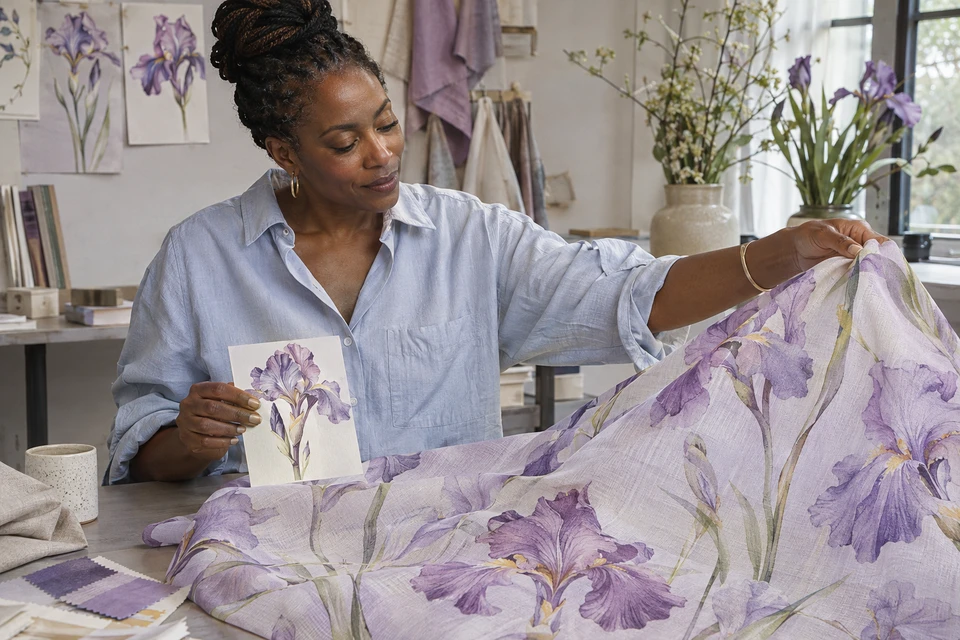
A floral image can look crisp in a catalogue and still be an unsuitable source for a large bedding print. Before paying for a strike-off, ask what pixel data exists and how large the flowers will become on the fabric.
- 1. Begin with the source file rather than the catalogue page
- 2. Relate available pixels to the chosen physical scale
- 3. Check what has been added through resampling
- 4. Use a bounded proof before a complete bedding sample
- 5. Decide whether to redraw, reduce or change the motif
- 6. Hand off a file with a known approval purpose
Begin with the source file rather than the catalogue page
A reference image is not automatically production artwork
Use the FY floral collection and a reference such as FR-01 to describe a preferred visual direction. Those pages help discuss flower character and composition; they do not establish access to a print-ready master or confirm a material and printing process. Obtain the authorised source artwork through the agreed project route, together with the scope of permitted use. An image displayed publicly is not, by itself, a transferable production file.
Ask whether the file is a native raster painting or scan, an exported preview, or a photograph of a finished bed. A bed photograph contains folds, lighting and perspective that are not part of a flat repeat. Improving its resolution does not remove that distinction. If a new interpretation must be drawn, quote and approve that development explicitly rather than pretending the reference can be enlarged directly into a production design.
Relate available pixels to the chosen physical scale
Read the numbers before changing the resolution label
Adobe's guidance distinguishes pixel dimensions, physical size and pixel density, and explains that resampling changes the pixel data. For a simple illustration, a 6,000-pixel-wide source used across 30 inches has 200 source pixels per inch; at 60 inches it has 100. These figures describe the relationship, not acceptance thresholds for a textile printer. Ask the proposed print provider what input specification is appropriate for the actual artwork, process and fabric.
Record the intended size of a recognisable flower as well as the repeat's overall dimensions. A source can be placed in a large file with generous empty margins without giving the important petal any more detail. Conversely, a small repeat printed repeatedly does not need to be enlarged to the width of the entire duvet. Make sure the team is evaluating the actual scaling operation, not confusing product width with the artwork tile's physical width.
Check what has been added through resampling
More pixels can mean a larger file rather than a better original
Request the native dimensions before enlargement and a short description of later processing. Keep the original and the proposed production file separately identified. A resampled file may be useful in a workflow, but its new dimensions should not be presented as the amount of original detail captured. Ask for comparisons at the intended output size rather than judging a thumbnail where both files can look equally smooth.
Select several difficult crops: a thin stem, a soft petal transition, a small flower centre and the edge of a leaf. Look for blocky steps, halos, invented texture or blurred boundaries that change the design character. Do not require every painterly edge to become hard and sharp. The decision is whether the intended detail survives convincingly, not whether every area has maximum contrast. Record which changes are acceptable interpretation and which require new artwork.
Use a bounded proof before a complete bedding sample
Spend the sampling effort on the uncertain details
Agree a proof that contains the difficult crops at their real intended size, along with enough surrounding pattern to judge context. A paper proof can help discuss scale and obvious image artifacts, but it cannot approve the fabric's printed colour or handle. Follow it with a process-relevant textile strike-off when those decisions are ready. Keep the purpose of each proof clear so a quick scale check is not mistaken for production approval.
For comparisons, hold the physical flower scale and viewing setup steady. Changing the substrate, print method and artwork processing at once makes it hard to know why one version looks better. Where several routes genuinely need evaluation, label them as separate proposals and record the variable each one changes. Ask for sample costs and lead times against that bounded scope; unlimited enlargement experiments are not a useful substitute for an agreed design objective.
Decide whether to redraw, reduce or change the motif
A smaller flower can be a design decision, not a hidden compromise
If the source cannot support the desired appearance, compare deliberate alternatives. The artwork owner may provide a better master, an illustrator may reconstruct selected details, or the buyer may choose a smaller flower scale. Each route has different approval and permission implications. Do not accept a new digitally generated petal shape simply because the file is technically larger; the revised design still needs the authorised decision-maker's review.
Consider the full bedding composition before reducing scale. A smaller bloom changes repetition and visual density, so the solution should be checked on a correctly scaled layout rather than only on the isolated flower crop. State what remains fixed, such as the colour direction or the relationship between the pillow and duvet. The supplier can then quote a defined revision instead of interpreting a general instruction to make the image print better.
Hand off a file with a known approval purpose
Keep the artwork decision connected to the physical proof
Retain the native source identity, production-file dimensions, physical repeat size, resampling notes and approved proof references together. Mark which file is for manufacturing and which images are only presentation previews. The printer should not have to recover the intended scale from an email attachment whose name says final but contains a reduced image. Verify the handoff with the recipient before releasing the broader sample order.
Send FY Bedding the floral reference, available source information, desired flower scale and proposed quantities through the custom enquiry. Ask for a development assessment without treating the reference page as proof of print-ready artwork or a confirmed process. A useful approval records what will be printed at what size, what has been checked physically and which decisions remain open before bulk production.
Keep native pixels, resampled pixels and physical flower size separate. Approve the difficult details at real scale, then use a textile strike-off for the material-dependent print decisions.
Method references: Adobe: Image size, resolution and resampling.