A botanical toile can contain more than flowers: a trellis, flowering tree or garden vignette may form a small scene that needs to remain legible as a whole. Reducing that artwork to fit a pillow does not automatically preserve its character. For a floral bedding programme, decide which scene units must survive, which details may simplify and how the pillow relates to the larger duvet. This is a composition decision before it is a bulk-printing decision. A collection reference should start that conversation, not substitute for a production-ready artwork and fabric proof.
Identify complete scenes
Distinguish a vignette from an isolated flower
Mark the principal scene units on the authorised artwork. A flowering branch may stand alone, while a tree leaning over a bench may need both elements to retain its intended reading. Decide where a scene begins and ends, and which background details can be omitted without changing its identity. Number those units in the design brief so comments refer to the same objects. Avoid a general instruction to make the flowers smaller when the problem is that a complete vignette no longer fits the visible panel.
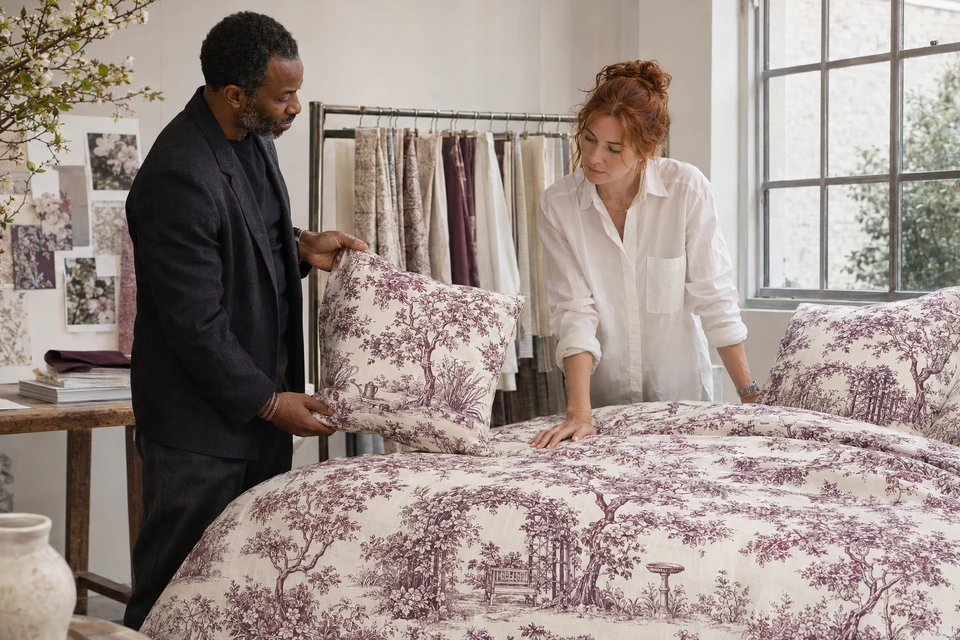
Use the FY floral collection to discuss visual direction, and attach the exact reference that prompted the enquiry. A page such as FR-01 is a way to identify a reference, not evidence that it is toile, printed in a particular process or available in the proposed fabric. Ask for an original or authorised scene layout suited to the project. Do not copy a third-party scene or imply a collaboration merely because a reference photograph appears in a design discussion.
Compare line clarity at finished size
Judge a cloth proof rather than a magnified screen
Print or otherwise prepare an actual-size working proof for composition, then request the appropriate fabric trial for the proposed production route. Look at fine stems, clustered petals and small background details under the agreed viewing conditions. A digital preview enlarged to fill a monitor can make details look comfortably separated when they are crowded at pillow scale. Compare the trial with the same-scale artwork and record which features need simplification rather than asking for a blanket increase in sharpness.
Keep substrate and process questions explicit. The selected cloth, its texture and the proposed reproduction method need supplier confirmation; none can be inferred reliably from a styled bed image. If a technical change is suggested to preserve a small detail, ask what else changes in appearance, handle or care requirements. A simplified flower centre may be a better design decision than promising an exact miniature version that the proposed trial cannot consistently show. Retain both accepted and rejected examples with clear version identities.
Coordinate pillow and duvet without forcing one repeat
Choose the relationship between the pieces
Lay the pillow mock-up above the duvet mock-up in the intended arrangement. Decide whether the pillow repeats a smaller complete scene, uses the same scale with fewer scenes or highlights one selected vignette. These are distinct options and should be quoted and sampled as such. Inspect the front view at normal room distance as well as close up. The purpose is to preserve a readable relationship, not to make every piece contain the same number of flowers or occupy the same visual density.
Check the pillow opening, seams and any flange only after the preferred scene relationship is clear. Mark the visible face and any zone that may disappear behind another pillow. If pairs are supplied, decide whether they share an identical scene or use coordinated alternatives. Record left-right presentation only where it matters to the design. This differs from simply cropping a large bouquet across bed sizes: the buyer is choosing how self-contained narrative units are distributed across several components of one coordinated set.
Build a sample sequence around the uncertain decisions
Avoid paying for a full set before the scene works
Separate the first artwork composition review from the later fabric and assembled-set reviews. Start with the scene unit and size relationship that are most uncertain. Once those are agreed, ask the supplier to confirm the sample scope, charges, minimum quantities and expected development sequence for the chosen route. If the pillow needs a separate layout, establish whether that creates an additional artwork or production requirement instead of assuming it is included in a duvet quotation.
For the assembled sample, review the complete made-bed view and keep close photographs of the smallest approved scene detail. Add the material identity and relevant care or performance evidence requirements to the record. Do not call a paper proof a colour or wash approval. Likewise, a satisfactory fabric swatch does not confirm scene placement on the finished set. Each review should answer a defined question and leave a clear record of what remains open before the order can be released.
Present the set without hiding the design logic
Connect retail images, pack identity and the final brief
Choose a retail presentation that shows at least one complete vignette and the pillow-to-duvet relationship. A folded pack may display only a small fragment, so compare that view with the assembled set before selecting the pack fold. Keep product naming tied to the approved artwork and component list, not to an assumed historical style or third-party designer relationship. If several coordinated layouts share a collection name, make their individual identifiers visible in the internal pack and ordering records.
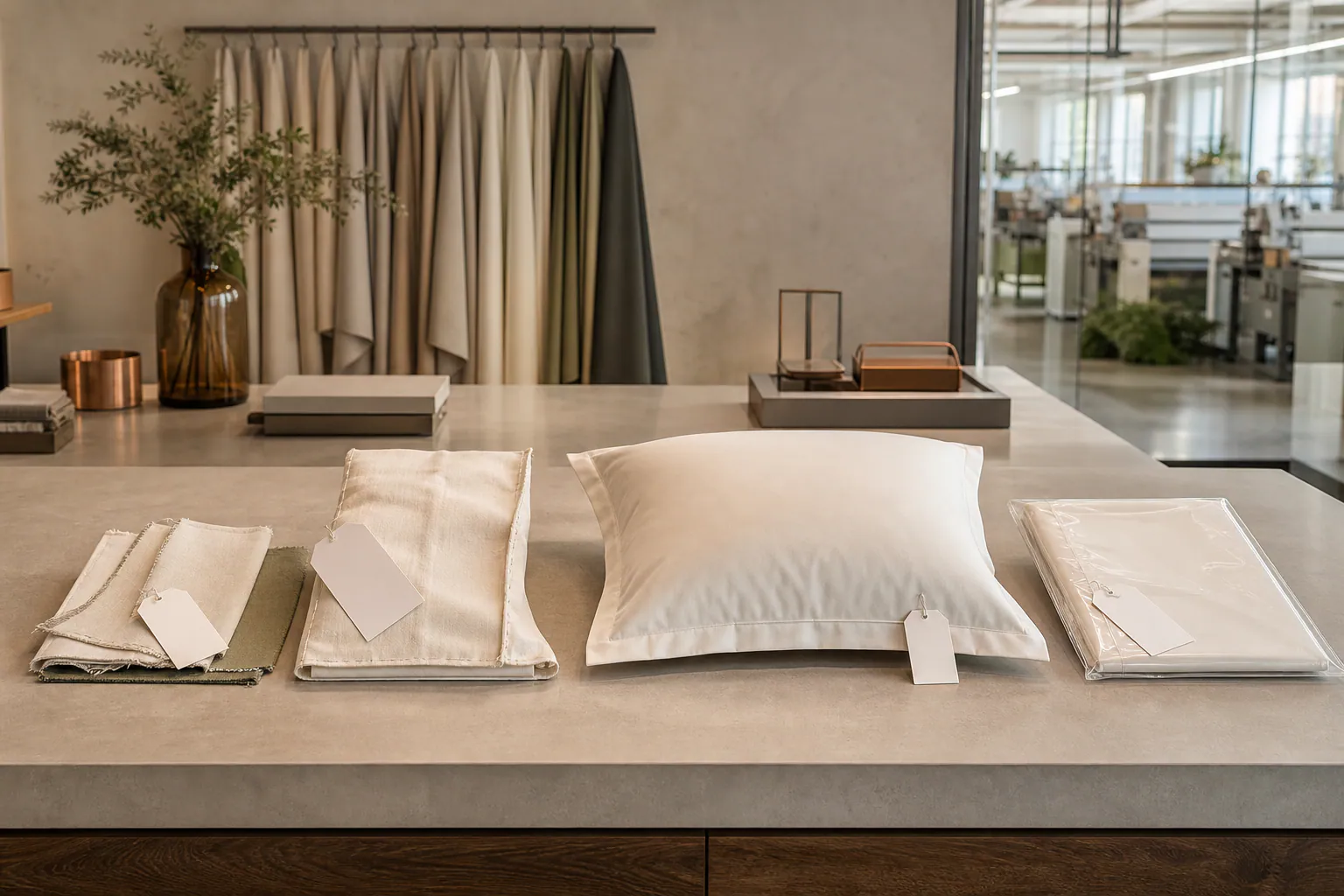
Send FY Bedding the chosen references, scene map, desired pillow and duvet dimensions, market and quantity breakdown. Ask which materials and production routes can be evaluated, and what evidence is required before any claims are used. The generated image accompanying this guide illustrates a design-review scenario; it does not identify a stocked set or a confirmed factory capability. Bulk approval should rest on the reviewed physical set and its linked specification, with scene changes controlled as carefully as other artwork revisions.
Keep the scene unit readable at actual size and approve the pillow-to-duvet relationship on a complete set, not on two unrelated close-up images.