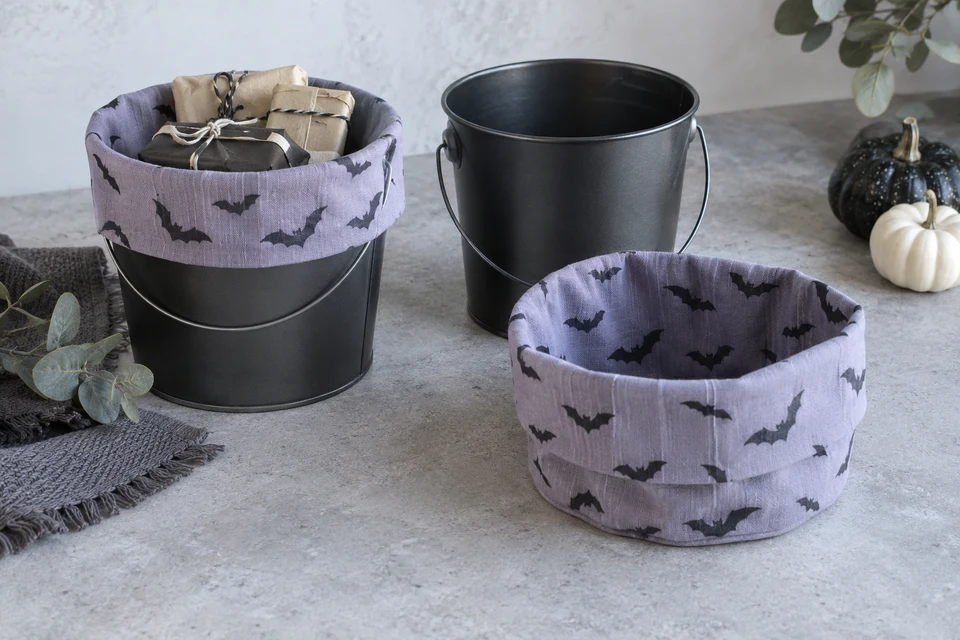
A seasonal bucket liner is a shaped textile component, not simply a circle of fabric placed inside a container. Its upper fold must remain presentable while the inner body reaches the base without pulling the rim inward. Buyers should approve it with the exact bucket reference and the intended packaged contents. This guide concerns decorative presentation with wrapped items; it does not establish direct food-contact suitability, carrying capacity or suitability for children.
Identify the controlling bucket geometry
The rim and base may need different pattern decisions
Record the opening, depth, base shape and taper of the actual container. Include any rim lip, handle attachment or internal projection that affects removal. A liner developed on a straight-sided bucket may sit differently in a tapered one despite an identical opening measurement. Photograph the empty bucket from above and from the side, then connect those references to the textile development brief.
Decide whether one liner is intended for one bucket or an explicitly listed family. Trial the smallest and largest controlling shapes before promising shared fit. Do not describe compatibility using capacity alone: a volume statement does not reveal rim profile or internal proportions. If the bucket is buyer-supplied, identify who keeps the reference sample and who approves later substitutions.
- Record taper, lip and handle attachments.
- Name compatible container references rather than nominal volume.
Specify the turned-over rim
External decoration consumes usable fabric
Draw the intended fold depth outside the bucket and the visible motif area after turning. Show whether the cuff is fixed by construction or folded by the person setting up the display. A bat border that looks centered on a flat strip can disappear into the fold. The pattern-placement guide helps separate printed position from final visible position.
Inspect the fold all around the opening without pulling the liner tight. Check the handle attachment areas and record whether the fold interrupts the handle route. If a tie or elastic component is proposed, have its intended use and component requirements reviewed separately. Do not add an improvised fastener merely to make the approval photograph look neat; it must belong to the quoted assembly.
- Measure the visible cuff in its folded state.
- Review rim continuity near handle attachments.
Review the interior empty and partly filled
Contents should not hide a pattern problem
Place the liner inside the empty reference bucket and inspect the base and side seams. Identify excess material, suspended corners or tension that pulls the cuff inward. Then add the representative wrapped packages in their ordinary display arrangement. Compare both states; a fully packed photograph may conceal an interior that does not settle properly on its own.
The storage-basket shape discussion is a related reference, but this purchase is a removable liner, not a self-supporting basket. State whether the liner is expected to retain any shape outside the bucket. Do not reject a soft removable component for collapsing after removal unless independent shape was part of the brief. Keep the container's structural function distinct from the textile's appearance.
- Inspect the empty base before adding packages.
- Separate liner fit from the bucket’s structural role.
Make removal and cleaning practical
The replaceable part needs a clear identity
Remove the liner using the intended method and inspect whether seams catch on the rim or handle fittings. Refit it without special styling. Record the steps and any orientation needed to restore the visible border. If staff must find a particular seam before refitting, provide a clear reference that does not depend on remembering the original photo.
Ask the technical owner to confirm the care route for the actual material, decoration and components. Review fit again after the agreed care assessment rather than assuming that a familiar fabric remains compatible. Use the buyer resources to record samples and open evidence requests. Direct food contact, intended-user considerations and any other regulated claims require their own review; a removable, clean-looking liner is not proof of those properties.
- Observe removal and refitting on the real bucket.
- Recheck rim and base fit after the agreed care assessment.
Quote liners and containers as separate units
Prevent set-count and replacement confusion
State whether the offer is liner-only, bucket-only or a combined set. For replacement liners, identify the compatible container reference on the purchasing record. A retail pack showing two buckets should not be interpreted as containing two liners unless the contents list says so. Compare colors, print variants and minimum quantities against the actual finished liner design, not a shared fabric swatch alone.
Review the fold used for shipment and the steps needed to recover the cuff. Share the bucket sample, wrapped display contents and proposed quantities when requesting a liner feasibility review. Confirm the offered construction and schedule before release. Keep sample photos focused on the sold parts so buyers do not mistake illustrative gifts, props or containers for included stock.
- State liner and bucket quantities independently.
- Keep replacement compatibility attached to each design.
Approve the removable liner on its named bucket, first empty and then with representative wrapped contents. Control the external cuff, inner base and refitting sequence as three separate observations.