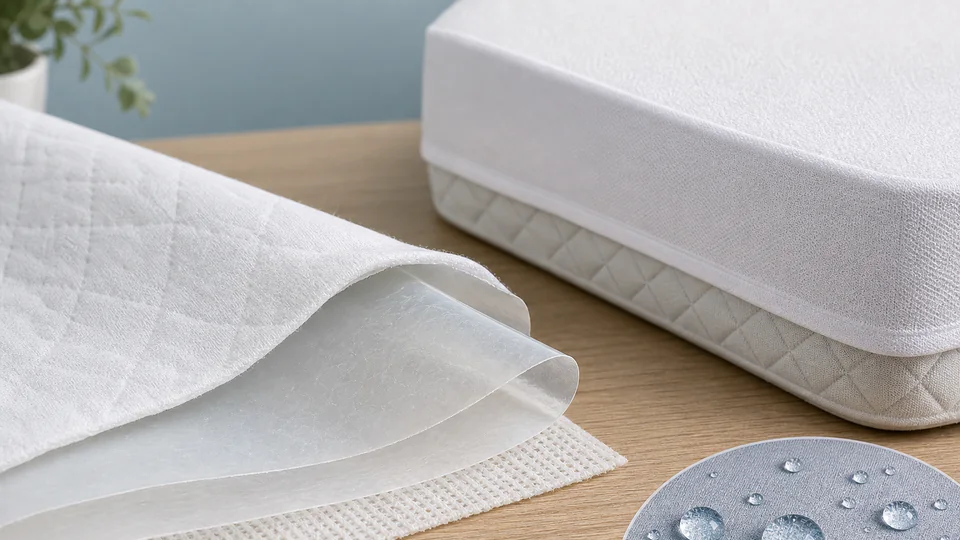
Waterproof performance belongs to a complete material stack and finished construction. Raw-film information cannot replace a fit, care and barrier trial on the actual product.
Define the protection format and use case
Identify whether the product is a fitted protector, pad, five-sided cover, encasement or another barrier construction. Record mattress dimensions, exposure direction, guest-contact surface, wash frequency and operating environment. These inputs affect membrane, lamination and seam decisions.
Use the protector procurement guide to connect barrier performance with fit and housekeeping. A waterproof fabric test does not prove that a finished protector stays on the bed or prevents leakage through construction details.
Specify the complete material stack
Record face fabric composition and finished weight, membrane material and nominal direction, lamination or bonding process, backing or skirt construction and any finish. Identify which side faces the sleeper and which side faces the mattress.
Ask how the selected stack affects hand, stretch, noise, heat and recovery. Approve the actual color and construction because changes in fabric, adhesive, coating weight or finishing can alter both comfort and barrier behavior.
Define performance methods and sample identity
Choose barrier, air or moisture transfer, bond, dimensional or other tests relevant to the buyer's use and market. State method, specimen direction, conditioning, endpoint and acceptance. Keep claim language within the evidence reviewed by the buyer's technical and legal teams.
Reports should identify the tested material stack or finished product clearly. A membrane-film data sheet may describe a raw input but not the laminated fabric after processing or the sewn protector after laundering.
Review seams, edges and fit as leakage risks
Map seams, quilting, needle holes, elastic attachment, zipper or closure and transitions between barrier and non-barrier components. Define which surfaces require protection and whether seam treatment is part of the design.
Install the sample on the nominated mattress and topper. Check pocket depth, stretch, recovery, corner security, noise and movement beneath the sheet. A tight sample may stress lamination or seams; an oversized one can bunch and compromise comfort.
Validate after care and control bulk changes
Run the intended wash and dry cycles, then inspect delamination, bubbling, cracking, hand, dimensions, elastic and barrier performance. State the recovery and conditioning time before assessment. Include foreseeable misuse observations without converting them into unsupported guarantees.
Reference the approved stack in the product BOM. Incoming inspection should confirm material identity, while periodic verification and complaint analysis monitor continuing performance. Reapprove a meaningful film, adhesive, fabric or process change.
Define how bulk faults will be investigated. Delamination may be localized by roll, bonding run, heat exposure or laundering history; leakage may also come from seams, punctures or incorrect installation. Retain representative material and finished samples so the team can locate the failure mode before changing the entire construction. Complaint records should identify mattress, care history, lot and exact leakage location. Compare unused retained product before assigning root cause.
Freeze face fabric, membrane, bonding route and construction with the approved sample. Recheck barrier and fit after the intended laundering process before bulk release.