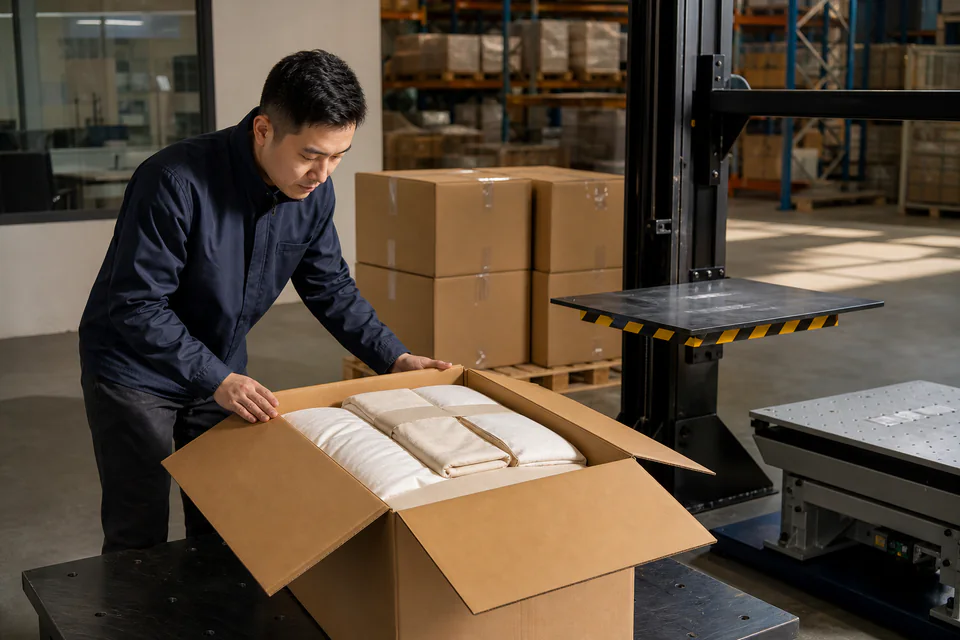
Soft goods are not immune to transit damage. A carton may split at hand holes, crush under stacking, transfer moisture, abrade retail packs or lose barcode readability even when the bedding itself is flexible. A useful validation plan reproduces the commercial pack and handling route, then evaluates both the shipping container and every consumer-facing item inside it.
Define the distribution route and failure risks
Map factory handling, inland transport, container loading, ports, distribution centers, parcel networks and final delivery. Identify manual lifts, conveyors, pallet transfers, high stacking, mixed loads and climate changes. Validation should address the route that the product will actually experience rather than applying an arbitrary test sequence disconnected from commercial risk.
Review historical damage photographs and claims by SKU. Large compressed bedding, small retail packs and mixed-size master cartons fail differently. Connect route risks to the export carton specification, including board construction, dimensions, closures, hand holes, markings, pallet pattern and maximum gross mass.
Build a production-representative test pack
Use commercial product, retail packaging, dividers, liners, desiccants, tape, strapping and carton materials from intended suppliers. Pack to the approved quantity and sequence, then record net and gross mass, carton dimensions and compression state. A hand-built laboratory carton with extra tape is not representative of packing-line output.
Include worst-case configurations: high gross mass, low internal support, sharp retail-pack edges or a size that leaves void space. If one carton design covers multiple SKUs, justify which configurations are tested. Condition packed cartons according to the buyer-approved plan before handling so moisture and board response are considered consistently.
Run a documented handling and transit sequence
Agree on drop orientations, heights, repetitions, vibration, compression or stacking exposures suitable for the route and buyer requirements. Use calibrated equipment and identify each carton face, edge and corner. Perform the sequence in the defined order because earlier impacts can weaken a carton before later compression or vibration.
Record setup, environmental condition, equipment, operator and observations after each stage without repairing the pack unless the method requires it. Safety controls are essential when handling heavy cartons and compression equipment. If external standards are referenced, name the exact method and version in the protocol rather than using the vague phrase ‘passed drop test.’
Inspect the carton and product from outside to inside
Before opening, check deformation, puncture, seam separation, tape lift, strap damage, moisture signs, hand-hole tearing and marking readability. Measure residual carton dimensions if crush affects warehousing. Photograph every face. Then open carefully and record whether products shifted, retail packs opened or accessories moved between SKUs.
Inspect consumer packaging for scuffs, creases, broken zippers, lost vacuum, label damage and barcode scanning. Examine bedding for soil, odor, moisture, compression marks and component damage. Relate findings to the container moisture-control plan when the route includes long ocean exposure.
Approve the pack and monitor commercial shipments
Define acceptance criteria before testing, including critical product exposure, carton integrity, retail presentation and scan performance. Record deviations and corrective actions such as board change, dimension reduction, internal support, closure pattern or pallet adjustment. Repeat the affected sequence on new production-representative packs rather than approving a drawing alone.
Freeze approved carton and packing specifications with supplier references. Revalidate changes to board mill, dimensions, pack count, compression ratio, tape, liner or route. Inspect first shipments and track damage by carton code and destination. Field data completes the validation loop and reveals risks that a controlled test cannot fully simulate.
Approve the route profile, worst-case commercial pack, carton and closure specification, conditioning, safe test sequence, inside-and-out acceptance criteria and revalidation triggers before shipment.