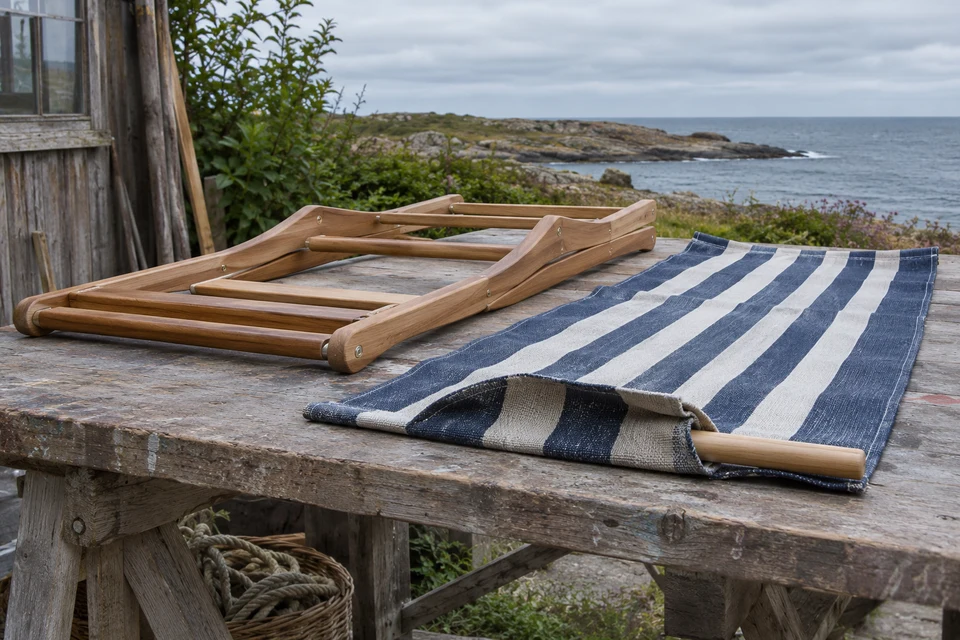
A removed deckchair sling can be laid on a bench and measured in seconds. That measurement does not tell a buyer where the frame carries the load or whether the old material has stretched since installation. Start with the exact frame and retention arrangement. The decision here is how to brief and compare a replacement textile for a known system. The chair manufacturer or other appropriately qualified party must assess suitability and safety of the finished assembly before it goes back into service.
Identify the frame and its attachments
Do not group by visual similarity
Give each frame variant an identifier and photograph both ends while the chair is out of use. Record where the fabric passes through a slot, turns around a rod or attaches by some other means. Include any marking that identifies the frame model in the private procurement file. Two frames can look identical in a resort photograph and use different clearances or attachment methods underneath. Ask the frame owner or manufacturer to identify the intended replacement specification before treating a removed sling as a pattern.
If the original sling is damaged, note where it is worn and whether it was removed intact. Do not pull a torn edge straight and use it as the datum for the new construction. Mark which dimensions come from the frame maker and which are observations from the used part. When those sources disagree, resolve the discrepancy rather than averaging the numbers. A sample room can reproduce a worn panel very accurately without reproducing the component that originally fit.
Draw the route around each rod
Give pocket measurements an unambiguous name
On a flat drawing, mark the finished outer ends, the pocket stitch lines and the locations of the rod centers when assembled as intended. A measurement from end to end includes the turned portions. A measurement between stitch lines answers a different question, and neither automatically equals the distance between rod centers. Put arrows on the drawing with start and finish points visible. Define whether a sample is relaxed on the table or held flat without tension for the measurement.
Include the rod profile and which end of each pocket is accessible. Check how a proposed seam or binding changes the clearance at the entry. A pocket can accept a loose rod on a bench and still be awkward to use when the fabric must first pass through a narrow frame slot. A stripe gives a useful visual guide to twist but cannot prove the two ends were sewn square. Review the full width at both ends and the orientation of any face or coating.
Review fit without loading the chair
Separate the sewing trial from performance evidence
Have an authorized technician demonstrate assembly under the frame owner's instructions with the chair kept out of service. Do not ask someone to sit in an unapproved prototype to see whether the length feels correct. Record whether the intended parts pass through their designated openings, where the rod ends finish and whether the panel can be attached without altering hardware. If the only way to fit the sample is to force or modify the frame, stop the trial and resolve the drawing.
Once dimensional fit is understood, request the evidence specified for the particular frame, textile, seam and service environment. A fabric data sheet alone does not validate the load capacity of a completed seat. Nor does an earlier successful purchase for a different model. Ask the responsible party to identify the relevant specification and who will release the complete assembly. Keep this decision independent of visual approval of stripe direction, edge color or the finish of the rod pocket.
Build the replacement order by frame
Price uncertainty separately
Count frames by verified variant, not by location or decorative color. A small initial order may involve several patterns and more setup than the total suggests. State whether rods travel with the textile, are retained by the buyer or must come from the frame maker. Ask for a sample quotation per pattern and a production quotation for each confirmed quantity. For outdoor use, identify the documentation required for the proposed environment without publishing an unsupported durability or weather-resistance claim.
Send FY Bedding the authorized replacement drawing, end photographs and the quantity by frame model when exploring a textile sample. Make clear that a sewing quotation is not approval to place chairs in guest areas. Keep the agreed measurement drawing with the final sample and retain the separate frame-side approval record. That division gives the sewing team precise work to price and the property team a clear point at which a chair may return to service.
If the two parties cannot point to the same rod centers and pocket openings on the drawing, do not order a size run. Resolve the frame identity before comparing fabric prices.