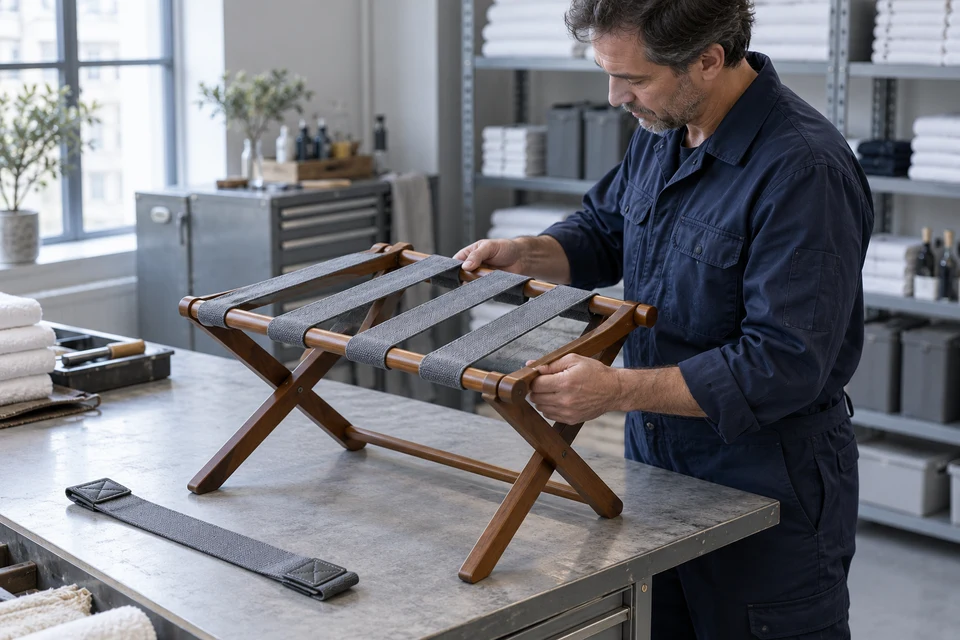
Replacing the textile straps on a hotel luggage rack can look like a simple webbing order. In practice, the retained frame, attachment route and finished strap geometry define the replacement. A similar colour and width do not prove compatibility or restore a rack's original load capacity. Treat the work as a controlled component replacement with the rack supplier or responsible technical reviewer involved.
Identify the retained rack first
Separate frame condition from textile replacement
Record the rack manufacturer, model and any available component instructions. Photograph the rack open and folded, including all attachment points. Have the responsible maintenance team assess the frame and hardware before deciding that replacement straps are appropriate. Worn webbing should not distract from unrelated frame damage, and new straps should not be used to imply that the whole rack has been revalidated.
Group the hotel inventory by actual rack construction rather than room number alone. Similar-looking racks may use different rails, fasteners or strap lengths. Keep the supplier's approved replacement specification where available. The evidence identity checklist helps distinguish a webbing test report from a report covering the installed rack assembly.
- Identify the rack model and existing strap arrangement.
- Exclude damaged or unidentified assemblies pending technical review.
Map every strap and attachment
Measure the finished route around the hardware
Count the straps and record their positions along the rails. Draw the route at each end: wrapped loop, stitched return, fastened tab or another specified system. Measure finished width, usable span and attachment dimensions using the reference supplied or approved for the rack. Do not replace these measurements with the total cut length of a loose strip.
Inspect the existing attachment carefully before requesting a new construction. A different loop size or folded return can change how the strap sits on the rail or how the rack folds. Use the seam and stitch specification framework to document the proposed textile details, while leaving structural suitability and installation approval to the responsible technical party.
- Name each attachment type in the purchase specification.
- Record finished loops and returns separately from raw cut length.
Specify the actual textile component
Do not substitute on appearance alone
Ask for the proposed fibre composition, weave, width, thickness, finish and colour reference. Keep an actual webbing sample and a completed strap sample. A visually matching tape can behave differently in the assembly; do not accept a substitution merely because it photographs similarly. Any evidence requested should identify the material and finished construction being supplied.
Record thread, reinforcement and any added end pieces in the bill of materials. If a supplier proposes a change to webbing, stitching or attachment, route it through the material substitution review before purchasing. This is especially important when a replacement is being sourced independently from the original rack manufacturer.
- Keep webbing and finished-strap references together.
- Do not infer an assembly load rating from textile dimensions.
Approve installation through the responsible reviewer
Check folding without an improvised load test
Agree who is authorized to install and review the replacement, and follow the rack supplier's instructions or the approved technical procedure. Document the installed route, strap alignment and hardware condition. Check that the rack can move between its specified stored and open positions without an unintended textile obstruction. These observations establish fit only; they do not establish a new load rating.
Any load or durability evaluation should use an appropriate defined procedure and competent oversight. Do not improvise by placing a person or arbitrary heavy object on the rack. Ask the responsible reviewer what evidence is required for return to service and what limits apply. The scope matrix can keep component evidence, installation approval and whole-product claims clearly separated in the maintenance file.
- Record the installation procedure and decision owner.
- Keep fit observations distinct from structural approval.
Build replacement kits around identified racks
Preserve traceability through maintenance
Decide whether the order is for individual straps or a complete model-specific set. List the strap count, attachment components and instructions included in each kit. If hardware is excluded, say so explicitly. Pack variants so maintenance staff do not combine different lengths or constructions. Retain enough information to link each kit to the approved rack model and strap revision.
Use the lot-coding checklist to record the supplied batch and the locations where it is installed. Compare the cost of a reviewed replacement program with the operational implications of replacing complete racks; the cheapest tape is not necessarily the appropriate decision. Send FY Bedding the rack references, attachment photographs, approved component requirements and kit quantities to establish whether the textile component scope can be supported.
- Count kits by rack model, not simply total rooms.
- Return racks to service only under the responsible approval process.
Order against an identified rack and approved attachment specification. Textile similarity and a neat installation do not independently establish the capacity of the complete luggage rack.