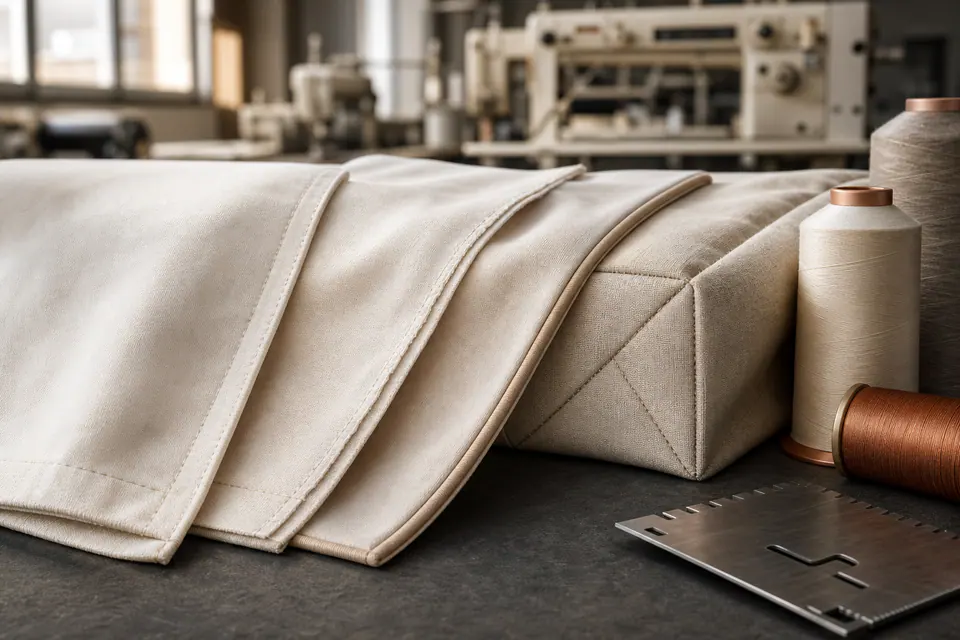
“Good stitching” is not a production specification. Bedding construction should identify the seam or edge type, seam allowance, stitch direction, stitch density range, thread, reinforcement, tolerance and finished appearance. The right detail depends on fabric, product function, care route and visible design.
1. Define what the seam must do
Identify whether the seam joins panels, encloses a raw edge, contains fill, secures elastic, creates a flange, carries a closure or supports repeated institutional laundering. Visible decorative seams have different appearance controls from concealed construction seams.
Consider fabric fraying, stretch, thickness, slippage and transparency. A seam suitable for stable woven sheeting may not suit a knit protector or lofty filled product.
2. Put measurable fields in the tech pack
| Field | Define | Why it matters |
|---|---|---|
| Seam/edge type | Construction diagram or recognized reference | Controls assembly and raw-edge finish |
| Allowance | Width and measurement point | Affects strength, dimensions and fraying risk |
| Stitch | Type, rows and density range | Controls stretch, security and appearance |
| Thread | Material, ticket/size and color direction | Affects durability and visual match |
| Reinforcement | Backtack, bartack or stress-point method | Controls opening at high-load locations |
| Tolerance | Position, straightness and visible variation | Creates an inspectable appearance standard |
3. Approve construction samples before the full product
For a new or high-risk construction, a seam section can compare alternative needles, thread, density, allowance or edge finish without producing a full sample each time. Review both face and inside.
Then approve the selected execution on the complete product because curves, corners, closures, quilting, fill and panel size can change behavior. Record it in the sample approval route.
4. Define workmanship defects consistently
Agree descriptions for open seam, skipped/broken stitch, seam grin, puckering, raw edge exposure, uneven allowance, needle damage, unsecured end, crooked visible row and incorrect component capture. Show acceptable and unacceptable physical examples where appearance is difficult to describe.
Classification should reflect location and product effect. An unsecured fill-containment seam has a different risk from a minor non-visible cosmetic variation.
5. Carry the standard into production and inspection
Verify first-off construction, machine setup, needle/thread, guides and operator reference. Inspect high-risk corners, closures, elastic joins and filled seams during production rather than waiting for packed goods.
Final inspection should apply the same defect definitions and approved sample. Repeated seam failures should enter the CAPA workflow.
Specify seam function, construction, allowance, stitch, thread and reinforcement together. Approve both inside and outside execution, then use the same defect language from first-off review through final inspection.