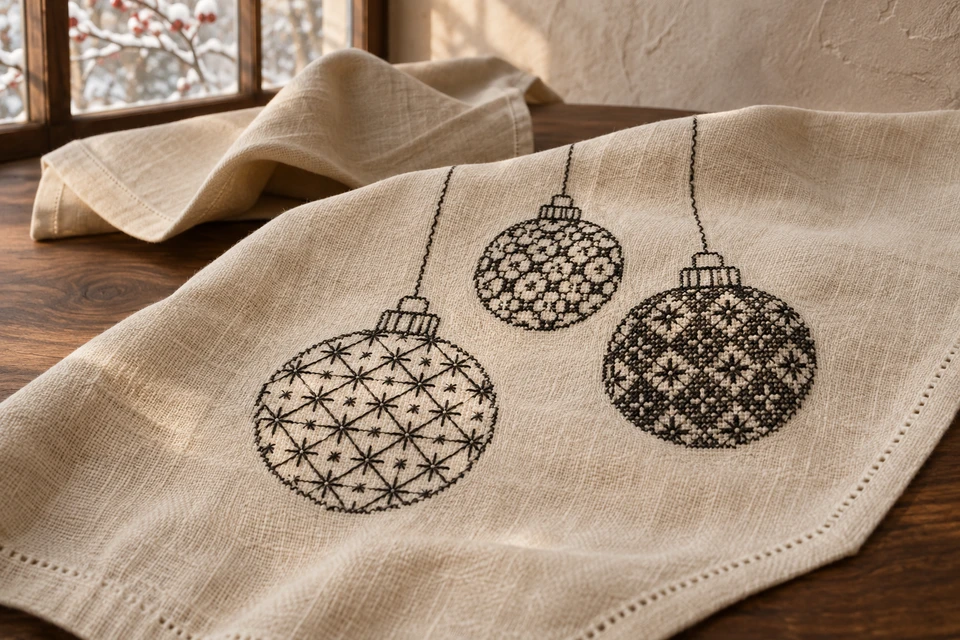
A blackwork Christmas ornament can look light, shaded or almost solid without changing its outside silhouette. That tonal balance is a purchasing decision: a sample with dense internal patterning is not automatically an improvement on a deliberately airy design. For napkins, the buyer also needs to see how that balance survives ordinary folding and the proposed care route.
Begin with a tonal intention
Decide where the eye should settle
Give each seasonal motif a visual role before discussing stitch totals. A central star may be the darkest element, with quieter baubles and an open background. Alternatively, a restrained monochrome border may be the intended whole effect. Mark these relationships on a design proof using plain terms such as light, middle and dark. The labels describe appearance, not universal density settings, and should remain attached to the particular artwork revision.
The Royal School of Needlework describes blackwork shading through variations in thread and pattern density. That establishes the technique's possibilities, not a recipe for the napkin being quoted. Ask whether the proposed production route is hand-worked, machine-interpreted or a printed imitation. If the supplier changes the route, obtain a new physical comparison; the same drawing does not establish equivalent texture or reverse construction.
Separate three contributors to darkness
Do not change everything in one sample
The geometry of the internal pattern, the thickness of the visible thread and the amount of ground left between marks can all affect the impression. Identify what is changing in each comparison. A heavier thread with an unchanged layout is one option; a denser pattern with the original thread is another. If both change simultaneously, the buyer cannot easily explain which feature made a favourite sample work.
Request a small comparison set using the actual proposed ground and clearly identified thread references. Include a complete motif as well as an enlarged detail. A magnified photograph can show clean stitching yet conceal that all motifs merge into similar dark shapes at table distance. Record the preferred tonal relationships from a normal view, then use detail inspection to explain the visible result rather than to replace that decision.
Keep the outline and filling distinct
Preserve the smallest open spaces
A bold outline may help define a bauble, but it can also dominate a delicate filling pattern. Review the point where the outline meets internal marks, particularly at narrow ornament necks, star tips and small hanging-loop shapes. Decide which spaces must remain visibly open. If the offered production method cannot retain them, a deliberate artwork simplification is preferable to approving a drawing and accepting a different stitched shape later.
Ask for the same critical region in every revision, photographed at a consistent scale. Do not judge only the largest open portion of the design. A correction that makes one tip cleaner can change neighbouring shading, so compare the full motif again. Keep comments factual: identify an unintentionally closed gap or lost line rather than describing the sample simply as too heavy. Such observations are easier for the maker to answer.
Review the napkin as a table article
A motif is not the entire sold unit
Place the finished napkin in the proposed fold and beside representative dinnerware. Check whether the darkest part of the design remains visible or disappears underneath the fold. Record the intended motif position from finished edges, not from a raw embroidery blank. Where several folds are shown in sales images, decide whether all are supported by the supplied placement or whether one presentation is the approved display reference.
Inspect the reverse separately. Identify exposed thread paths, any retained backing and the internal finish that the supplier actually proposes. A tidy face does not establish a reversible article or suitability for every dining service. Compare the decorated area with plain cloth when folding and handling the sample. If the motif creates an unexpectedly rigid corner, address the construction and placement together rather than accepting a more attractive front photograph.
Carry the tonal reference through care and packing
Compare equivalent viewing conditions
Agree the care procedure with the technical owner for the whole napkin, including the ground, embroidery and any retained layer. After that procedure, compare the sample under the same ordinary lighting and in the same fold used for initial approval. Record changed openness, distortion, thread appearance and motif position without turning those observations into an unsupported durability claim. The trial identifies the behaviour of that sample under those conditions.
Packing can also change the presentation of a small decorated corner. Retain one sample in the intended folded pack and compare it after normal unpacking. If special pressing or rearrangement is needed to recover the intended effect, decide who performs it and whether that is realistic for the sales channel. Do not allow a heavily prepared display sample to stand in for the ordinary product received by a retailer or hotel.
Quote the approved interpretation
Keep substitutions visible
The commercial brief should connect the artwork, tonal map, actual process, ground, thread references, finished size and pack quantity. Ask the supplier to separate minimums related to the embroidered design from those related to fabric or packed sets. A shared black thread does not establish that different patterns have identical development effort, production availability or order minimums. Obtain those terms for the specific proposal instead of inferring them from a sample image.
Send FY Bedding the seasonal motif, preferred tonal hierarchy and intended table presentation to discuss the development scope. Confirm permissions for the artwork and request a physical sample before committing to public claims or quantities. A design discussion does not confirm a particular embroidery capability, stock position or Christmas delivery date. The release decision is the named interpretation that both buyer and maker can recognise in a complete napkin.
Keep one approved light-to-dark pattern map linked to the actual thread, ground and process. Release the complete folded napkin only when its small open spaces, reverse and post-care appearance support that map.
Method references: Royal School of Needlework: blackwork tonal density.