For a counted cross-stitch Christmas runner, the ground fabric is part of the design geometry. A chart approved on one grid can produce a different physical motif on another. The buyer's task is to connect the chart, stitch arrangement, finished textile and visible reverse before treating an attractive seasonal sketch as a bulk specification.
Confirm what the supplier is actually offering
Separate counted stitching from a printed stitch effect
Request a close sample and an assembly description. Is the motif counted cross-stitch worked into a regular ground, a machine-embroidered cross-stitch effect, or a printed image resembling embroidery? These are different offers and should not share an ambiguous handmade description. Record the actual process, the supplied stage and any work expected at the destination. A finished runner is not interchangeable with a craft kit or an unhemmed stitched panel.
The embroidery approval guide helps document the process and thread references. Ask the supplier to confirm feasibility rather than assuming FY Bedding or a proposed production partner supports every stitch method. Keep any public description consistent with the confirmed route. A lifestyle image may illustrate a concept, but only an identified physical sample can authorize the specific construction being purchased.
- Identify counted, machine-effect or printed construction.
- Specify whether the delivery is a finished runner or another supply stage.
Connect the chart to the ground-fabric grid
Record stitch dimensions and physical dimensions together
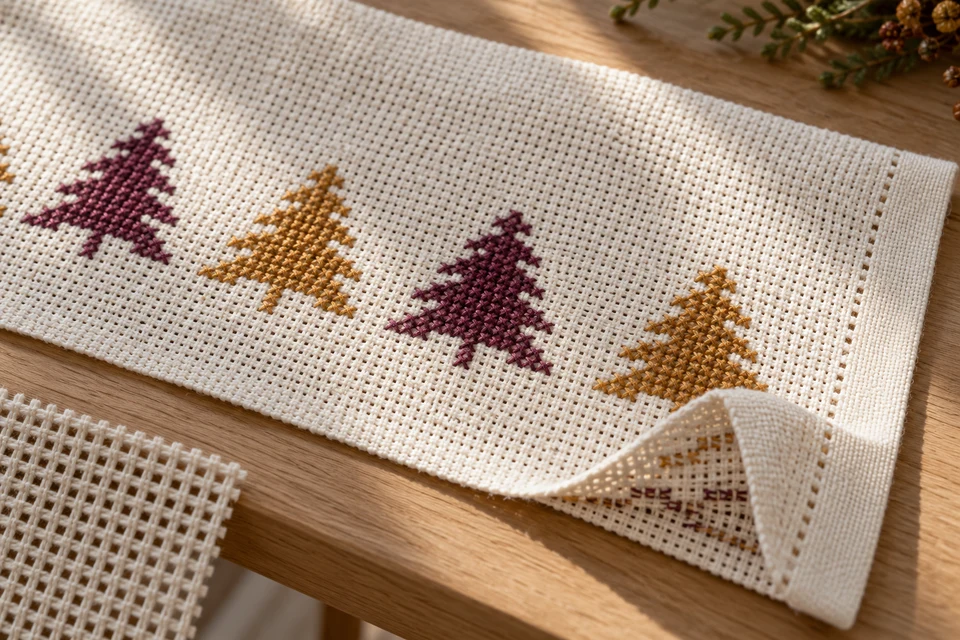
List the chart's horizontal and vertical stitch counts, the ground-fabric reference and the way a cross is placed on that ground. Ask the maker to state the effective stitches per unit of length used for this assembly. Do not interchange a fabric-thread count with a stitch count without explaining the stitch arrangement. Mark the expected physical motif width and height, then verify both on the production-intent sample rather than relying on a calculation alone.
DMC describes Aida count in terms of stitches per inch; that is a useful terminology reference, not a specification for every ground or stitching route. Keep the project's actual grid and finished motif measurements in the technical pack. A proposed ground substitution must reopen motif-size approval. An unchanged chart file does not justify assuming that the stitched Christmas trees will occupy the same space on a different fabric.
- Record chart counts, ground reference and effective stitch spacing.
- Confirm the physical motif on the actual supplied material.
Approve thread coverage without losing the grid character
Review crosses, gaps and directional consistency
Identify thread material, colour references and the proposed strand or thread arrangement appropriate to the confirmed process. Compare the visible crosses at normal viewing distance and in a detail view. Decide how much ground remains visible and what texture is intentional. A heavily covered sample and an open, delicate sample may use similar colours but create different products. Do not resolve a coverage concern by adding thread without reviewing the changed bulk and reverse.
Use the component list to retain the accepted ground and thread combination. Inspect recurring motifs for missing crosses, inconsistent orientation and unintended long connecting paths where relevant. Record the agreed appearance with actual acceptable and unacceptable samples rather than implying a universal craft rule. Keep the evaluation specific to the production method; a machine-effect sample should not inherit approval from a hand-worked prototype without a complete comparison.
- Approve visible ground and thread coverage together.
- Retain normal-distance and detail photographs of the accepted stitching.
Place the stitched zone within the finished runner
Leave room for hems and the intended table use
Draw the stitched area relative to the runner's finished edges, hems and any joined panels. A chart may fit the raw cut piece but leave inadequate clearance once the hem is folded. Review the runner on the target table with representative objects so the seasonal motif is not hidden unintentionally. If the range includes several lengths, identify whether motifs repeat, spacing changes or the stitched zone remains fixed rather than simply scaling every cross.
The dimension and tolerance framework can document finished measuring points, while stitch-grid accuracy needs its own reference. Inspect the reverse for thread paths, knots, backing and any lining included in the offer. Keep a deliberately unlined reverse distinct from a lined product. Do not describe a runner as reversible merely because its back is tidy; both presented faces require explicit design and use approval.
- Measure motif clearance from the finished hem, not the raw edge.
- Identify lined and unlined versions as different constructions.
Retain one complete stitched, cared-for and packed reference
Freeze the grid before seasonal quantities are combined
Agree the proposed care route for the complete runner, including embroidery threads, ground and any reverse layer. After the sample procedure, compare motif shape, ground distortion, hem appearance and the relationship between stitched and unstitched areas. Do not transfer care instructions from an unembroidered fabric or from another brand's Aida product to this finished assembly. The care-label checklist should reconcile the instructions with the evidence for the actual supplied sample.
Ask for minimums and lead-time assumptions by ground, chart, colour set and finished size. Confirm chart ownership or permission and retain the approved file revision before requesting production. Review the packed fold so raised stitching is not judged only in a loose studio sample. Send FY Bedding the chart dimensions, process preference, ground reference and quantity split to scope the project; neither the design concept nor a favourable sample guarantees available stock or a holiday delivery date.
- Recheck stitched and unstitched areas after the agreed care review.
- Freeze chart, ground and thread references before bulk release.
The approval reference is a chart-ground-thread combination on a finished runner. Changes to grid or process can reopen the motif-scale and appearance decision even when the artwork file is unchanged.