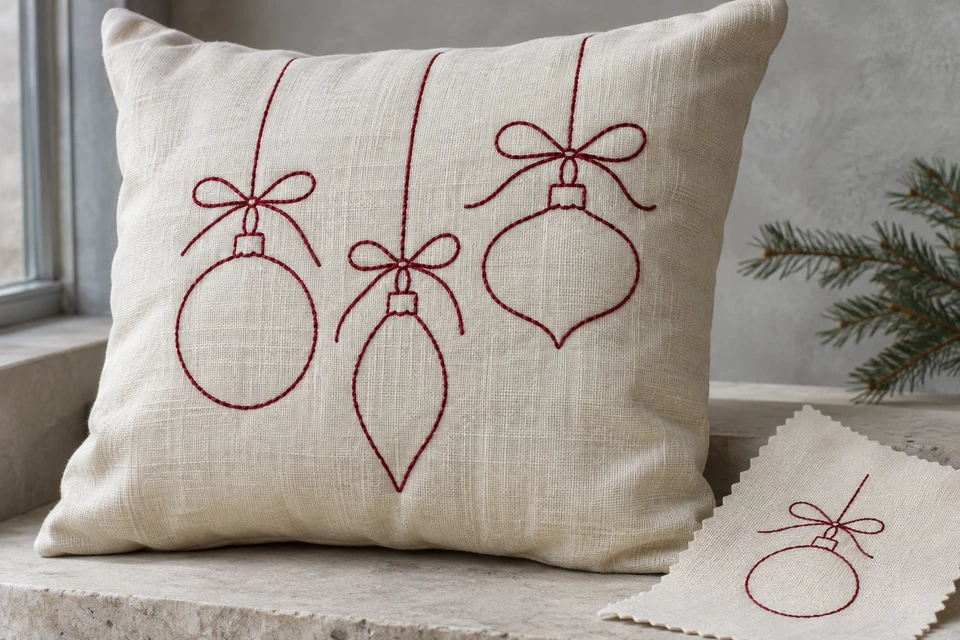
The appeal of a redwork Christmas cushion may be the fabric left visible inside a drawn bell, bow or tree. Filling those interiors with dense stitches changes the design even when the supplier keeps exactly the approved red. The buyer should therefore define where the motif is an outline, where lines may intersect and which spaces must remain open. A clear decision at this stage prevents a well-intended attempt to make the embroidery richer from producing a different retail product.
Establish an outline-led proposal
Red thread alone does not define the appearance
The International Quilt Museum describes redwork through outline embroidery in red thread. That limited definition is useful here; it does not prescribe a single stitch, machine setting or modern cushion construction. Ask the proposed maker to identify how the line will be stitched and whether the offer is hand-worked, machine-produced or simply printed. Do not let a technique description become an unsupported handmade claim in customer-facing copy.
Choose original or appropriately authorised seasonal artwork and separate its outer contours from internal detail lines. If a star has an empty centre, show that clearly on the approved illustration. If a bow includes a small filled accent, identify it as an exception instead of relying on the maker to decide where solid areas would look better. The purpose is a shared interpretation of the drawing, not a rule that every redwork design must look equally sparse.
Mark the spaces that carry the drawing
Empty fabric can be an essential design element
Select a few important open areas in the motif: the gap between two branches, the space inside a hanging ornament and the separation between a ribbon and its tail, for example. Show these on a full-scale development drawing. The maker should understand that closing one of these gaps is a design change, even when the outside silhouette still fits within its specified dimensions. Overall motif width cannot detect every lost interior detail.
Inspect an actual stitched study at the proposed scale. A drawing made of very fine lines can suggest more open space than the thread leaves on the fabric. Decide whether to simplify the illustration, enlarge a feature or adjust the proposed stitching interpretation. Record the selected revision and preserve the discarded comparison for context. Do not solve the problem by asking for invisibly fine thread without confirming that the intended construction can produce and retain the appearance.
Review crossings and endpoints in context
A small knot of lines can become the focal point
Look closely at the places where several contours meet. Christmas illustrations often concentrate detail around a tied bow, bell attachment or ornament hanger. Ask whether those junctions should read as one clear connection or as separate lines passing nearby. A sample can be locally tidy while a thick junction visually overwhelms the rest of a delicate motif. Compare the complete illustration after each proposed correction rather than judging the repaired crossing alone.
Endpoints deserve a similar review. Decide which lines deliberately stop short and which should visibly meet. Avoid a blanket instruction to connect every nearby end: it can close the open spaces that give the drawing its character. Retain photographs showing accepted junctions and terminations on the actual ground fabric. These references are more useful to an inspector than the statement that all embroidery should look neat, because they identify what the buyer considers part of this particular design.
Keep ground fabric and line contrast in the same sample
The empty area is also a material choice
Review the red line on the proposed cushion face rather than on a convenient substitute cloth. Ground texture, surface colour and visible stitch penetration all influence how the outline reads. A slightly mottled ivory and a clean white may support different visual directions. State which is intended, and keep the choice distinct from proof of fibre identity or performance. A photograph cannot establish those specifications.
Check the motif on the assembled cushion with the proposed insert arrangement. Curvature can hide part of the line near an edge or make two features appear closer together. Observe the face from an ordinary seating distance as well as at the sample table. If the design requires a particular empty margin, show it relative to the finished seam rather than the raw cut panel. Do not claim that one flat stitch-out approves every cushion size and filling combination.
Prevent late embellishment from changing the range
An added fill area needs a new decision
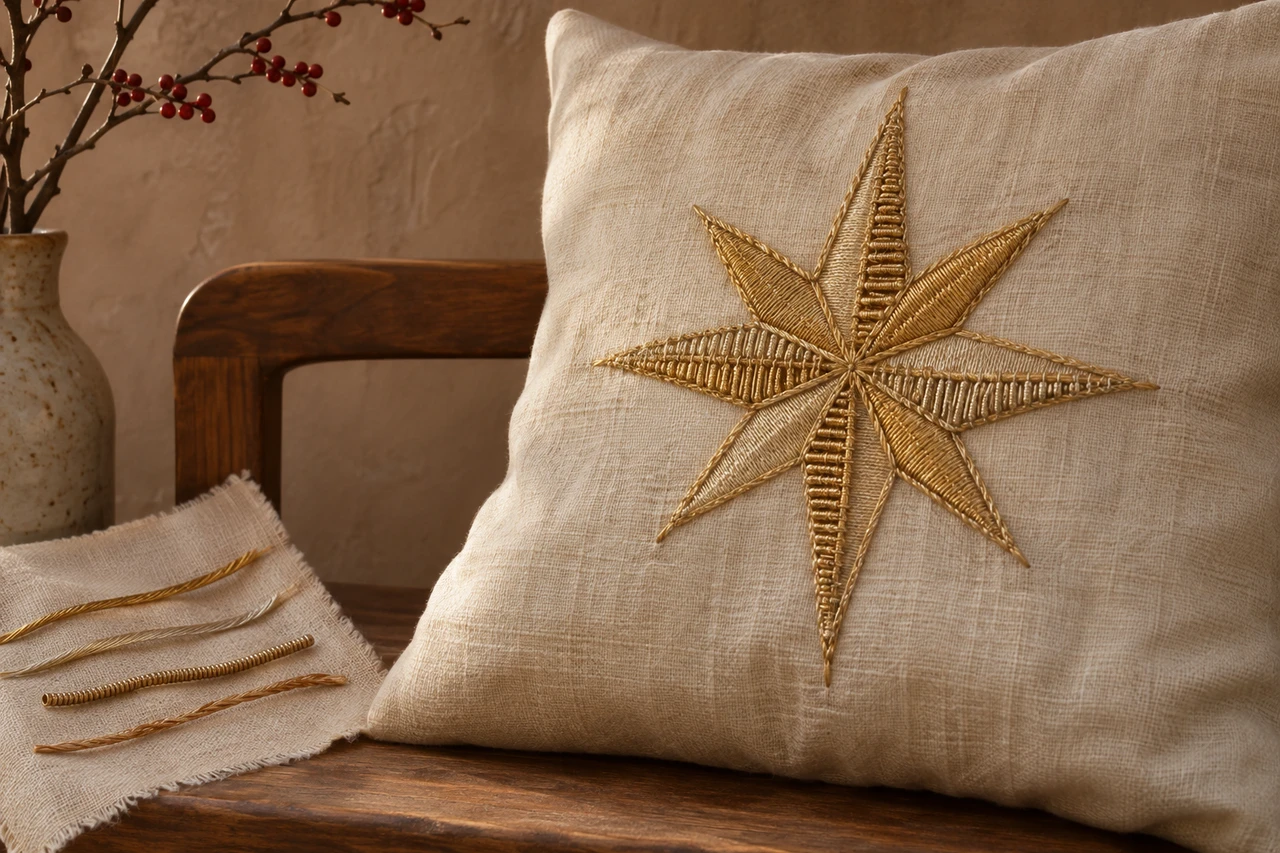
Seasonal development often invites additions: metallic thread, a filled star, a bead or another colour. Treat each as a separate proposal with its own appearance and construction review. A quotation for simple outline work should not be compared directly with a decorated version while the sample identities remain ambiguous. Ask for clear options and quantities, then choose the route that fits the retail concept and development scope.
Review the accepted cushion after the agreed care and handling conditions. Keep colour transfer, seam performance and decoration security as separate evidence questions; the outline approval does not answer them. For visual comparison, return to the open spaces, crossings and margins identified earlier. If the ground or line changes enough to obscure those features, describe the actual observation rather than assuming every difference is a thread-colour problem.
Share the full-scale motif, proposed ground, marked open areas and target quantities with FY Bedding through a project enquiry. Request a stitched interpretation and completed sample before confirming the collection description. Include the intended launch context, but confirm sample and production timing rather than promising Christmas delivery. The released reference should make it easy for another buyer to distinguish the chosen open-outline cushion from a more heavily filled alternative.
Are the intentional empty spaces, line crossings and endpoints still readable on the assembled cushion, and does the order explicitly exclude any unapproved fill or added decoration?
Method references: International Quilt Museum: redwork outline tradition.