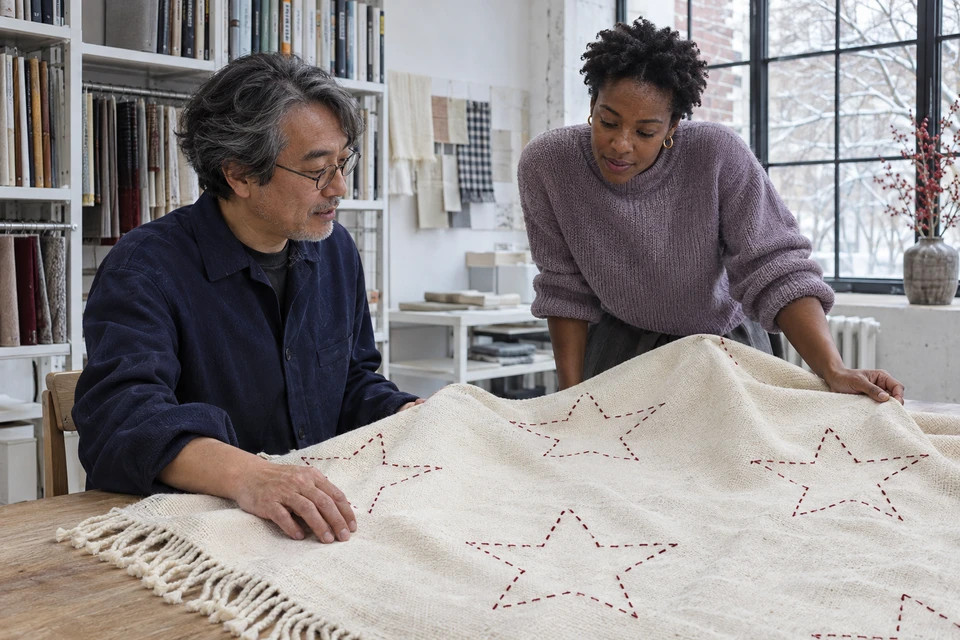
On a running-stitch Christmas throw, the empty intervals are part of the design. Turning every star outline into a continuous line can remove the quiet, hand-drawn character that the buyer selected. Yet an unexplained long interruption can also be a workmanship concern. The useful purchasing reference is therefore a visible rhythm of thread and ground, with agreed variation, rather than a general instruction to keep the stitching neat or make every line continuous.
Name the stitch effect precisely
A decorative dash is not a broken continuous line
The Royal School of Needlework's StitchBank describes running stitch as a sequence of straight surface stitches separated by regular intervals. It also distinguishes temporary basting from decorative and construction uses. For the proposed throw, ask whether the visible marks are permanent running stitches, another embroidery method imitating that appearance, or printed dashes. Put the actual route into the brief. An image of a dashed star is not enough to identify the process or to justify a handmade description.
State whether the selected stitches are only decorative or also join layers in the offered assembly. That distinction belongs in the component and construction record, even though the present design review concerns visual cadence. If the stitches have a structural role, request the appropriate separate technical assessment. A pleasing rhythm does not establish layer retention. Likewise, the existence of temporary sample-room basting must not lead a reviewer to accept removable construction marks as the intended permanent seasonal design.
Build a small rhythm comparison before a complete throw
Change one variable at a time
Ask for several short stitched passages on the proposed ground and thread combination. Keep the motif segment and preparation condition consistent while varying the visible dash and gap relationship. Include the measured lengths in the technical record, but let the design team choose through real samples at normal viewing distance. There is no universal ratio that suits every thread thickness, ground texture and Christmas motif. A tiny screen preview can make a coarse dash look delicate because its scale is hidden.
Compare how much of the ground remains visible between stitches and whether adjacent marks visually merge. Record the chosen passage with a scale reference in the internal photograph and retain the physical sample. Do not use a camera zoom level as the only size reference. If a more prominent thread is introduced later, review the same passage again before assuming that unchanged stitch lengths preserve the original rhythm. Thread width and shadow can alter the perceived gap without changing the nominal spacing.
Include curves, turns and short motif sections
A straight test line is only the starting point
Select representative passages from the actual artwork: a long straight star side, a short point and a rounded seasonal element if the design contains one. Ask the maker how the cadence will be interpreted where the available path is shorter than a complete dash-and-gap sequence. Compare actual alternatives and choose the intended result. Do not instruct an inspector to lengthen or shorten stitches arbitrarily at every corner; the accepted motif should explain how those locations are meant to look.
Keep this review distinct from the overall motif placement. A star can be correctly centred while its dash rhythm looks inconsistent, and a well-stitched star can still sit in the wrong location on the throw. Use separate comments for those findings. Where two design lines approach one another, view the sample from the intended side and decide whether the negative space remains legible. The objective is not to impose an embroidery tradition's supposedly universal rules, but to agree the appearance of this specific commercial design.
Set a visual boundary for intentional variation
Do not give every irregularity the same name
If the buyer wants a relaxed rather than mechanically uniform appearance, select examples showing the acceptable range. Include a clearly unsuitable example for comparison, such as an isolated interruption that disrupts the motif. Label these in the inspection record with the reason for the decision. Avoid approving unlimited variation under a craft-style description. At the same time, do not reject every slight difference merely because an enlarged photograph reveals that the stitches are not perfectly identical.
For a questionable passage, record the observed lengths, spacing and location before assigning a cause. Check the reverse with the maker when needed to determine whether the feature is an intended gap, an omitted section or another construction issue. Do not pull a surface thread to investigate it casually. A repair proposal may change the rhythm around the original finding, so review the whole local passage afterward. Keep the accepted condition visible in the reference rather than replacing every observation with a generic quality pass.
Review the rhythm on the draped textile
Surface curvature changes what the eye joins
Lay the complete throw flat, then drape it over the intended furniture or bed arrangement. Look at the same motifs under ordinary room light. Folds can hide several gaps and make a dashed outline appear continuous, while a heavy textured ground can partly conceal a fine thread. Decide which display view is the primary design reference and retain both flat and draped photographs. A close material sample cannot describe how the seasonal stitching reads across an entire throw.
If the project requires care evaluation, compare the same marked passages before and after the agreed procedure, using a consistent relaxed state. Record changes in ground shape separately from changes in the stitch sequence or visible thread. Do not restore the appearance through undocumented stretching, pressing or retouching and then call it unchanged. The responsible technical team should define any required performance evidence; this visual comparison does not itself support a wash-life claim or an instruction suitable for every proposed thread and fabric.
Carry the cadence into quotation and inspection
Buy a recognisable stitched effect
Release the selected rhythm passage, actual motif sample, ground and thread references with the full throw dimensions. Ask the supplier to explain which changes in thread, motif coverage or stitching route affect sampling, quantities and production planning. A quotation for a printed dashed effect is not like-for-like with the approved stitched construction. A different manufacturing method may still be considered, but it needs an openly revised sample and description rather than an undocumented substitution to meet a seasonal target.
Send FY Bedding the preferred Christmas artwork, photographs of the selected dash-and-gap examples and the intended supplied construction when discussing development. Confirm feasible sampling and delivery conditions for that brief without assuming stock or pre-holiday arrival. The final reference should let a receiving reviewer answer two questions separately: does the throw contain the intended seasonal layout, and do its stitched passages preserve the agreed rhythm? That separation makes a subjective design preference easier to communicate without inventing a universal numerical quality rule.
Approve a real dash-and-gap reference on the proposed ground, include short and turning passages, and distinguish the chosen visual variation from unexplained interruptions.
Method references: Royal School of Needlework Stitch Bank: running-stitch structure.