A pillowcase described as ultrasonically joined is not simply a sewn pillowcase with a different stitch count. The buying decision concerns the materials being bonded, the location and shape of the joining track, and the evidence for the completed product's intended use. Start with that defined assembly rather than accepting a broad claim that a seam is seamless, stronger or suitable for every fabric. The process name alone does not establish those outcomes.
Ask exactly what is joined
A bonded edge may be only one part of the assembly
Request a drawing showing which pillowcase edges are ultrasonically joined and which are sewn, folded, left open or finished by another route. Identify the closure and any component captured in the joint. A product may combine several construction methods, so the quotation should not imply that every visible seam uses the same process. Mark the proposed bond track separately from the cut edge and the finished outside dimensions.
Dukane's fabric-and-film process guide describes ultrasonic bonding and identifies thermoplastic compatibility as an important material consideration. Use that as a reason to ask for the actual material stack, not as a universal recipe or a claim about FY Bedding equipment. The guide's general application examples do not prove that a particular pillowcase is suitable for protective, clinical or repeated-laundering use. Those would require their own scoped evidence and product review.
Identify every material at the bond interface
A fibre label may omit a relevant layer
Ask for the construction of the layers that meet at the joint, including any coating, film or other bonding component. Distinguish the composition of the main cloth from the material actually participating in the bond. Do not assume that a plain cotton face can be joined by the proposed method without an explained compatible construction. Equally, do not infer the whole product's composition from one thin layer used at the seam.
Have the supplier's technical team assess the actual combination rather than relying on a generic percentage copied from a process brochure. Thickness, construction and material interaction can matter, and a supplier should demonstrate the offered combination with representative samples. Keep any material substitution visible in the development record. Replacing a layer with one that looks identical may still change the joint, so visual similarity is not sufficient approval for an unreviewed alternative.
Compare a representative seam section before a complete run
Describe geometry without pretending it proves strength
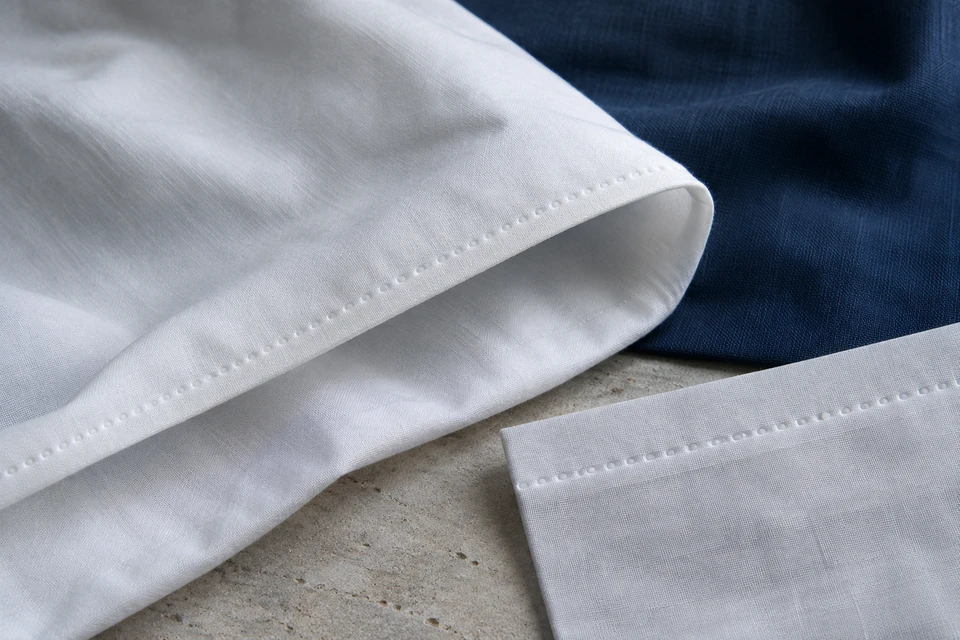
Request a sample section made with the proposed materials and joining route. Record the track position, width, pattern and relationship to the trimmed edge. Inspect both sides for discontinuities, unwanted holes, local stiffness, sharp-feeling edges or areas where the layers separate. Describe observations using consistent terms and photographs. Do not classify a visible pattern as a performance failure or success without the agreed evaluation criteria.
Ask for the supplier's explanation when a sample differs from the drawing. A narrower track, changed pattern or additional seam may be a deliberate technical revision, but the buyer needs to know which version the quotation covers. Avoid comparing one supplier's single-layer-looking photograph with another's complete multi-layer section as though both represent the same construction. The useful comparison is a clearly identified assembly that performs the same intended joining function.
Assess the complete pillowcase at corners and openings
A straight sample does not cover every load direction
Review a finished unit using the intended pillow or dimensional reference. Observe how the joint behaves when the cover is fitted and removed in the normal way. Inspect corners, transitions into other seams and the opening where handling concentrates. A neat straight coupon may not reveal how the complete assembly bends or how a bond ends beside a closure. Keep this practical observation separate from laboratory strength measurements.
Specify the intended service context without borrowing unsupported benefits from other ultrasonic applications. If the product is an ordinary bedding cover, describe it that way. Do not add barrier, infection-control or sterile-use claims because a process guide also mentions medical garments. Likewise, a fused-looking seam is not evidence of waterproofness. Any such requirement would change the product brief and require appropriate qualified evaluation of the complete construction.
Agree evidence for the actual service and care route
Process identity and durability are different approvals
Ask the buyer and relevant test provider to define the performance questions, methods and acceptance requirements for the proposed use. Request results tied to the actual material stack and finished construction. If care durability matters, include the agreed care exposure and subsequent evaluation. Do not describe a one-time handling demonstration as proof that every future lot or laundering condition will be acceptable.
Keep records of specimen identity, material revision and seam configuration with the results. If a sample is modified after testing, establish whether the evidence still covers it. A changed bonding layer, pattern or closure may need a targeted repeat assessment. The purchasing team should be able to tell which construction was tested, which was photographed and which will be supplied, rather than assembling a favourable story from different prototypes.
For an enquiry to FY Bedding, provide the proposed pillowcase use, dimensions, material information, joint drawing and quantities. Ask whether an appropriate development route can be confirmed; this article is not an offer of a specific bonding capability. Compare the complete quoted assembly with a sewn alternative only after the differences are explicit. Release one selected specification with its sample and evidence references, and identify any remaining qualification work before treating the product as ready for supply.
Are the material layers, bonded edges and seam geometry explicitly identified, and does the available evidence cover that completed pillowcase rather than a different process example?
Method references: Dukane: ultrasonic fabric joining and material compatibility.