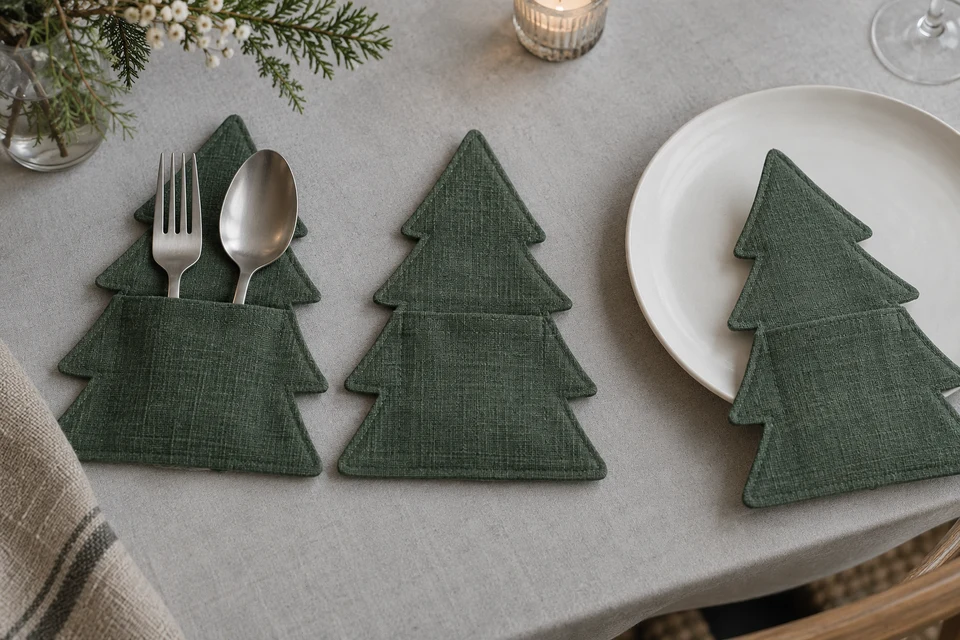
A sewn tree-shaped cutlery sleeve is a finished pocket, not a napkin folded into a pocket. The seams define its useful opening and depth, while the tree outline creates a decorative area that may not be usable storage space. Buyers developing a Christmas table-setting accessory should approve those features together with the actual pack count. The sleeve is a presentation accessory; this guide does not claim that it provides a hygienic barrier or secures utensils during transport.
Define the setting represented by one sleeve
Product count and guest count must agree
List the utensils intended for one setting and identify their actual dimensions or references. Decide whether one sleeve holds the complete chosen combination or whether some pieces stay outside it. A photograph containing a fork and spoon should not imply compatibility with every restaurant set. Keep that combination attached to the product brief and distinguish props from supplied contents.
State what one retail unit means: a single sleeve, a pair or a defined pack of settings. If colors or motifs are mixed, show the count of each. A listing described as a set can otherwise be interpreted as including cutlery or table linen. Establish the sold-unit language before sample packaging is designed so the front photograph and contents description tell the same story.
- Identify utensils by reference, not generic names alone.
- Define sleeve count and excluded props.
Measure the opening between finished seams
The widest tree branch is not the pocket width
Ask for a drawing of the clear entry, internal depth and seam allowances. Mark the actual pocket opening on the finished tree shape. Decorative points outside the seam do not add usable space. Insert the identified utensils using the operator's permitted handling method and observe whether the pocket accepts them without distortion or forced stretching.
The folded-napkin guide addresses a related presentation but a different construction. A sewn sleeve cannot be adjusted by changing the fold each day. If the opening is unsuitable, revise the pattern or utensil combination explicitly. Keep the corrected sample identifiable so a wider prototype is not confused with an earlier version that only looked adequate when empty.
- Measure clear entry and useful depth independently.
- Revise the pattern rather than forcing an unsuitable setting.
Approve the outline with the pocket filled
Tiered branches can change the visible balance
Place the filled sleeve where it will appear on the table and review the visible utensil height relative to the tree top. Check whether the lower pocket front conceals enough of the handles for the intended appearance without making removal awkward. Evaluate the outer points and edge finish in the relaxed state. A flat empty silhouette may look more symmetrical than the filled object.
Compare the color and motif with the Christmas table collection, then approve the accessory as its own sample. Keep decorative buttons, cords or detachable trim out of the specification unless they are deliberately selected and appropriately assessed. Additional decoration should not obscure the entry or turn a clear sewn shape into an assembly with undocumented parts.
- Review visible utensil height in the actual setting.
- Approve outer edges and any additional components separately.
Distinguish presentation from service controls
The operator owns the preparation method
Ask the hospitality or retail technical owner to confirm the intended use, preparation and care requirements. Observe ordinary insertion and removal through that approved method. Record catching seams, confusing orientation or a pocket that turns inside out during removal. These observations help refine the product, but they do not establish sanitation, protective performance or universal retention.
Keep the care and construction questions in the buyer evidence record. If the sleeve is intended for repeated use, review the same opening and outline after the agreed care assessment. Do not assume a sewn felt-like or woven accessory follows the care instructions of a napkin from another program. The finished assembly and its decoration need their own accepted information.
- Document the permitted preparation and removal method.
- Recheck the finished pocket after the agreed care assessment.
Build a pack that preserves both count and shape
Receiving should be able to verify a complete setting pack
Trial the proposed pack arrangement and inspect pointed edges after opening. Decide whether sleeves lie flat, nest or require a separating layer, and quote that actual configuration. Count every piece by design and color. For a mixed pack, retain a simple contents map so packing staff do not infer the ratio from a promotional photograph. Confirm minimums for the actual finished variants rather than a shared fabric color alone.
Share the utensil combination, clear-opening drawing, desired setting count and quantities when requesting a Christmas sleeve review. Keep the approved filled sample and packed unit together in the release record. Confirm feasibility and timing before describing stock availability; a seasonal illustration establishes neither the final construction nor a delivery commitment.
- Verify counts by color and design after opening the pack.
- Retain both filled-pocket and packed-unit references.
Buy the useful sewn pocket and the accurately counted setting pack. Keep decorative tree width, clear entry, utensil presentation and service requirements distinct in the approval record.