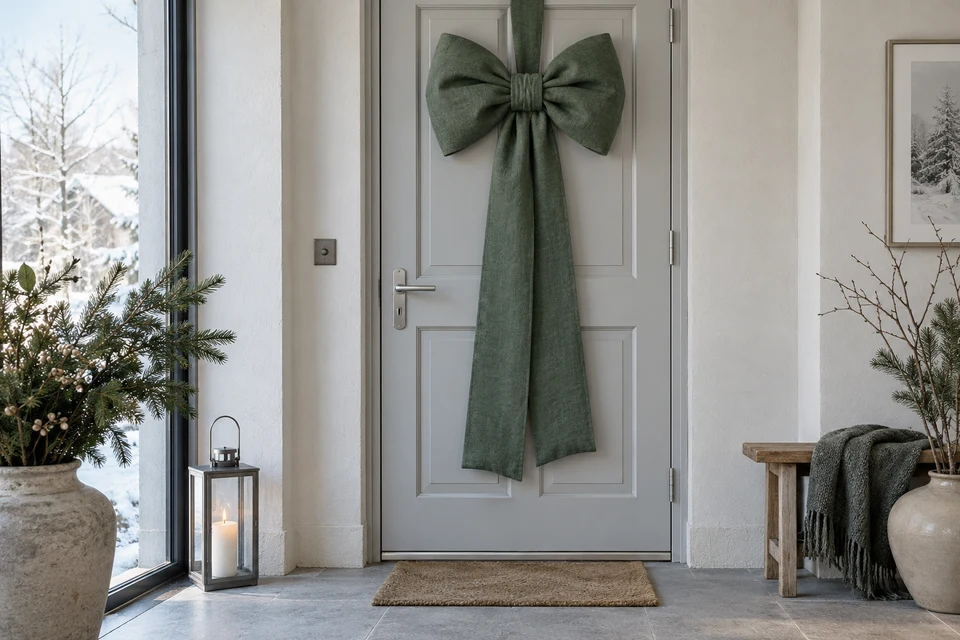
A large Christmas door bow combines several visual and functional parts: loops create volume, a center wrap holds the composition, and a sash or tails connect it to the door. Quoting only the overall bow width leaves much of that assembly undefined. Buyers need a door-specific installation reference and an honest description of the parts supplied. Decorative appearance alone does not establish secure installation, surface compatibility or suitability for every entrance.
Separate the bow into quoted components
Volume and coverage come from different pieces
Draw the loops, center wrap, sash route and loose tails individually. Identify which are sewn together and which are adjusted during installation. A preformed bow and a long strip tied by the customer can look similar in a photograph but create different assembly work. Record that choice in the seasonal textile brief, including any backing or shaping component.
Measure the relaxed loops and the intended projected depth as well as overall width. State whether both loops are meant to be identical or deliberately asymmetrical. Avoid describing a soft fabric loop with one rigid measurement that only holds while a stylist supports it. Keep a naturally resting reference so the supplier and buyer compare the same appearance.
- List loops, wrap, sash and tails separately.
- Record the intended assembly method and resting shape.
Map the sash around the actual door
A familiar tying method is not proof of compatible installation
Obtain the door dimensions and hardware positions, then have the responsible operator identify permissible installation areas. Show whether the sash crosses the front, passes around the door or attaches through a separate offered system. Keep the handle, required notices and access clear. Any interference with normal operation needs resolution before the decoration is accepted.
The chair-sash guide illustrates why the route matters, but it is not approval for a door. Doors introduce different movement, gaps and site restrictions. Ask the relevant mounting and site reviewers to assess the actual arrangement. Do not force material through a tight edge or modify hardware to reproduce a styled image. If compatibility cannot be established, change the installation concept.
- Show the complete route, including concealed sections.
- Obtain operator review for the intended door arrangement.
Approve loop recovery without hidden supports
Packing can change the first customer impression
Pack the proposed bow using the intended retail method, then unpack it without an undocumented steaming or shaping step. Observe whether the loops recover the approved appearance through the stated setup procedure. Record any support inserted during photography and either include it in the offer or remove it from the reference. A dramatic showroom loop may be a different product from a flat-packed soft bow.
Review loop edges, seam placement and the center wrap against the collection's visual direction. Ask whether the same material works for both substantial loops and flat hanging tails. If separate materials are proposed, identify them clearly. Do not conceal a construction change behind one color name; it can alter appearance, care requirements and the quoted assembly.
- Use the actual packed sample for recovery review.
- Disclose all shaping parts and setup steps.
Check the tails in their installed position
Length should support the design without obstructing use
Specify where each tail ends relative to the handle, panel features and threshold. Review the door both closed and in the ordinary positions approved by the operator. Observe whether the tails move into a problematic area or hide the center of the design. A shorter tail can improve the composition as well as clearance, but it should be reapproved rather than trimmed informally during installation.
Keep installation observations in the project record, separate from any durability or environmental-exposure claim. An indoor entryway photo does not establish outdoor weather suitability. Confirm the intended location and evidence requirements before using exterior-use language. Any care instruction must cover the whole assembly, including backing, supports and parts that may need removal.
- Approve tail endpoints on the named door.
- Separate indoor presentation from outdoor-use evidence.
Release a complete installation and pack description
Make the sold unit clear at a glance
State whether the retail unit contains a preformed bow, sash, fixing parts and instructions, and identify exclusions. Trial the instructions with a reviewer who did not watch the designer assemble the original. Record unclear orientation or hidden adjustments. Compare offers only after confirming equal material scope, loop construction, accessory content and design quantities; a lower price may omit the very parts that produce the reference shape.
Share the door reference, proposed route, relaxed bow dimensions and quantity mix when discussing a Christmas door-bow program. Ask for feasibility and a sample sequence before committing to production. Preserve the approved assembled and unpacked views. Delivery timing and available materials need project confirmation rather than assumptions based on a seasonal concept image.
- State supplied parts and exclusions in the retail unit.
- Keep installation and unpacking references with the order.
Buy the complete bow assembly and its defined installation scope, not only a width and color. Approve relaxed loops, sash routing and tail endpoints on the actual door reference.