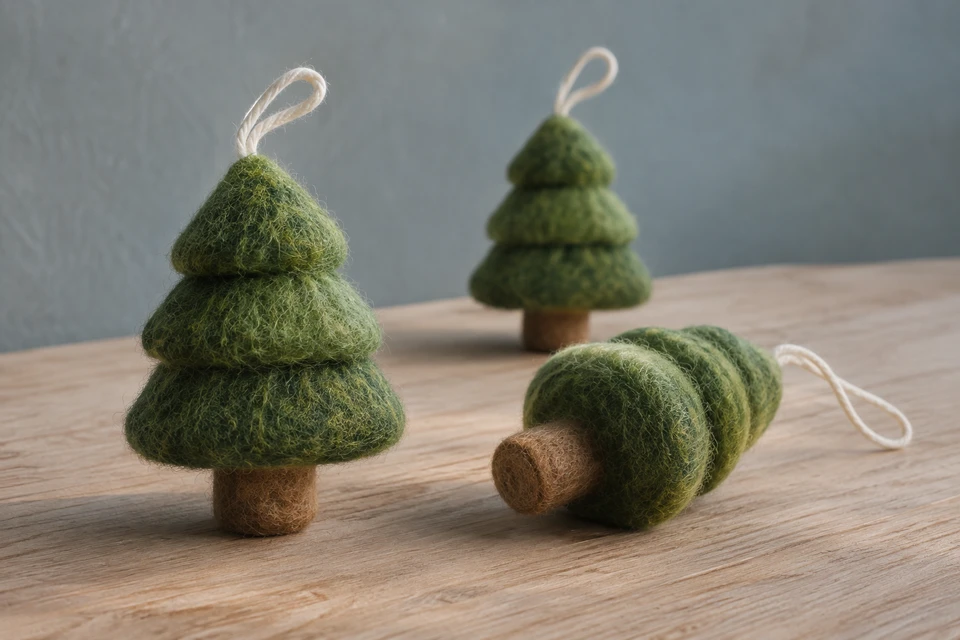
A front photograph can make a rounded needle-felted Christmas ornament and a flat felt silhouette look surprisingly similar. They are different purchasing propositions. When the intended product has volume, the approved sample needs to explain that volume: its depth, contours, underside and natural hanging position, not only the outline that looks best in a catalogue. Begin the enquiry with the complete object you expect to receive.
Establish whether the proposal is a solid form
A silhouette does not specify depth
Ask the maker to identify how the ornament is constructed. A needle-felted form, a sewn felt shell containing filling and a laminated cut-felt profile should not share an ambiguous product description. Ashford's own needle-felting introduction illustrates the development of three-dimensional forms from basic shapes. That explains why a formed object needs a different reference from a flat cutting outline; it does not establish any particular FY Bedding material, process or available range.
Request a short written construction description and a physical sample before approving the purchase unit. Record whether the shape is formed throughout, built around an identified core or assembled from separate elements. Confirm the proposed fibre composition through supplier information rather than the appearance of fuzzy green material. Where an internal component is proposed, ask whether it changes the intended use, handling or evidence required for the finished decoration.
Build a five-view shape record
Front, rear, sides and underside answer different questions
Set the sample on an uncluttered surface and photograph its front, rear, both sides and underside with the same orientation identified throughout. Include a scale reference in the private approval record. Measure overall height, maximum width and depth, naming whether a loop or protruding part is included. An ornament ordered as a rounded tree should not quietly become an oval form because only its broadest face was assessed.
Choose the features that carry the design. For a tree, those might be the relation between its tiers, the proportion of the trunk and the degree of rounding at the base. Record which differences are intentionally allowed across an assortment. Avoid requiring mathematical symmetry if the approved design has a softly formed character, but do not use the word handmade as an unlimited tolerance. An accepted and a rejected example are more useful than a vague instruction to keep the shape attractive.
Separate contour from surface finish
Fuzziness should not conceal an unfinished form
Inspect the sample under ordinary side light and again from the intended display distance. A softly hairy surface can be intentional while a large loose tuft or a locally hollow contour requires another decision. Describe the visible finding and its location rather than prescribing a needle gauge, working time or repair technique. The competent maker should propose the method needed to achieve the agreed finished result.
Compare more than one production-intent piece. Place them in the same orientation before judging variation; a turned object can appear narrower without actually being a different size. Ask how the maker will check the approved contour and what evidence will accompany later samples. Photographic appearance does not prove attachment strength, resistance to shedding or suitability for children. Those questions require their own project-specific evaluation and must remain separate from the visual shape approval.
Review the loop on the complete ornament
The natural angle is part of the selling view
Suspend the sample by the proposed loop without holding its body level. Check whether the expected front faces outward or whether the object consistently turns to one side. Identify where the loop enters the form and whether the connection is visible in the intended display. A loop added after the shape sample has been approved can change the presentation sufficiently to require another review.
Define the loop as a component with an identified material, length basis and proposed attachment route. Do not assume that it can be pulled out and repositioned without affecting the body. If the offer includes a detachable fitting, review the supplied assembly and the information the customer will receive. Keep decorative-use descriptions within the agreed product scope; a small seasonal shape is not evidence of toy suitability, a load rating or any universal safety claim.
Compare the delivered shape with the approved shape
Packaging should not require undisclosed reshaping
Pack the completed assortment in the proposed selling and transport format, then unpack it for another five-view check. Look for flattened sides, compressed tiers, loops caught under neighbouring pieces and variants that are difficult to count. Record what the reviewer did between opening the pack and taking the photographs. A sample restored by substantial hidden manipulation should not be presented as the ordinary received condition.
Where light arrangement is intended, document that step and trial it with another person. Where the shape does not recover as expected, request a revised pack or construction proposal and repeat the relevant review. Retain the original observation so the team knows why the change was made. The accepted pack, not just a loose ornament in a display bowl, should accompany the final purchase specification and the inspection reference.
Request comparable quotes
Purchase one defined ornament, not an attractive outline
Give suppliers the shape record, construction scope, assortment quantities, loop details and packing requirement together. Ask them to identify any departures before comparing price or minimum quantities. A quotation for a simpler flat form is not automatically a lower-cost equivalent. Record development stages and sample timing against the actual proposal; neither this guide nor an editorial illustration confirms stock or Christmas delivery.
For an FY Bedding development enquiry, share the intended three-dimensional form and the view that will appear in your retail presentation. Ask for feasibility, material identification and a production-intent sample with the proposed loop. Release the order only when the same finished unit can be recognised in the drawing, sample, quotation and pack, with separate performance or market evidence still clearly identified where required.
Approve the ornament in the round: defined construction, five-view dimensions, observable surface finish, freely hanging angle and the actual unpacked condition.
Method references: Ashford: introduction to three-dimensional needle felting.