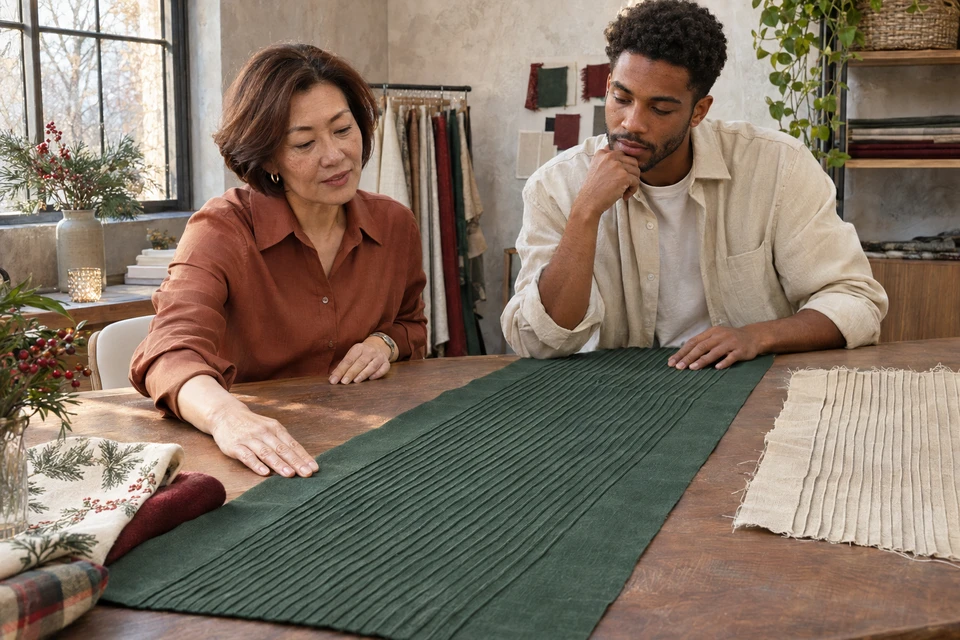
A Christmas table runner with fine stitched ridges may consume more cloth across its width than the finished face suggests. The purchasing problem is not solved by naming a runner size: the offer must say whether its width describes raw fabric, a tucked panel or a hemmed article. Otherwise seemingly comparable quotations can refer to different amounts of usable work.
Name the supplied stage
Start with the unit being bought
Distinguish cloth for later tucking, already tucked fabric, cut decorated panels and finished table runners. Each stage transfers different work to the buyer or another supplier. Ask who controls cutting after tucking, who owns unusable edges and which stage is represented by the quoted measurement. A metre of untreated cloth is not directly interchangeable with a metre of decorated fabric when the resulting usable width is different.
BERNINA describes pintucks as narrow stitched folds and notes that they reduce the fabric area, often being worked before final cutting. This is a construction principle, not a standard consumption allowance. The actual take-up must come from the proposed fabric and tuck arrangement. Do not apply a remembered percentage from a different sewing project to a commercial runner order, especially if the direction or number of ridges changes.
Draw three width references
Keep hems out of the take-up calculation
Show the raw working width, the relaxed width after tucking and the finished width after edge construction as separate dimensions. Identify the same reference boundaries through the sequence. If the supplier trims the sides between operations, record the trim separately so the whole reduction is not wrongly attributed to the tucks. The buyer needs a transparent relationship between the material entering the process and the unit being delivered.
Place the ridges on a simple width map. Note whether they run along the runner, across it or only within a decorative inset. Plain side margins can be as important as the tucked field because they provide clearance for hems or contrasting borders. Mark the planned Christmas colour-block or motif placement against the final tucked field, not against an undeveloped blank whose proportions may change during construction.
Request a representative width trial
One isolated ridge is not a consumption proof
A tiny sample can demonstrate the character of a tuck but may not represent a complete field of repeated ridges. Ask for enough of the proposed arrangement to verify its cumulative width change and the intended plain margins. Use the same fabric direction, thread arrangement and cord option, if any, as the production proposal. Keep these details with the trial rather than treating the tuck's visual name as a sufficient specification.
Measure in an agreed relaxed state without pulling the field open to reach the desired number. Record the initial and resulting widths with the sample identity and method. If the technical owner needs conditioning or a rest period, document it. The purpose is a repeatable comparison, not a universal measuring tension. For a revised trial, state which input changed so its result can be evaluated against the original reference.
Turn the trial into a comparable offer
Ask what the consumption figure includes
Request the supplier's proposed material allowance for the approved field and clarify its basis. Does it include edge trimming, cutting losses, sample work or only the width taken into the tucks? Where cloth is sold by linear length, confirm the usable tucked width attached to that length. Keep the units explicit and do not compare a raw-fabric rate directly with a completed-panel rate as though the processing work were free.
For a range with narrow and wide runners, ask whether the ridge count, spacing or plain margins change. A wider size may require another field arrangement rather than a simple extension of the same blank. Obtain minimums and development charges for the actual variants. If a supplier offers a more economical layout, retain it as a separately approved design option; a cost adjustment should not silently alter the finished seasonal presentation.
Inspect the completed runner
Check where the ridges meet other construction
View the sample flat on the intended table and inspect both ends. Identify where tuck lines terminate or enter a hem, border or joining seam. Record unwanted bulk, uneven margin widths or a distorted edge against the agreed reference. This is not a request for a generic sewing recipe. It is a way to connect the fabric-consumption decision with the appearance and handling of the product that will be sold.
If cords are proposed inside the tucks, identify them as components rather than assuming every ridge is unfilled. Ask the maker to confirm the complete care route and inspect an actual processed sample. Changes in the tucked field or its relationship to plain margins should reopen the relevant measurements. A neat first sample does not establish wash stability, stain resistance or suitability for every hospitality laundry process.
Keep the width basis through shipment
Preserve the measuring reference with the order
The final specification should include the agreed supplied stage, three width references, ridge map, material identities and accepted trial. Add the finished length, pack fold and quantity by variant. For fabric-only supply, state the usable width and the buyer's remaining work clearly. For complete runners, retain the finished article as the purchase reference even if the supplier also provides raw-material consumption information for transparency.
Unpack a representative folded sample and compare the field without artificially stretching it. Confirm how receiving staff should measure the actual delivered stage and which evidence resolves a disagreement. Share the width map and intended table use with FY Bedding to discuss sampling and an appropriately scoped quotation. Any Christmas launch date still depends on confirmed development, production and transport arrangements; a consumption trial is not a delivery commitment.
Compare quotations at the same supplied stage. Keep raw, tucked and finished widths separate, and use a representative field trial to establish take-up instead of an assumed universal percentage.
Method references: BERNINA: narrow stitched tucks and fabric take-up.