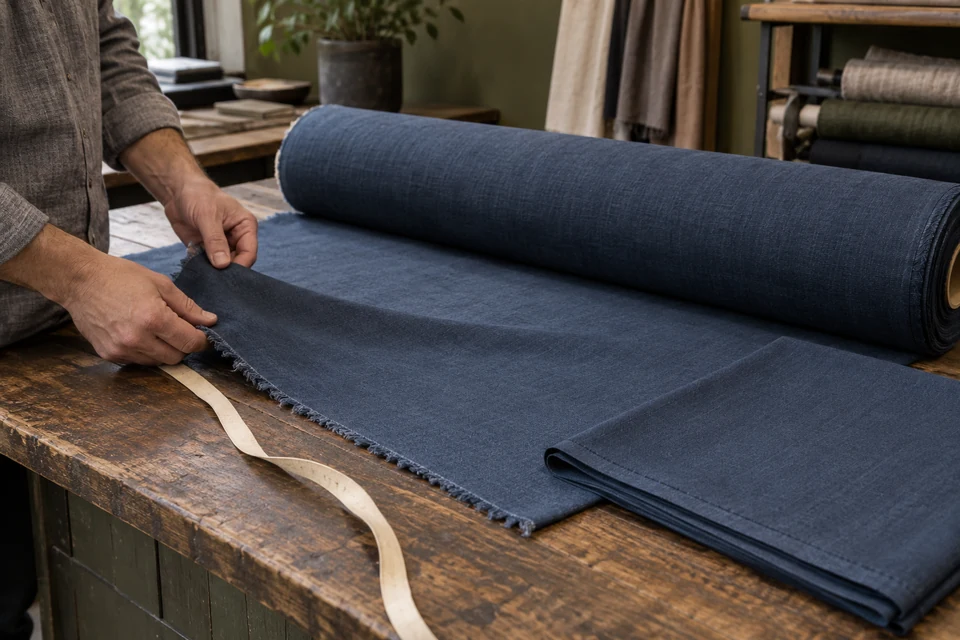
A buyer comparing fabric supplied by the meter with completed textile items supplied by the piece is comparing two supply scopes, not merely two ways of writing a price. The fabric route leaves making, trim purchasing and some material risk elsewhere in the chain. The finished-piece route may include those tasks, but only where the supplier's offer says so. Minimum quantities need to be read at the same time as this scope difference. This guide is about commercial normalization and responsibility, distinct from checking decimal punctuation or unit notation on an order. No conversion here should be treated as a supplier's confirmed consumption or price.
Name the unit at each interface
Start with what changes hands
For each proposal, identify the purchased and delivered unit: finished fabric length, sewn panel, one completed cover, a pair, a set or an assembled retail pack. Name the condition and components at delivery. The quotation comparison guide is a useful starting point for collecting exclusions. A meter quote for face cloth does not include completed covers merely because the supplier has estimated how many pieces that cloth might make.
Record who owns cutting, sewing, trims, packing and final inspection under each route. Where several suppliers are involved, identify the handoff and approval owner rather than allow unassigned tasks to appear as savings. Keep the project's target sold unit visible throughout the comparison so different supply offers can be normalized without pretending that they already represent the same product.
- Identify the delivered condition and complete unit.
- List making, trim and packing responsibility.
- Keep estimated output separate from the purchased fabric quantity.
Verify the fabric basis
Meters cannot be assessed without width and direction
Confirm the offered fabric reference, finished condition, usable width and any direction or pattern requirements. A length price needs its width basis attached; meters of materially different usable widths are not like-for-like inputs. The usable-width guide explains why the cutting team needs the cloth available within accepted boundaries rather than nominal roll dimensions. State what evidence or measurement is still required before the width is accepted.
Ask whether the offer is for available finished stock, reserved greige cloth or another material stage. The fabric booking guide helps separate those commitments. A proposed material-stage minimum is not automatically a delivered-fabric minimum, and any finishing or color decisions may still create further quantity and timing conditions. James Hare's trade FAQs, linked below, illustrate why stock-cut and special-order conditions must be distinguished. Those are that supplier's terms, not FY Bedding's minimums or an industry-wide guarantee.
- Attach usable width and material condition to the length price.
- Record grain, face and pattern constraints.
- Distinguish stock, greige reservation and finished delivery.
Show the conversion model
Use a reviewed pattern mix, not one rectangle calculation
Ask the maker to provide the consumption basis for the actual sizes, components and quantities. Record the marker or pattern reference, usable width, direction, matching allowance and treatment of defects or joins. The bill-of-materials guide connects material usage to the complete item. A cover may have several fabric pieces or trims, so dividing total meters by a single visible face-panel length is not a sound comparison.
Identify whether consumption is a provisional estimate, a sampled layout or a measured production result. Keep uncertainty visible rather than round it into an apparently precise finished-piece equivalent. If size mix, width or construction changes, request a revised conversion. Do not use an old consumption figure to claim that a new meter minimum is sufficient for every SKU in a different collection.
- Link consumption to the actual size and component mix.
- Separate estimates from verified production data.
- Recalculate when width, pattern or mix changes.
Split the minimum constraints
Material minimums and making minimums have different owners
Collect minimum quantities separately for fabric booking, dyeing or printing, trims, individual sewn variants and packing or assembly. The component-minimum guide helps identify genuine shared inputs. Do not assume that meeting a mill's meter minimum obliges an independent maker to sew a very small quantity of each size, or that meeting a sewn-piece minimum makes every custom component available.
Build the requested assortment alongside those constraints and ask each responsible supplier to confirm its proposal. Identify optional shared colors or compatible variants as alternatives, not automatic permission to change the brand's approved range. Where a finished-piece supplier has already consolidated components, ask what remains guaranteed in its quoted scope before reconstructing a fabric route that may lose the benefit.
- Confirm material, trim, sewn-variant and packing minimums.
- Assign each constraint to its responsible supplier.
- Separate optional assortment changes from approved requirements.
Assign loss and leftover responsibility
Purchased meters do not all become saleable units
State how planned cutting allowances, rejected material and remaining stock are treated commercially under the proposed supply route. Confirm who owns usable remnants and where they are held. The remnant reconciliation guide explains why leftover material needs identity and an agreed use rather than an assumption that it is free stock for a later order. Keep the allowance basis separate from an unexplained order-wide waste percentage.
For a finished-piece proposal, ask whether material ownership or leftover balances are included in any special customer-supplied-material arrangement. Do not infer a right to surplus cloth from a finished-unit price. If the buyer wants a defined reserve for repeat production, make that an explicit proposal with traceable quantity and storage responsibility, not a hidden promise derived from the original fabric consumption model.
- Specify ownership of remnants and reserves.
- Separate planned allowances from unexplained loss.
- Do not infer surplus-material rights from a piece price.
Normalize cost without inventing a quote
Compare a complete model with stated assumptions
Prepare a comparison for the same approved target quantity and product specification. Show fabric purchasing, making, trims, packing, relevant handling and inspection scope, plus any excluded tasks. Use actual quoted terms where available and label unresolved estimates clearly. The price-driver guide explains the role of construction and order mix. No illustrative calculation should be published as FY Bedding's price or a general market rate.
Keep the supplier's confirmed quote separate from the buyer's conversion worksheet. If the worksheet suggests a lower effective cost, confirm that it has not omitted assembly, unusable material, variant minimums or another supplied component. A useful commercial decision may favor a higher headline input price if it removes unassigned work or gives a clearer supply responsibility; that preference needs the actual project assumptions, not a universal sourcing rule.
- Use the same target quantity and specification.
- Label estimates and unresolved exclusions.
- Keep a buyer worksheet separate from a supplier commitment.
Release one unambiguous buying route
The purchase order must preserve the selected scope
Before release, confirm the chosen purchased unit, supplier responsibilities, minimums and conversion assumptions in the actual order documents. The SKU quantity-planning guide connects the final variant quantities to that decision. The notation review is a separate final check: clear punctuation cannot resolve an underlying disagreement about whether the order buys cloth or finished goods.
Buyers can submit both supply routes for a scoped comparison, including the size matrix, usable-width requirements, material stage and work they expect each party to perform. Preserve unanswered questions rather than write a guaranteed finished-piece output from an unconfirmed meter allowance. Revisit the commercial model if any of those inputs changes before order acceptance.
- Release the selected purchased unit and responsibility map.
- Check notation only after commercial scope is settled.
- Reopen the model when a controlling input changes.
Normalize meter and piece offers only after delivery scope, usable width, consumption, minimums and leftover ownership are clear. A conversion worksheet supports comparison; it does not create a supplier price or output guarantee.
Method references: James Hare: Trade ordering and special-order scope example.