A bakery can change a Christmas pie from a plain carton to a window box without changing its listed diameter. The change matters to the buyer ordering the carrier: a clear window, a tucked lid and a projecting ribbon each react differently when the handles come together. Buy the carrier for the assembled gift that leaves the counter.
Start at the packing bench
Measure the part that actually goes into the bag
Take a box from the proposed seasonal packaging run. Assemble it with the board, insert and decoration that the bakery intends to use. A flat packaging drawing can identify the board size but not the widest point after folding. Find that point at the lid ears, corners and any wrapped bow. Record the height at the centre as well as at the perimeter. If a bakery substitutes packaging by branch, identify which branch uses which box before asking for a single carrier quotation.
Do not send a pie diameter as the sole sizing instruction. A round plate in a square carton needs space at the corners; a tall carton with a shallow base can tip while being lowered through a narrow mouth. Mark one box as the fit reference and keep another for destructive inspection of creases or pressure marks. A clean dummy with the same weight distribution is more useful for early sampling than a photograph of a decorated pie.
Compare two handle paths
Watch the lid while the box leaves the counter
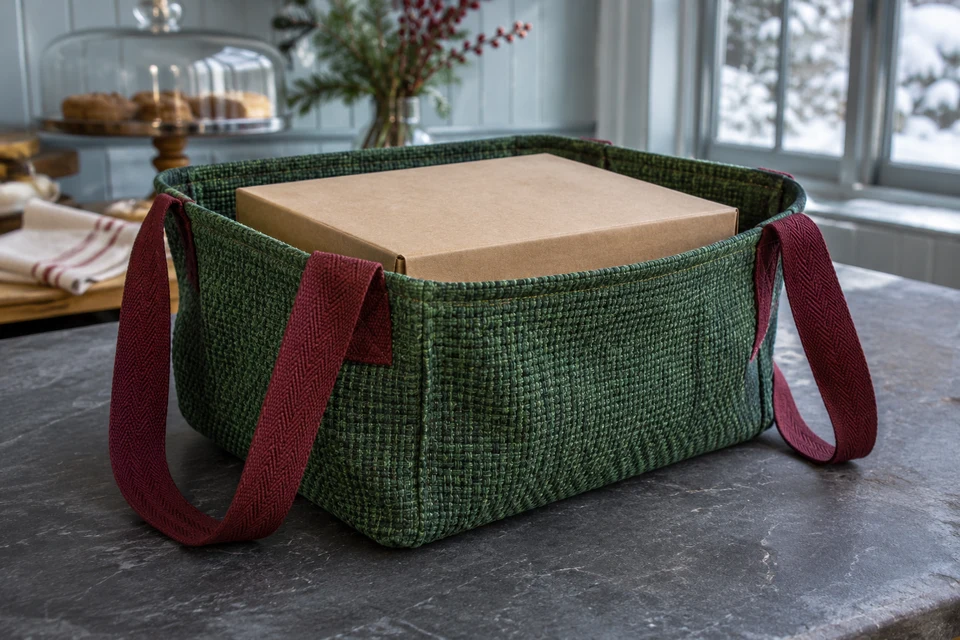
Stand the loaded dummy on a level counter. One person should bring the handles together as if handing the gift across to a customer; another should watch the lid from the side. Notice where the textile tightens first. Pulling the handles upright can turn soft sides into four inclined planes that meet over the lid even when the empty bag looks roomy. Put a loose slip of paper on the highest point during a repeat lift. If it becomes trapped, inspect the contact rather than assuming the lid is clear.
Compare that sample with one whose handles attach farther out or whose top opening stays wider. A longer handle might solve contact yet allow the base to swing farther when the gift changes hands. Ask the counter team to try passing it to another person and setting it down on a narrow shelf. Select the handle configuration that suits the actual handover. Do not infer a rated carrying load or thermal performance from this exercise.
Separate base support from presentation
Choose what the bakery will have to assemble
A removable base can keep an empty carrier square on display. It also becomes another piece to insert, count and locate during the busiest part of a Christmas pickup. Compare a sample with a fixed base and one with a removable board. Use the same box each time, lift it briefly and inspect whether its bottom bows across the middle. Check that a board cannot rotate into a diagonal position that raises one corner of the gift.
If the retailer wants a carrier that folds flat after use, fold a sample the way a customer would, reopen it and repeat the handover. Examine the base line where a packing crease crosses it. Discuss how a replacement board would be identified and whether the retailer is supplying it. State clearly that this project concerns a closed box holding a cooled pie; contact with unwrapped food, oven use and insulation are separate briefs requiring their own evidence.
Put the counter routine in the order
Test the second box as well as the first
Ask one employee who has not seen the prototype to pack the reference gift. Can the employee lower it straight down, find both handles and remove the box without gripping the window? Record the movement that requires the second hand. If two boxes are needed for two pie sizes, repeat the routine with the smaller gift: empty space that accommodates the large carton can let the small one shift when carried. A size-specific insert may be preferable to a larger universal bag.
Keep photographs of the assembled reference carton, the lifted carrier in profile and the base on the counter with the sample decision. For the quotation, identify order quantity by carrier size, seasonal colour, packaging configuration and whether the bakery or supplier supplies the board. Ask for the sample and commercial schedule separately. A Christmas motif is a design choice; it does not establish when a carrier can be delivered.
Send the packed-box dimensions, handle preference and handover photographs with your sampling request. Approve the smallest and largest intended gifts before releasing the assortment.