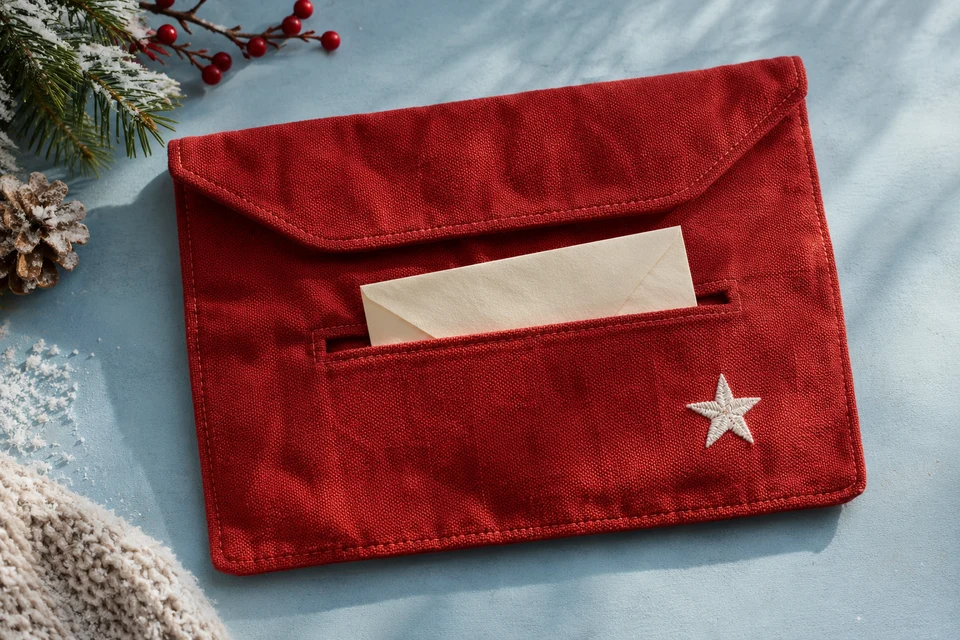
For a Christmas letter station, the slowest part of the day can be emptying the pouch, not posting into it. A narrow slit may look like a traditional letterbox, yet a stiff envelope can stop halfway and block the next one. A generous slit fixes that problem only if a member of staff can also reach and remove the stack. Treat posting and retrieval as separate operations in the buying brief.
Choose the envelopes before the decoration
Find the least forgiving item in the assortment
Collect the stationery the event team will actually offer. Include the folded sheet without its envelope if customers may post it on its own. Try a sealed envelope, an unsealed one with a flap sticking out and the largest card permitted by the organiser. Trace their maximum widths on scrap paper. A decorative sample that takes a single empty envelope lengthwise may not take a completed card in the orientation visitors naturally choose.
Agree which formats are not intended to fit. Making the opening wider for a rare oversized card can allow the front of a soft pouch to sag. An alternative is to offer staff collection for that format and size the pouch for the programme's normal envelope. Use clean dummy mail in the trial. Names, addresses or children's letters are not needed to decide whether a seam allowance catches a corner.
Inspect the throat from both sides
Reproduce the snag before changing the pattern
Hold the pouch where it will be displayed and post a dummy slowly. Watch the edges of the slit turn inward as the paper goes through. Then open the staff access and look behind the slit. An envelope that clears the front binding may still meet a loose liner, a label or the lower edge of a decorative patch. Record the point where the paper stopped before asking for a wider opening.
Repeat with several envelopes already inside. The accumulated stack can push the liner forward and change the route of the next envelope. Compare an internal guide with a cleaner, shorter seam finish if there is a snag. A long guide can align the paper but becomes an extra space where an unsealed flap may lodge. Choose the version that accepts and releases the retailer's dummy formats, not the one that looks most like a metal mailbox.
Empty the pouch on the actual fixture
Choose the side that staff can really reach
Set up the proposed rail or counter display with the pouch in place. A rear zip is convenient on a sample held in the hand but inaccessible when the back sits against a wall. A top flap can work if it clears the shelf above. Ask a staff member to empty the pouch into an ordinary collection tray. Observe whether the staff member has to take the whole display down or tip letters onto the counter.
Use a count of blank dummies to check the result. Slip one small card into the bottom corner before the trial and see whether it comes out with the rest. If it stays behind, a lighter-coloured lining or a different lower seam may make emptying easier. Decide who controls the collection and where letters go afterwards. A textile closure used in a merchandising trial should not be described as secure storage.
Define one store kit and its limits
Align sample approval with the operating plan
List the textile pouch, attachment pieces, collection instructions and any stationery as separate lines in the request. A quotation for an empty pouch is not comparable to a quotation that includes fixtures and printed cards. If several store formats are involved, identify the location with the least rear clearance. Photograph the accepted installation from the staff side as well as from the visitor side so other sites can reproduce it.
For a short run it may be sensible to keep the pouch body common and vary an embroidered detail. Ask how that affects decoration minimums and sample lead time rather than assuming the common body removes all minimums. If the retailer changes the envelope after approval, run the slot test again. If the fixture changes, repeat the retrieval trial even if the front view of the display appears identical.
Ask for a working pouch with an accessible staff opening. Release the store kit only after the largest accepted envelope goes in freely and every dummy comes out at the intended location.