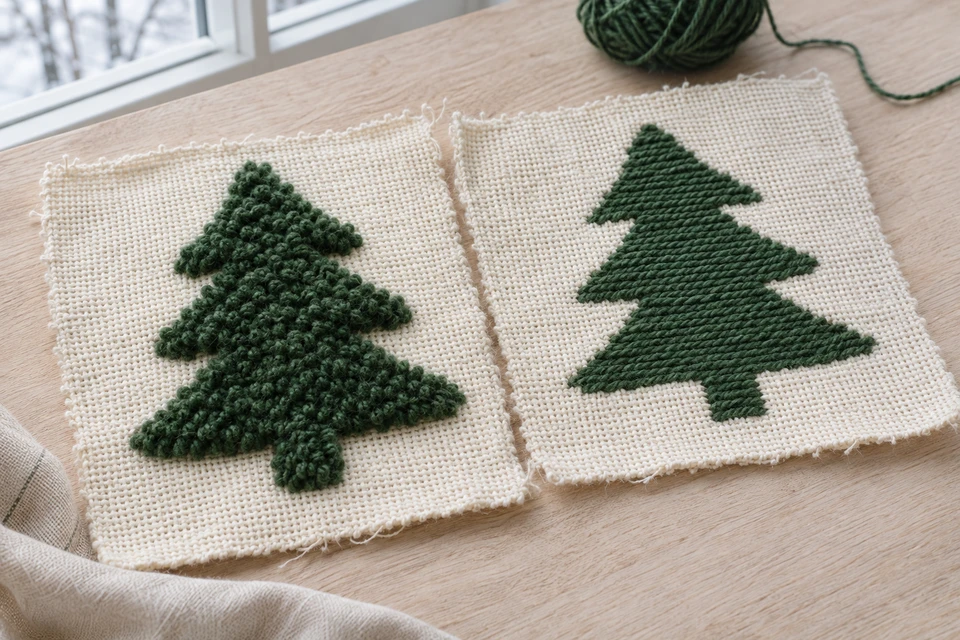
A punch-needle Christmas tree can have two quite different appearances without changing its colours: a rounded loop surface and a flatter stitched surface. For a cushion buyer, choosing which one faces the customer is an early design decision, not an instruction to leave until the cover is sewn. A sample photograph taken from an unspecified side can send the development team toward the wrong product even when everybody agrees on the tree outline and yarn shade.
Identify the two faces before naming the product
Front and back need a project definition
Ask the maker to show both sides of one unassembled punched panel. Keep the two views linked to the same physical sample. Punch Needle World's guidance explains that traditional loop-facing work and contemporary flat-side presentation are both possible. That is a useful distinction for a brief; it does not establish which construction a proposed supplier can deliver or how that supplier should finish a cushion. Write down the selected outward face explicitly instead of relying on the terms right side and wrong side.
Use a neutral face identifier on the technical drawing and sample record. For example, identify the loop-bearing face separately from the flat-stitch face, then mark the intended outside of the cover. Do not put identification marks on the retail product unless they are part of the approved specification. A photograph of the outside alone will not explain the decision to a sewing room that receives panels stacked with the other side uppermost. Include a view of the reverse and a clear assembly orientation.
Compare appearance with the same motif and yarn
Isolate the decision that changes the surface
Request a paired development reference showing the same Christmas motif, scale, yarn proposal and ground. Inspect the loop and flat presentations under the same ordinary lighting, first at normal cushion-viewing distance and then close up. Describe what changes: the prominence of the tree edge, visible ground between stitches, the apparent depth of small branches and the way the colour reads across the surface. Avoid declaring either face inherently more luxurious or durable. Those are different claims from a design preference.
A supplier may propose a flat stitched interpretation produced by another embroidery route. That may be a valid alternative, but it is not automatically the reverse of the offered punch-needle panel. Keep it separately identified and ask for its actual construction. Otherwise, the team can approve the appearance of one process while purchasing another under the same name. Record which paired reference was used for the face selection and which questions still need a finished sample rather than another attractive close-up.
Keep mixed-face designs intentional
A texture change is not an accidental reversal
Some briefs deliberately combine a looped tree with flatter surrounding details. If that is the intended effect, map the regions separately and ask the maker to explain the proposed construction. Do not assume that any combination seen in a concept picture can be achieved simply by turning parts of a completed panel over. The production proposal must show how the selected surfaces become one coherent face and what remains on the inside. Approve the physical junction, not just the two attractive textures in isolation.
Use a complete representative motif containing the smallest branch and any narrow gap between regions. Mark where the surface changes and whether that change should be sharp or gradual. A production inspector then has a reference for distinguishing the intended mixed treatment from a section worked or assembled in the wrong orientation. If the maker simplifies the design for feasibility, update the face map and compare the revision at the original display scale. A texture substitution should not be hidden inside a general colour approval.
Translate the face choice into a sewn cover
An outward surface changes what remains inside
After selecting the face, request an empty cover made from the proposed punched panel, back fabric and closure. Confirm that the chosen surface is outside at the seam and near the opening. Inspect the interior to understand which stitch surface, yarn ends and retained layers are present. The face decision does not itself authorize removing a backing or adding an adhesive. Ask the technical owner to identify the offered assembly and any evidence required for its intended use, keeping appearance and attachment assessment separate.
Fit the nominated insert and review the seasonal motif as a whole. A looped edge may appear different when it curves around a cushion corner; a flat presentation can reveal more of the underlying stitch arrangement. Keep the insert fixed while comparing versions so a fill change does not masquerade as a face improvement. Record whether the sale unit is cover-only or includes that insert. The project should not imply that every customer's filling will reproduce the photographed shape, especially when the design extends close to the seams.
Make photography show the purchased face
Do not sell the sample room's preferred angle
Give the photography team the accepted outward-face reference and require an overall product view as well as a useful detail. Avoid mixing a loop-side hero image with flat-side close-ups unless the listing clearly explains the actual supplied construction. A purchaser should not need specialist craft knowledge to understand what arrives. Where several versions are offered, use separate product identifiers and images rather than a shared gallery that makes the alternatives look like interchangeable views of one cover.
Trial the intended fold and presentation pack, then open it as the recipient would. Confirm that the selected surface is immediately identifiable and that the packing arrangement has not turned the panel inside out for convenience. Record the actual handling and any appearance concern before restyling it. Packaging observation is not an attachment or wash test. If the brief includes care evaluation, use a complete identified cover and return to the same outward-face comparison after the agreed procedure.
Release a face-specific sample reference
Keep the purchasing description unambiguous
The final brief should identify the motif revision, yarn and ground proposal, outward face, any mixed regions, complete cover construction and included contents. Ask for sampling stages and minimum quantities against that defined offer. A loop-facing version and a flat-facing version may require different work or internal finishing; do not assume their quotations or delivery conditions are identical. Record confirmed differences before the retail assortment is expanded into multiple colours or cover sizes.
Share the paired panel views and the preferred finished presentation with FY Bedding when requesting a development discussion. Confirm whether the proposed route can be evaluated and what further sample evidence is needed. Keep the chosen unassembled face reference with the accepted sewn cover so later production questions can be answered without reconstructing the decision from a styled image. The collection concept establishes neither available stock nor a promise of delivery before Christmas; the confirmed specification and supplier response must supply that information.
Identify loop and flat faces on the same sample, choose the intended outside, and carry that identity through the sewn cover, product photographs and retail pack.
Method references: Punch Needle World: loop and flat sides of punch-needle work.