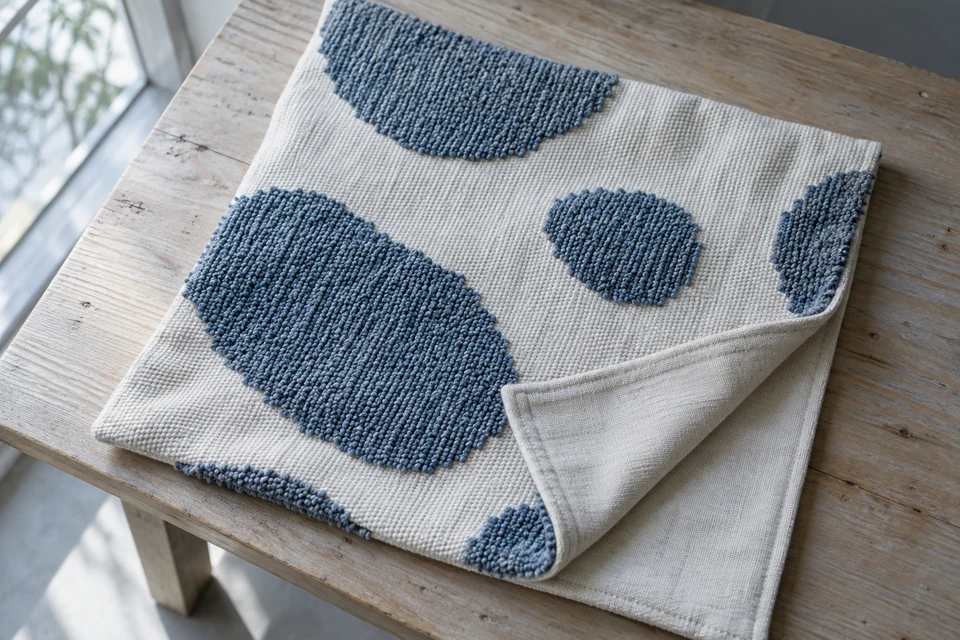
A tufted cushion brief needs to identify the raised yarn areas and the exposed ground as two parts of one finished design. A photograph of a colorful arch or geometric mound does not explain how the yarn is held, what the inside looks like, or where the decoration stops before a seam. For a private-label buyer, those are separate decisions with consequences for the sample and the offer. This guide concerns decorative cotton cushion-cover development, with the stated cotton composition still to be confirmed for the actual components. It does not treat a tufted appearance as evidence of handmade production, secure attachment or a particular service life.
Draw the raised-and-ground map
Specify empty spaces as carefully as the yarn shapes
Ask the design owner to mark each raised area on a full front-panel drawing, including its outline, color and relationship to the surrounding plain ground. Number adjoining areas so comments can refer to an exact region rather than to the orange part of a photograph. Identify narrow channels, isolated small shapes and the spaces between motifs. A maker can then explain which boundaries the proposed construction can reproduce. Keep the authorized artwork and the proposed sample map together in the technical pack; do not release a different layout simply because its overall palette looks similar.
Compare the drawing with the complete sample, not only with its most appealing texture crop. Locate any region that has been enlarged, merged or omitted and ask whether the change is deliberate. Record the amount of visible ground at the panel perimeter and around the closure side using agreed finished landmarks. Those areas can make the motif look centered or displaced after sewing. This is not an applique edge decision: the buyer is mapping yarn relief and open ground, rather than approving the boundary of a separate applied fabric piece.
- Give each raised region a reference name.
- Show plain channels and perimeter ground.
- Resolve layout departures before a sewn sample is accepted.
Identify the offered tuft assembly
The decorative name must lead to an understandable component record
Request a construction explanation and an inside view from the proposed maker. Ask which material forms the visible yarn, which fabric provides the ground, and what stitching, retained layer or covering is present on the reverse. Where a cotton offer is required, obtain the intended composition statement for each relevant component instead of extending the yarn description to the whole cover. A plain back panel, zipper tape and an inside layer can have different identities. Use the component record to connect those identities to the particular sample and quotation.
Keep alternatives visibly separate. A supplier may propose a looped fabric, chenille yarn effect or printed imitation as a less complex interpretation of the same drawing. Such an alternative can be considered, but it is a different construction decision. The boucle comparison concerns a looped surface and its room context; it should not be used to approve discrete tufts by another name. Ask the supplier to label the proposed route and describe its actual finish. Do not infer the route from a macro photograph or invent attachment performance from the apparent thickness of the yarn.
- Separate yarn, ground, reverse layers and back-panel identities.
- Describe alternatives as alternatives, not equivalent names.
- Keep attachment evidence outside the visual approval.
Inspect the motif-to-seam transition
A clean central sample does not settle the perimeter
Open the cover and follow the decoration toward every sewn edge. Identify where raised yarn approaches a seam, where it is intentionally interrupted, and whether the ground remains accessible for the offered seam construction. Look particularly at small shapes close to corners and at the zipper ends. Ask the maker to show how those locations are finished on the production-intent sample. The seam brief can record the proposed seam identity, but the tuft map must separately identify the decorative areas whose appearance should survive that junction.
Compare the same locations from the face and inside. Note yarn caught in a closure, an unexpected ridge under a seam, or a cut-back area that changes the outline. Describe the observation and ask for a revision or an agreed reference; do not prescribe a cutting or securing method that the technical owner has not validated. A revised seam can alter the visible ground margin even when the central tuft pattern is unchanged. Photograph the full corner and the labeled motif region together, so a close-up cannot conceal how far the change extends into the design.
- Follow the map into all corners and zipper ends.
- Review the same junction from outside and inside.
- Recheck visible ground after a seam revision.
Approve the reverse as a working surface
Access to the insert is part of the cover purchase
Turn the empty cover sufficiently to inspect the interior without damaging it. Record exposed construction, loose ends and any retained covering layer as the maker presents them. Ask which features are intentional, what the agreed finished state is, and whether any removable development material remains. Do not tell a sample room to strip an inside layer merely to improve a photograph. If that layer forms part of the offered assembly, its role and identity belong in the decision. Request another sample when the supplied explanation and the observed interior do not agree.
Insert and remove the nominated cushion form by the normal opening route, noting where the form touches the reverse of the decorated panel. Record an inaccessible corner, a closure obstruction or an interior feature that makes ordinary handling difficult. Keep these observations separate from the visual softness of the exterior. The buyer can decide to require a different internal finish, but that request must go back into the revised component and cost scope. A supplier photograph with the insert already fitted does not show the access route or the interior state that the retail customer will encounter.
- Inspect the complete inside before filling.
- Do not remove a retained layer without technical agreement.
- Observe insertion and removal rather than assuming access.
Compare relief in the finished cushion
Keep the insert and viewing state fixed while judging the design
Use the identified insert for each decorative revision and note its identity in the review. View the cushion upright, from the side and in the intended seating or bedroom arrangement. Observe whether the raised areas remain distinct, whether plain channels disappear around curvature, and whether the pattern turns unexpectedly around a corner. The insert relationship is a separate fit decision; this review holds that choice constant to isolate the tuft layout. Do not adjust the fill between candidates and attribute the changed relief entirely to the yarn construction.
If the project calls for a care comparison, use the complete identified cover under the agreed care instructions and compare it in the same filled state afterward. Note altered outlines, exposed ground, reverse appearance and closure access without styling away the observations. Separate changed outer dimensions from a changed decorative surface. The responsible technical owner must determine any additional assessment and acceptable limits. Photographs of unchanged relief after one observed preparation are not proof of permanent shape, secure attachment or universal care compatibility; they are references for the particular offered assembly and the documented review.
- Hold the insert choice constant across decorative revisions.
- Include side views and curved motif boundaries.
- Record post-care geometry and relief separately.
Quote the mapped design and retain the right reference
A cover name cannot identify every included detail
Send the released front map, component identities, inside finish and closure arrangement with the required cover sizes. Ask whether changes in yarn color, ground color, motif area or reverse covering alter the proposed sampling and commercial scope. Compare offers against those exact fields rather than ranking several products described only as tufted cotton. Identify whether the price includes the cover alone, a named insert or a presentation pack. Request the supplier's actual minimum and delivery conditions for the selected construction; this guide supplies no quantity or timing assumption for a tufted program.
Keep the accepted empty and filled references identifiable, including the inside view and the map revision. For retail photography, show the complete motif as well as the texture, and avoid converting a back-finish observation into a quality promise. A later revision to the reverse should reopen the insertion review even if the front is unchanged. Buyers considering a colorful decorative range can discuss a complete tufted-cover sample with the front map and interior questions, or submit the proposed private-label assembly for a scoped supply discussion. Availability and technical suitability remain to be confirmed.
- Compare offers against the same front map and inside assembly.
- Identify cover-only and insert-included contents.
- Retain an interior reference alongside the attractive face.
A tufted-cover approval is complete only when the raised-region map, plain ground, perimeter transitions, reverse finish and ordinary insert access describe the same sample. Keep visual relief separate from material identity and attachment evidence.