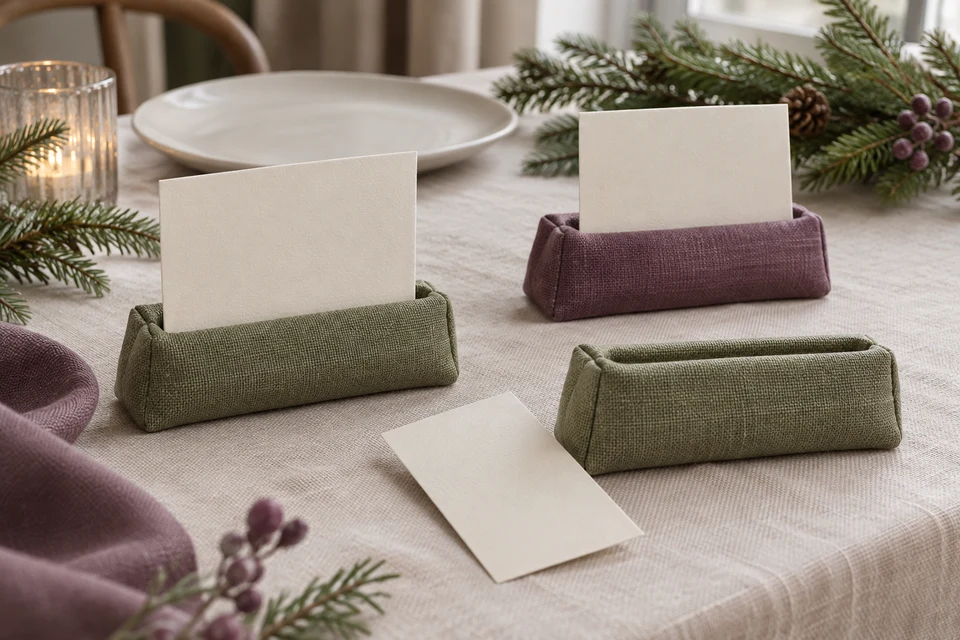
A fabric place-card stand has a small but demanding job: support a name card without swallowing its message or competing with the table setting. Christmas dining programmes often combine decorative table linen, foliage and printed menus, so a holder that looks attractive alone can become difficult to read when placed in the finished setting. For hospitality and retail buyers, the starting sample should include the intended card. The textile stand and paper insert form a working combination; approving them through separate photographs leaves their most important interface unresolved.
Specify the card before the textile slot
Thickness and format belong in the brief
Send representative cards from the intended print process, including any folded format or surface finish. Record the width, height and orientation in which each will be displayed. If the operator will print names locally, agree the range of card stocks it plans to use. A stand developed around one stiff sample may not support a thinner replacement in the same way. Avoid describing the requirement only as suitable for standard cards when the programme has not defined a standard.
Include the longest likely name layout as a proofing example without using personal guest information. Mark the area that must remain above the slot. This prevents the supplier from solving a support problem simply by burying more of the card. Where cards are double-sided, consider both reading directions. The back may face another guest, a service aisle or a photography position, each of which changes the visual acceptance decision.
Separate the slot opening from its depth
Inspect what grips the card
Examine the sample with the card removed. Identify whether support comes from a folded textile channel, padding, an internal insert or a combination of these. Ask the supplier to describe the proposed construction and its material specification. A neat external seam does not reveal how the slot is formed internally, and similar-looking holders may require different insertion techniques. Record which edges are meant to flex and which should remain in position.
Insert the card slowly to the intended stopping point. Note any snagging, buckling or tendency for the slot lining to turn inward. Inspect the printed face after removal, especially along the contact line. If the sample only works when the card is pushed to the very bottom, compare that depth with the approved visible name area. Adjust the slot, the card format or the support design openly rather than accepting a concealed compromise.
Judge readability from the guest position
Build a realistic Christmas place setting
Place the holder beside the actual plate, folded napkin and menu used in the programme. Add the intended centrepiece or foliage at its planned height. Sit at the table to assess the card angle; a view from above can hide a readability problem. Check whether a guest can distinguish the name without moving a glass or leaning around another accessory. Use the table's planned lighting rather than a bright sample-room spotlight alone.
Compare the holder in more than one position before fixing the merchandising image. A dark textile colour may frame an ivory card well but disappear against a dark runner. A very wide stand may take space needed for service items. Record the selected location in the styling guide while keeping the product dimensions in the technical brief. Neither document should rely on the other to explain the approved setup.
Test routine handling without overstating performance
Observe insertion, removal and resetting
Ask a member of the setup team to place and remove several cards using normal care. Include a change of seating assignment and a reset for the next service. Observe whether staff hold the textile base or pull directly on the card. These actions help reveal whether the slot opening remains usable and whether the holder needs an instruction. They do not establish an unlimited service life or a resistance claim.
If the buyer plans repeated use, agree a relevant handling and cleaning evaluation before approving that description for sale. Keep cleaning instructions tied to the confirmed materials and completed evidence. A decorative sample should not be assumed washable because its outer face resembles table linen. Document the acceptance points that matter to the operator, such as a usable slot after the agreed reset sequence, without inventing a universal cycle count.
Pack the stand for the operator's workflow
Keep card supply and holder quantity distinct
Decide whether the selling unit includes blank cards, printed cards or textile holders only. For a mixed-colour Christmas assortment, state the quantity of each colour rather than leaving the packing team to create an informal mix. Where spare holders are required, identify them separately from the number of place settings. This allows an operator to count a delivery without interpreting a lifestyle image or opening every inner pack.
Approve the unpacked shape as well as the packed presentation. A holder compressed under another item may need attention before cards can be inserted. Ask whether the pack needs internal separation and confirm that the proposed carton arrangement preserves the approved slot. Share the card examples, table layout and expected order quantities with FY Bedding when discussing a development sample. Confirm sampling, minimum quantities and timing directly; the seasonal concept alone does not establish availability or a delivery commitment.
Approve the holder with the actual card, the complete place setting and the operator's reset method; a cardless sample is not a finished functional approval.