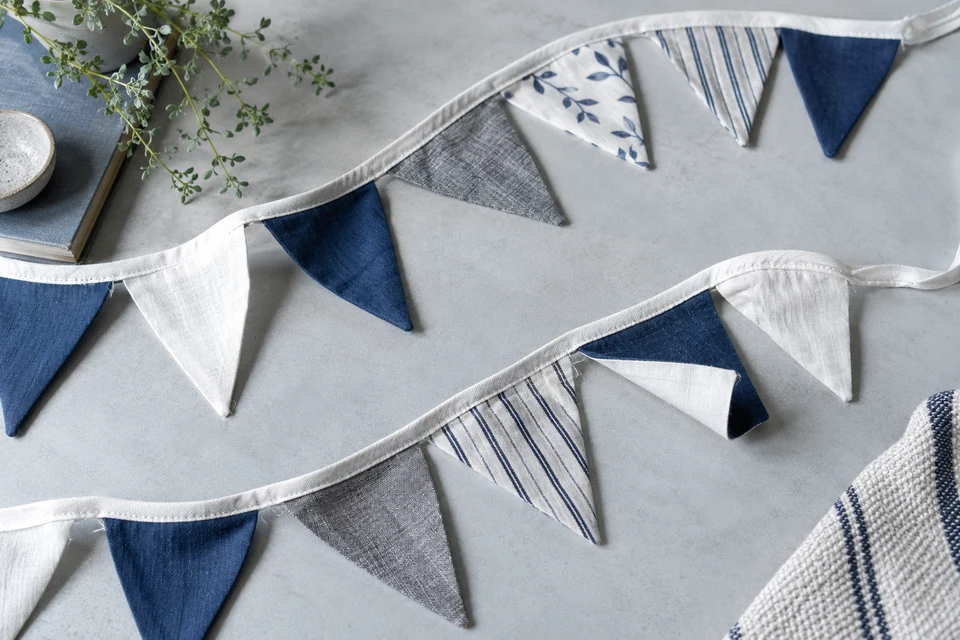
Fabric bunting is read as a sequence, not as a collection of unrelated triangles. In a retail or hospitality display, the reverse may be visible and the two ends may frame different parts of the room. Buyers need to approve the complete string, its face relationships and the packed order. This guide concerns decorative textile bunting for an installation assessed by the site owner. It is not a toy, a load-bearing line or evidence of suitability near heat, electrical equipment or children.
Define the sequence before choosing a unit price
Count the pennants and the spaces
Specify the number of pennants, their finished outline and the spacing between them. Distinguish the decorative span from the extra tape at each end; a quoted total length can otherwise describe very different visible coverage. Draw the color order from the designated starting end and label that end in the controlled brief. The artwork version record should identify the sequence as well as individual motifs.
State whether the pattern repeats and what happens when a required span ends partway through a repeat. If several shorter strings form one display, decide whether their join is meant to continue the color order or begin a new sequence. Ask for a full-length sample or an explicitly bounded representative section. A loose pennant sample cannot prove that spacing and order will remain consistent across the finished item.
- Separate visible span from free end lengths.
- Approve sequence direction and repeat boundaries.
Specify what double-sided means
The reverse is not automatically a second display face
Choose whether each pennant has matching faces, contrasting faces or a deliberately simpler reverse. Identify the layers and any print or embroidery that may show through. Inspect the sample from both intended viewing directions under relevant light. Do not assume that two pieces of fabric create the same appearance as a single reversible weave. Record the assembly in the bill of materials.
For directional motifs, check whether the reverse is upright in the installed orientation. A mirrored or rotated image can be acceptable only if that is the approved design, not an accidental result of turning the panel. Consider how the tape join reads on each side. Keep printed, embroidered and plain alternatives separately named in quotations because their preparation and finishing may differ even when the front photographs look similar.
- Approve both faces in their hanging orientation.
- Record show-through and motif direction separately.
Inspect points and attachment as a complete string
Small shape differences become a repeated rhythm
Lay the bunting without tension and compare the pennant tips, upper edges and spaces. Look for inconsistent turning at points, twisted panels or exposed raw edges outside the approved construction. Then hang the sample only using an arrangement approved by the responsible site owner. The objective is to observe the decorative drape and sequence, not to improvise a strength test or a public-installation safety assessment.
Use the stitch specification to describe the agreed pennant-to-tape attachment. Record the reverse of that join and the finishing of both free ends. An attractive tape surface does not establish attachment strength. Where the intended use requires performance evidence, ask the technical owner to define the scope and method rather than writing a universal load statement from a visual check.
- Compare repeated points and spaces without tension.
- Keep drape approval separate from strength evidence.
Build an orderable color and motif mix
A shared tape does not remove design minima
List each finished sequence as an item with its own revision and quantity. Ask the supplier which materials can be shared across sequences and which printed or decorated components have separate preparation requirements. The component MOQ guide helps structure that conversation without assuming unlimited small runs. Record any proposed stock-material substitution before it becomes a different visual range.
Agree what the sample proves: shape, color combination, reverse construction or the exact finished sequence. If production material is unavailable at the first sample stage, identify substitutes and the decisions still open. Do not use an early mock-up to approve final colorfastness or a particular venue's compliance requirement. Delivery planning should begin from the actual artwork and material approval gates, not simply from the date a sample request was sent.
- Quote finished sequences, not only loose pennants.
- Identify component minima and sample substitutions.
Pack so the first opening preserves the order
Make installation information specific
Try the proposed fold or winding arrangement and reopen the complete string without re-sorting it. Check whether tape twists, points are trapped or two strings become mixed. Record how the approved starting end can be identified without adding an unapproved visible mark. Use the pack-out check to confirm the number of strings and accessories actually included.
State the decorative use and refer installation requirements to the responsible owner; do not imply that supplied tape establishes a safe fixing system. Ask FY Bedding to review the intended setting, sequence drawing, material direction and order mix before discussing sample scope. Keep the accepted packed and installed views together so purchasing, production and the display team are working from the same product rather than three separate interpretations.
- Reopen the full pack without manually restoring the sequence.
- Confirm exactly what fixing accessories, if any, are included.
Approve the whole bunting string from both viewing directions, with count, spacing, sequence, free ends and pack order fixed under one revision.