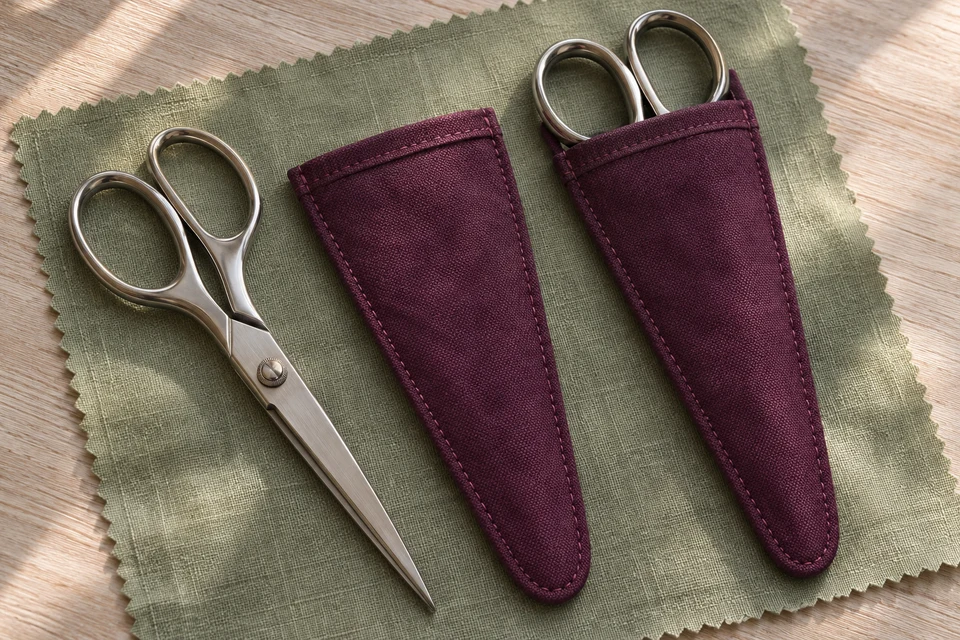
A fabric scissor sheath can organise a sewing kit and cover a closed tool during storage, but its fit should not be judged from the outside length alone. The usable pocket ends at an internal seam, while the blade tip may travel along a different path as the tool is inserted. A sheath that looks long enough can therefore place the tip against the stitching or leave part of the blade exposed. Buyers should develop the accessory with a named pair of scissors in the fully closed position and keep storage fit separate from puncture resistance or other protective claims.
Identify the exact closed tool
Distinguish blade length from insertion length
Provide the supplier with a representative tool or an accurate dimensional reference accompanied by photographs. Record the distance from the closed tip to the intended stopping point near the handle or pivot, not only the blade length quoted on packaging. Include the widest portion that must pass through the opening. Two scissors with the same stated overall length can have different handle transitions and different requirements for a sewn storage pocket.
State whether the project covers one tool model or a defined family. If several models are intended, name each one in the trial list and approve them individually. Do not market the sheath as fitting all sewing scissors based on a single example. Keep the tool reference with the approved textile sample so later orders can be checked against the same geometry rather than an approximate replacement supplied during inspection.
Map the internal stopping point
Allow room beyond the closed tip
Ask for a construction drawing showing the stitch line, turned seam and usable internal pocket. Compare that drawing with the closed tool in the proposed seated position. The outside rounded end is not the same as the space available inside. Binding, lining and seam turn can reduce usable depth. Define where the tool should stop and how the user can recognise that position without pushing the tip firmly into the closed end.
Review an appropriate development sample that allows the internal construction to be inspected. This might be a separate section sample rather than cutting the approved finished piece. Confirm that the production proposal matches the inspected layers and seam position. Do not infer a reinforcing layer from the firmness of the sample. If a liner or insert is proposed, identify its specification and the evidence needed for any performance statement made about it.
Observe a careful insertion and removal route
Keep blades fully closed throughout
Trial the sheath with the scissors fully closed and with careful handling appropriate to the tool. Watch whether the tip naturally enters the intended pocket or catches at the opening. Check whether the pivot or handle transition forces the mouth to stretch or fold. Record the visible amount of handle and any blade area remaining outside once seated. The approved sample should demonstrate the intended stored position clearly.
Do not use an insertion trial to test the fabric by deliberately driving the point against it. That would be a different evaluation requiring an appropriate procedure and controls. A simple fit review should identify geometry and usability problems, not imitate a protection test. If the buyer requires retention during transport or resistance to penetration, define those requirements separately and obtain suitable evidence before making a claim or approving the intended use.
Review the seam and opening after the agreed trial
Describe findings without overclaiming
Inspect the opening edge, internal tip area and main seam after the specified handling sequence. Look for visible distortion, loose threads or changes that make the pocket harder to use. Record the exact tool, sample construction and sequence used in the review. An observation from a small development trial is useful for revising the pattern, but it is not an unlimited durability statement. Keep the approval language proportionate to what was actually assessed.
Discuss the proposed care instructions in relation to the confirmed textile construction. If washing is part of the intended use, review fit again after the agreed care evaluation with the tool removed during cleaning. Dimensional change can affect usable pocket depth as well as the opening. Do not print generic care wording copied from another fabric accessory when the lining, reinforcement or closure differs from the approved sample.
Define the retail scope and included items
Avoid confusing a sheath with a safety device
State whether the scissors are included or shown only to demonstrate fit. Identify the compatible tool models or dimensions accurately, and describe the accessory as a storage sheath within the agreed scope. Avoid protective, puncture-proof or child-safe language without a supported basis. The textile cover does not replace responsible storage and handling of the scissors, and a neat closed-end seam should not be presented as evidence of a safety rating.
Send FY Bedding the closed-tool reference, intended seated position and proposed retail presentation to discuss development. Confirm sampling steps, material options, quantities and timing for the actual project. Retain the final tool-and-sheath pairing, internal construction record and approved pack copy together. Release the accessory only when the usable internal dimensions support the named tool and the description does not extend beyond the function and evidence that have been agreed.
Approve the actual closed tool inside the finished pocket; keep seam clearance, fit and any protective performance requirements as separate decisions.