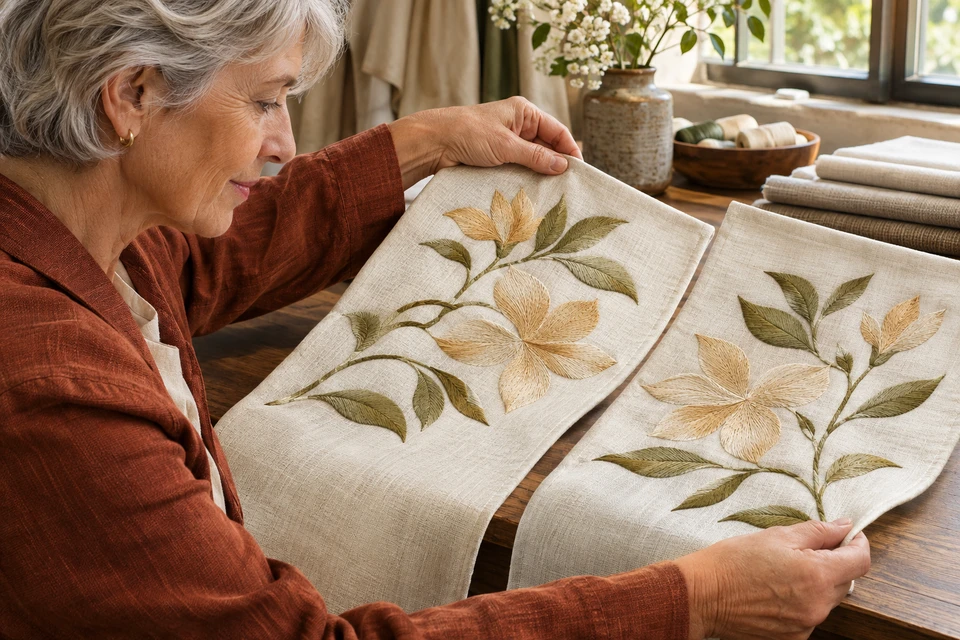
Two embroidered leaves made with the same proposed thread can look unexpectedly different when their stitches follow different paths. Before a buyer orders a new green shade, the development team should check whether the embroidery itself has changed. Stitch direction belongs in the floral design approval, alongside the thread selection. The useful question is which orientation was intended within each petal or leaf, and whether the sample represents that decision consistently. A colour correction should not be used to conceal an unresolved digitising difference.
- 1. Map the botanical form before reviewing the thread
- 2. Compare one controlled difference at a time
- 3. Review the transitions inside the flower
- 4. Keep the orientation decision independent of workmanship
- 5. Approve the motif in its finished product position
- 6. Release the direction map with the colour reference
Map the botanical form before reviewing the thread
A leaf outline does not show how it will be filled
Identify a few representative flower and leaf shapes in the authorised artwork. Mark the intended flow of stitches within each shape, such as across a petal, outward from a centre or along sections of a leaf. The purpose is to communicate the desired form, not to prescribe a machine setting without technical input. Ask the digitising team to explain how its proposed stitch plan translates that intention on the selected fabric.
DMC's guidance on stitch direction shows how changing orientation affects the texture and definition of botanical shapes. That supports treating orientation as a design decision, but its examples do not establish a machine-embroidery specification for a new product. A production-intent sample must connect the buyer's visual aim to the actual thread, ground fabric and proposed embroidery route. Keep that sample distinct from a hand-stitched inspiration piece.
Compare one controlled difference at a time
Do not change the thread and direction in the same unexplained trial
If a petal looks wrong, request a comparison that isolates the suspected cause. Keep the declared thread, base and other relevant settings consistent while the technical team changes the direction map, or keep the map consistent while comparing thread proposals. Identify which variable each trial is intended to assess. A set of attractive but undocumented alternatives makes it difficult to know what the buyer has actually selected.
Keep the trial pieces in a common orientation during review, then turn them together through the same viewing positions. Note where a difference persists and where it depends on the view. Use ordinary project lighting and any additional viewing condition agreed for the sample assessment. Do not conclude from a single photograph that a thread batch is off-shade, nor dismiss a possible colour issue merely because changing the angle makes it less obvious.
Review the transitions inside the flower
An abrupt boundary may come from the stitch plan
Examine the junction between adjacent petal sections and the two sides of a leaf. Ask where the digitised plan changes direction and whether that change is part of the accepted design. Compare the physical boundary with the marked artwork. A line that appears through a flower may be an intentional division, an unwanted visual break or a separate workmanship issue. The reviewer should describe the observation before deciding which correction to request.
Include both the smallest and largest botanical elements represented in the proposed range. A direction plan that gives a large petal a convincing form may not translate unchanged into a small motif. Request the intended scale on the actual proposed ground instead of relying on a magnified screen rendering. Keep any authorised simplification visible in the design record, including what happens where narrow petals or tightly grouped leaves meet.
Keep the orientation decision independent of workmanship
A pleasing direction map does not approve every stitch
After agreeing the visual flow, review the actual sample for the other construction questions relevant to the project. The direction map does not settle coverage, tension, attachment, reverse finish or performance. Ask the technical owner to define the necessary checks and evidence for the intended product. Do not treat a successful decorative comparison as certification or infer that a densely filled leaf is automatically more durable.
Conversely, do not accept an unapproved change in stitch orientation simply because the maker says the machine work is technically sound. The purchasing specification can contain both a visual design requirement and a construction requirement. If those requirements conflict on the proposed material, request a documented alternative for the buyer's decision. Quietly replacing the accepted petal flow with a different fill is not the same as resolving the conflict.
Approve the motif in its finished product position
Rotation on the article is another deliberate choice
Check the embroidery on the intended pillowcase, duvet panel or other agreed article. Identify the top of the design and its relationship to seams, openings and the normal viewing direction. A swatch can be turned freely on a table, while the finished product has a more specific orientation in use. Record that orientation in the placement drawing so the accepted direction map is not inadvertently rotated during production preparation.
Where a pair or set uses mirrored botanical layouts, discuss whether the stitch directions are also mirrored or deliberately retained. Request the appropriate sample comparison rather than assuming that mirroring the outline resolves the whole embroidery file. Keep the accepted left and right versions identifiable. The aim is a coherent set, not automatic mathematical symmetry when the visual design calls for a different treatment.
Release the direction map with the colour reference
Give later revisions a traceable starting point
For an FY Bedding floral project, begin with the desired botanical direction and the artwork you are authorised to develop. Use the published floral collection as a conversation reference, without inferring the exact process or thread used in a displayed product. Send the intended article, motif size, quantities and the direction features that matter most. Ask which sample stages will demonstrate the proposed translation before order approval. The FR-01 floral reference may help communicate a botanical direction; its photograph does not confirm the proposed production technique.
Retain the accepted stitch-direction map, embroidery-file revision, thread references and finished sample together. If a later revision changes the fill approach, review its visual effect before trying to correct it with a new shade. If the evidence instead points to a real thread-colour difference, investigate that separately with the relevant material records. This separation helps the buyer request a precise correction while preserving the botanical form that made the design worth developing.
Before changing a floral embroidery shade, compare the stitch-direction map, thread reference and physical sample under matched viewing conditions; release the accepted direction and colour decisions together.
Method references: DMC: botanical stitch direction in hand embroidery.