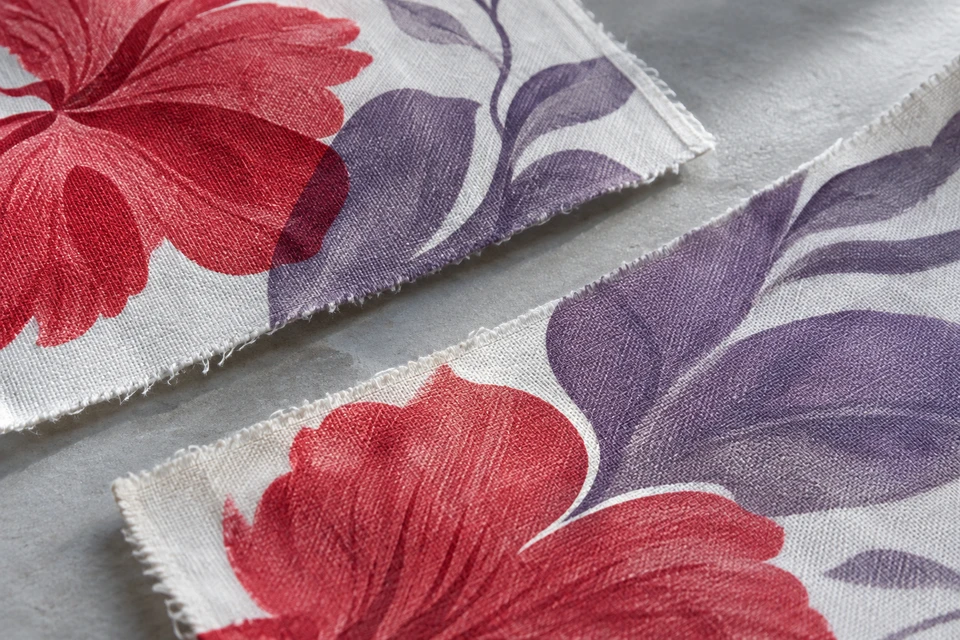
Two colours that meet cleanly in floral artwork may leave a visible gap when their printed positions differ. A printer may propose a small intentional overlap to address that risk. Buyers should understand where the overlap belongs and how it changes fine petals before approving separations. This is a controlled prepress decision, not permission to hide any registration error by making every flower heavier.
Confirm whether trapping belongs in the proposed route
Do not apply paper-print assumptions to every textile
Ask the receiving printer to explain whether it requires intentional overlaps between adjacent colour areas for the selected textile process. Adobe describes trapping as a small overlap intended to compensate for possible gaps between separately printed colours. That general concept is useful vocabulary. It does not establish the right amount, direction or necessity for an unidentified fabric, ink system or production method.
Record the printer's proposal and the owner responsible for preparing it. Some projects may receive separations already adjusted by the artwork team; others may require the production studio to perform that work. Avoid two teams independently adding overlaps to the same file. A buyer should be able to identify whether a delivered proof is before or after the proposed adjustment, and which version is being compared with the physical sample.
Mark boundaries that carry the floral drawing
The smallest gap may be intentional artwork
Choose a few important transitions: a pale petal beside a dark leaf, a narrow vein and the space between two blossoms. State whether each location should show touching colours, a visible outline or unprinted cloth. Do not treat every light line as an error. Some botanical designs rely on narrow gaps to separate overlapping forms, and closing them can change the character of the entire composition.
Ask for enlarged proof details alongside the full motif at finished scale. The close view shows the proposed overlap; the full view reveals whether it changes the apparent petal width or the balance of the flower. Keep the accepted outer contour identifiable. A solution that removes a pale gap but creates an unintended dark ridge may still fail the design brief, even if the two colour areas now meet consistently.
Review the printer's direction and amount
Require a proposal, not a universal number
Have the printer identify which colour area is being extended or reduced at each critical boundary. Adobe's spread and choke terminology describes different overlap relationships, but procurement should not infer a suitable textile setting from a software example. Ask the technical team to propose values appropriate to its actual process and to demonstrate the result. Keep those settings in the technical record owned by the responsible operator.
The buyer's approval should describe the intended visual outcome and reference the accepted proof and sample. Do not prescribe a standard overlap width for all colours, motifs and substrates. Fine veins may need a different design decision from broad petal fields. If the proposed adjustment removes a feature that the process cannot reliably preserve, approve a deliberate artwork revision rather than leaving the production team to conceal the change within an undocumented setting.
Separate a planned overlap from a production deviation
The acceptance reference needs both meanings
Compare the proposed separation proof with a physical strike-off made through the intended route. Record where an overlap was deliberately included and where the sample still shows an unintended gap or doubled edge. This distinction helps the team investigate the right issue. An intentional overlap visible in a technical proof is not necessarily a print fault, while an attractive first sample does not authorise uncontrolled position changes later.
Ask the printer to retain the relevant separation revision with the sample. If a correction changes registration, artwork or overlap, identify which changed and repeat the affected comparison. Do not accept a corrected sample without the file that produced it. Otherwise a later run may return to an earlier interpretation even though the buyer believes the visible boundary has already been resolved.
Recheck the relationships in each colourway
Similar shapes can have different visible boundaries
A dark outline around a pale flower may conceal an overlap differently from two mid-tone colours meeting without an outline. Review the actual proposed colour combinations rather than assuming one approved arrangement covers the full assortment. Ask the printer which technical adjustments change between versions and have the designer confirm that the intended flower still reads correctly. Keep separate proof references where the boundary treatment differs.
The same caution applies when motif size changes. A narrow vein that survives in a large print may become visually crowded in a smaller version. Evaluate the smaller physical motif instead of shrinking an approval photograph. Commercial scope should identify which colourways and sizes are included in development, so additional separation work is discussed before an order is treated as ready for production.
Release one agreed separation state
Give each handoff a clear owner
The release record should connect authorised artwork, selected ground, proposed process, separation revision, overlap decisions and accepted fabric sample. State whether the recipient may alter the separations and what approval is required if it does. Keep the unadjusted design available as a reference, but identify the active production version unambiguously. A file named final is not enough when several teams have modified its boundaries. If FR-01 informs the visual brief, still obtain authorised artwork and the actual printer's separation decision; the collection photograph cannot supply them.
For a floral enquiry with FY Bedding, share the desired motif, product format and intended colourways, then ask for a scoped print-development discussion. Collection photographs may guide the botanical direction but cannot reveal how their colour separations were prepared. Do not assign a particular print process or confirmed material to a displayed style without evidence. The final decision should be a demonstrated floral boundary and an agreed technical handoff, not a general promise that trapping will eliminate all print variation.
Agree who controls trapping, where overlap is permitted and which gaps are intentional. Verify the receiving separations on the proposed fabric, keeping the printer's technical settings separate from unsupported universal rules.
Method references: Adobe Illustrator: intentional trapping between colour separations.