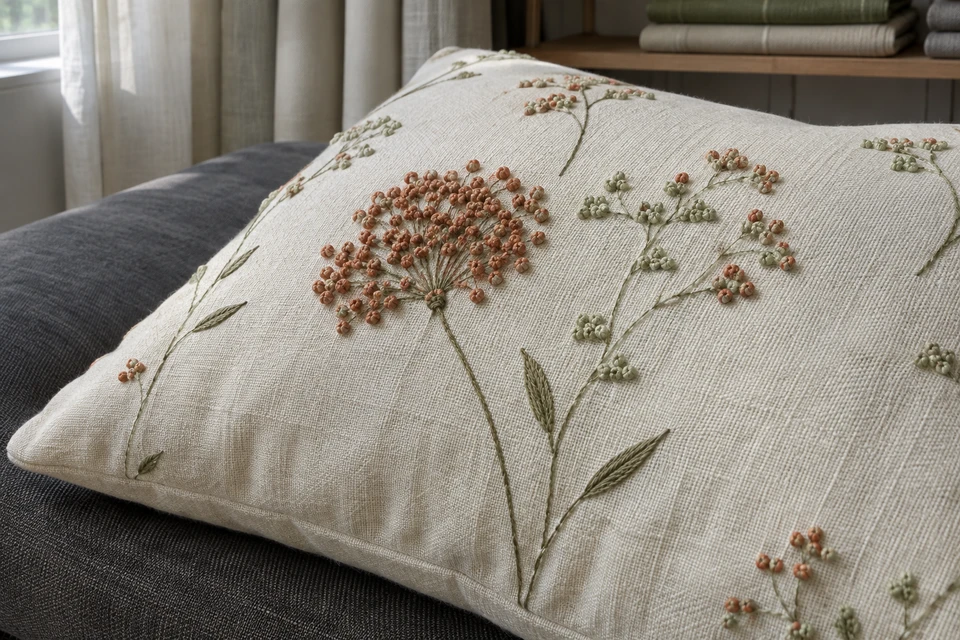
The small raised dots in a floral cushion can change the character of a flower centre or an entire blossom cluster. A drawing may show them as identical circles, while the physical embroidery creates a more textured surface. Before sampling, decide where individual knots should remain readable and where they should form a dense group. That decision gives the supplier a usable target without reducing the design to an arbitrary total stitch count.
Identify the actual raised element
A printed dot or attached bead is a different construction
The Royal School of Needlework describes the French knot as a raised knotted stitch that can be used individually or in groups. Use that construction distinction when discussing a floral proposal. Ask whether the sample uses stitched knots, a machine-produced interpretation, attached beads or a printed imitation. Similar-looking images do not establish the same supplied article. Record the proposed method accurately and keep alternatives separately identified through sampling and quotation.
This is especially important when a reference photograph is enlarged. A small flower centre may appear to contain individual knots even when the original image does not provide enough detail to confirm them. Request a physical sample and a close photograph of the actual proposed construction. Do not infer a handmade claim, a particular thread material or a named stitch from visual resemblance alone. The final description should follow the documented sample, not the buyer's first impression of a reference.
Define the cluster rather than only the motif outline
Open ground is an active part of the design
Mark the outer boundary of each important cluster and indicate whether the dots should be isolated, loosely grouped or closely packed. Identify areas where the ground must remain visible. For a flower centre, a dense core with a lighter edge may be intentional; for scattered seed-like details, each dot may need clear space around it. Use a simple annotated design reference to communicate that relationship before the supplier interprets it in thread.
Avoid a universal density value applied across every flower. A small blossom and a broad flower centre may need different arrangements to remain legible at the finished cushion scale. Choose representative areas and explain the visual result each should achieve. If a supplier proposes a different cluster shape to suit its process, compare that proposal with the intended flower rather than accepting it solely because the total number of dots is similar. Distribution matters as well as quantity.
Review height, footprint and colour together
A close-up should support the normal view
Examine the first sample at ordinary viewing distance, then look closely at the raised elements. Note whether the dots read as separate marks, merge into a mass or disappear against the ground. Use the same lighting for comparisons, because side light can make a low-relief surface appear more pronounced. Keep a normal-view photograph and a detail photograph together so reviewers do not approve different impressions of the same sample.
When an adjustment is needed, state which part of the appearance should change: the visible footprint, the separation between knots, the cluster edge or the contrast with the ground. Let the embroidery specialist propose how to achieve that result. Do not assume that adding thread or increasing the number of knots will improve every cluster. A revision may make a flower centre too heavy or obscure the surrounding petals, so review the complete local motif again after the change.
Check the transition into stems and petals
The cluster should belong to the flower
At a stem junction or the edge of a petal, inspect whether the raised dots interrupt an intended line or leave an awkward gap. These local relationships can be missed when reviewers focus only on the most decorative central area. Select a few reference locations on the artwork and use them consistently during development. Keep the discussion tied to those locations rather than asking for a generally fuller or neater design without explaining the issue.
For a design with repeated flowers, compare more than one cluster on the finished face. They need not be mechanically identical if a controlled variation is intended, but that variation should be understood. Agree a representative appearance range using actual samples rather than a blanket statement that all variation is acceptable. Separate deliberate changes in cluster shape from missing elements, loose threads or unapproved substitutions. Each observation should have a clear review decision and responsible follow-up.
Approve the assembled cover and its handling
Decoration alone does not establish durability
Place the approved embroidery into the proposed cushion-cover construction for the final sample. Check how the clusters sit when the cover is fitted as intended, and inspect the reverse finish with the supplier. A flat decorated panel does not show every effect of assembly or filling. Keep the cover dimensions, insert arrangement and decoration placement recorded so the sample is not later compared with a differently assembled display piece.
Agree any handling, care or durability evaluation appropriate to the intended market and use. A raised dot's attractive appearance does not prove its resistance to snagging or repeated contact. Request the relevant evidence for the actual construction rather than making a claim from the stitch name. If the product is intended for a setting with specific safety or performance requirements, have those requirements assessed separately; this design-approval method is not a certification or a substitute for that assessment.
Freeze the cluster reference before ordering
Give the next reviewer a repeatable comparison
Keep the approved physical sample, artwork revision, thread references and marked cluster locations together. Note which areas are dense, which remain open and what variation has been accepted. Include photographs with a consistent scale and lighting description. The receiving team should be able to locate the same flower centre and compare the same relationship, without guessing which of several development samples is the current reference. The FR-01 floral reference can communicate a botanical direction; its photograph does not confirm the proposed production process or materials.
For a new FY Bedding enquiry, share the floral direction, product size, intended decoration method, target quantities and sample-review needs. Use the existing floral collection as a starting point for botanical styling, while leaving unconfirmed construction details explicitly open. Ask for a project-specific development proposal and timing rather than assuming that a pictured design is ready stock. A clear cluster brief makes the first sample more useful and gives both parties a practical basis for deciding whether to proceed.
Mark cluster boundaries, visible-ground areas and representative junctions before sampling. Approve the actual raised construction and assembled cover, then retain the identified physical reference for later comparisons.
Method references: Royal School of Needlework Stitch Bank: French-knot structure.