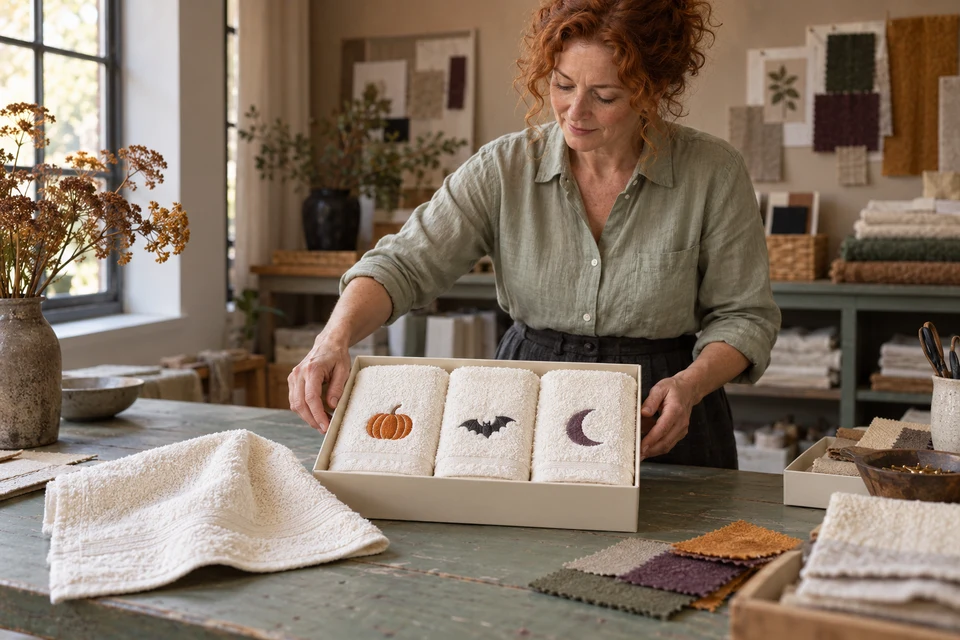
Three towels do not necessarily make the pumpkin, bat and moon trio that a seasonal gift photograph promises. One duplicated motif can leave the total piece count correct while changing the selling unit. The buyer therefore needs a motif-level packing reference and an agreed fold that lets the customer understand the assortment. This guide focuses on the embroidered three-design set; towel performance, materials and care evidence still require their own specifications and verification.
Define three components before naming the set
A set code must resolve to individual motif identities
Give the pumpkin, bat and moon towels individual references within the set. Record whether their base towel, dimensions, border and thread palette are identical or deliberately different. Keep a separate reference for the complete selling unit. This allows a packing instruction to say one of each specified motif rather than three assorted seasonal towels, which permits interpretations the designer may never have intended.
Use the component record to connect those references. Decide whether a change to one embroidery file creates a revised set or a separately sold variant. Do not mix a new pumpkin with old bat and moon towels without checking that the combined presentation remains approved. The visual relationship among three small motifs is part of the purchased assortment, not a detail that can be left entirely to the packing line.
- Identify all three towels and the complete set.
- Record the exact permitted combination of embroidery revisions.
Fold for the intended first view
Count visible motifs in the unopened presentation
Mock up the actual tray, sleeve or band with production-intent towels. Decide whether all three motifs should be visible before the pack is opened or whether a card must explain hidden designs. Check the proposed fold against the finished embroidery position. A beautiful flat towel may place the motif on the inside of the retail fold, leaving the customer unable to distinguish the trio from three plain pieces.
The packaging approval record can retain the fold sequence and pack photograph. Have someone who did not design the set reproduce the fold using those instructions. If the person must repeatedly adjust each towel to expose the embroidery, ask whether the motif position or packaging should change. Do not solve an unreliable pack by approving only a carefully styled prototype.
- State whether every motif must be visible without opening.
- Trial the fold with a fresh reviewer and the actual pack.
Inspect embroidery on the finished towel
The back and folded bulk matter as well as the face
Review each design at its finished size on the offered towel, including the reverse. Compare the density and outline of the bat with the pumpkin and crescent rather than assuming the same embroidery settings suit every shape. Look at the surrounding fabric, exposed backing and how the decorated area lies when folded. Record the actual construction proposed by the maker; the image alone cannot establish fiber content or thread performance.
Use the embroidery backing checklist for those hidden details. Request appropriate care and performance evaluation for the supplied towel and decoration. Keep observed neatness separate from an unsupported guarantee of softness, color retention or long life. A correction to one motif should be checked in the three-piece pack because changed thickness can alter the stacked presentation.
- Inspect each motif's front and reverse.
- Repack the trio after a decoration change.
Verify one of each before sealing
Carton totals cannot prove individual set completeness
Build a packing reference showing one pumpkin, one bat and one moon. Decide where the packer can confirm motif identity before the fold hides it. A carton with equal totals of the three motifs can still contain individual packs with duplicates. The acceptance check must therefore address the selling unit, not only aggregate quantities received from embroidery or folding.
The set completeness guide provides a structure for that verification. Keep rejected or unidentified pieces separate until their correct variant is established. If the buyer accepts alternative motif mixes, define them as explicit variants with their own images and counts. Avoid an open-ended assortment note that allows a supplier to use whichever designs remain at the end of a production run.
- Check motif identity before it becomes hidden.
- Do not substitute carton-level balance for pack-level checks.
Plan replacements without breaking the trio
A single towel reorder needs more than a color name
Decide whether damaged pieces will be replaced individually or only as a complete set. Where single replacements are supported, retain motif, embroidery revision, base towel and color references so the service team can identify the needed piece. A new white towel with a similar bat is not automatically a matching replacement. If matching cannot be confirmed, communicate the available option rather than quietly changing the original assortment.
Use the bundle replacement framework to record the service rule. Ask for minimums by towel construction, embroidered design and mixed set. Include sample, packing and replacement requirements in the quotation request. Confirm the feasible production and delivery sequence independently of the gift campaign; neither a festive motif nor a small towel format establishes availability for a particular holiday date.
- Retain individual motif references for the agreed service period.
- Quote a defined trio and any replacement scope separately.
Send FY Bedding the three motif files, base towel brief and intended gift-pack view. Request an embroidered trio and a repeatable packing demonstration. Approve one-of-each verification and the replacement rule before placing the seasonal set order.