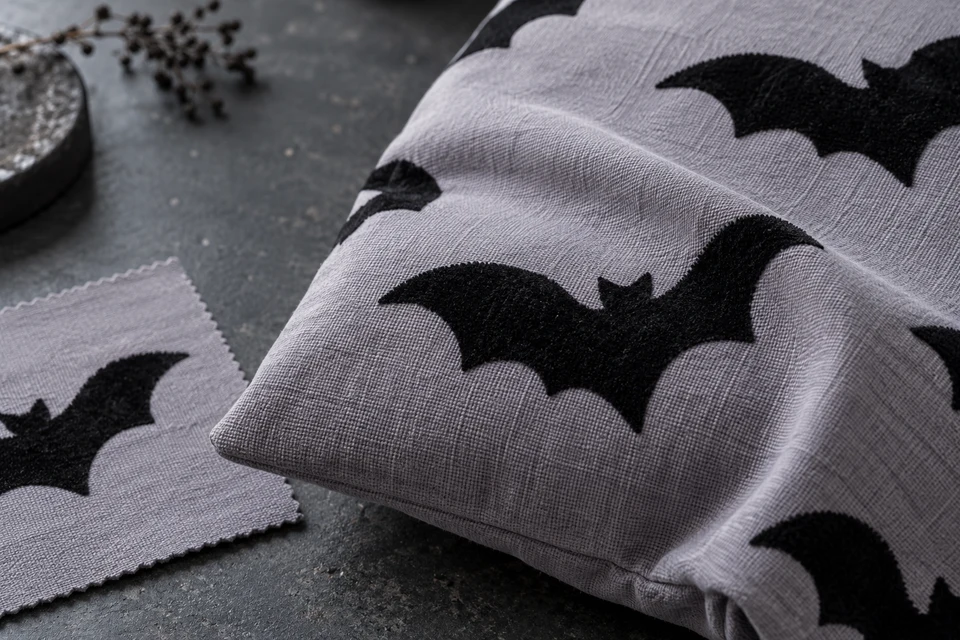
A raised black bat motif can look convincing in one photograph while losing definition when the cushion bends or the lighting changes. Flocked decoration therefore needs a review of the finished cover, not only an artwork file. The procurement decision is whether the offered surface creates the intended tactile and visual contrast in normal presentation. It is not a claim that all flocked fabrics share the same composition, care performance or durability.
Identify the offered surface process
A velvet-like appearance is not a material specification
The American Flock Association describes flocking as applying fibers to an adhesive-coated surface. That basic process distinction does not identify the fiber, adhesive or performance of a particular cushion. Ask the supplier to name the offered decoration and base fabric, and retain a physical sample. Do not silently substitute a smooth ink print because its photograph resembles the approved raised silhouette.
Link the surface sample to the cushion development brief, including the intended room use and target market. If the supplier proposes an alternative process, compare it as an alternative product rather than an equivalent name. Record the questions that remain open, especially care and material evidence, before the commercial team describes the effect as washable, hard-wearing or suitable for a particular user group.
- Identify the actual raised-decoration process.
- Keep appearance approval separate from material and performance claims.
Approve the bat outline at finished scale
Small gaps and pointed wings need a physical reference
Review a production-intent motif on the actual base cloth. Observe the wing points, body, ears and gaps between nearby shapes from the intended viewing distance. Then inspect the edges closely. Decide which details are essential to recognition and which could be simplified if the offered process cannot reproduce them cleanly. Avoid choosing the finest digital outline before seeing how the textile surface resolves it.
Use the placement record to locate motifs relative to seams and the filled cushion face. Mark the accepted example and any rejected edge conditions with dated photographs. Those images should illustrate the buyer's decision, not invent an industry-wide tolerance. A sample with unusually careful hand correction should not become the basis of a production claim unless that correction is part of the agreed method.
- Inspect silhouette recognition at normal distance.
- Record accepted physical edges, not only digital artwork.
Compare contrast under ordinary light
Keep directional appearance from becoming a surprise
Place the sample in the lighting conditions relevant to its intended display and rotate the cushion without changing the camera exposure to flatter each view. Observe how the raised motif separates from the woven ground. A black motif on charcoal cloth offers a different visual result from the same motif on lavender. Approve that relationship with the buyer rather than assuming that matching color names guarantee equivalent contrast.
Record front and oblique views alongside the seasonal design references. Ask whether photographs used for the listing represent the range of ordinary appearance reasonably. Do not retouch away a visible surface variation and then treat the retouched image as the acceptance standard. Keep samples available for receiving staff, who may inspect the product under different but ordinary light.
- Compare front and oblique views consistently.
- Preserve a physical contrast reference for receiving.
Review folds after the actual pack is opened
Do not assess a specially groomed showroom cover
Pack a sample using the proposed retail fold, then reopen it through the intended customer sequence. Inspect areas where raised motifs meet a fold or press against another surface. Record any persistent visible mark, displaced material or change in outline for technical review. An informal handling observation is useful development evidence, but it is not a validated abrasion, adhesion or service-life result.
For the agreed care assessment, ask the responsible technical owner to define the method and acceptance criteria for the complete decorated cover. The inspection resources can organize those questions. Do not improvise brushing, ironing or solvent treatment to recover the photographed surface. If recovery requires a permitted step, make it explicit; otherwise revise decoration placement, packing or construction and assess the revised sample.
- Inspect motif areas crossed by the retail fold.
- Route surface recovery and care methods through technical review.
Compare complete decorated-cover quotations
Coverage and revisions belong in the commercial scope
Specify the cover size, base cloth, decoration area, motif count, reverse treatment and closure. Confirm whether inserts are excluded. Two quotations described as flocked Halloween cushions may cover different decorated areas or use different grounds, so compare those inputs before unit price. Require any revised surface or adhesive system to return for the appropriate approval rather than treating it as an invisible sourcing change.
For a raised-motif sample discussion, send the artwork, contrast reference, pack fold and intended care expectations. Confirm which development stages and evidence are included in the offer. Keep the approved sample tied to its production revision and avoid promising holiday stock or delivery based on a conceptual image. The useful release combines recognizable artwork, honest presentation and a documented technical evidence plan.
- Compare decorated area and base cloth across offers.
- Reapprove relevant material or process substitutions.
Approve a flocked cushion through the actual raised motif, filled presentation and reopened pack. Treat care, adhesion and durability as separate evidence questions, not conclusions drawn from a soft-looking photograph.
Method references: American Flock Association: flocking process.