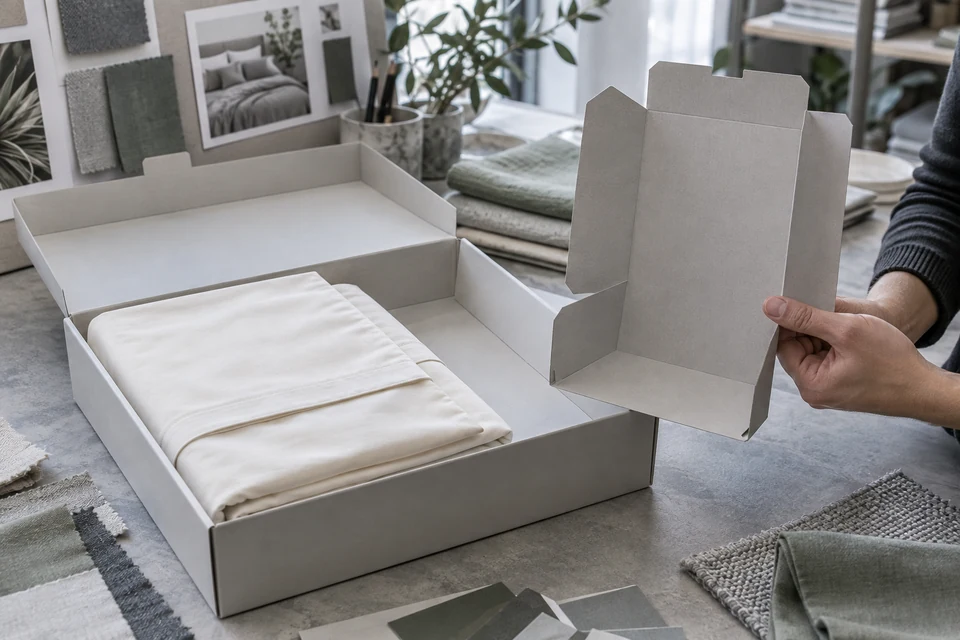
A scored box insert can define how a bedding set is supported and presented inside its consumer pack. Its fold direction, erected shape and exposed edges should be reviewed against the actual textile arrangement before approval. A flat drawing alone cannot show every contact that appears after assembly. This guide concerns the internal insert and product interface, not outer-box transport strength or a universal protection rating. Packaging specialists must define any required performance evaluation for the offered materials and distribution route beyond the limited observations made during a fit trial.
Identify the insert's purpose and construction
Separate support from appearance
State what the insert is intended to do in the approved pack: separate components, locate a fold or support a presentation arrangement. Identify the offered board or material specification, drawing revision and intended assembly direction. The packaging approval record should treat it as a controlled component rather than an optional piece of board added by the packer. A tidy photograph does not explain whether the insert has a functional requirement or is simply part of the visual presentation selected by the brand.
Map the scored lines, tabs and other assembly features to the erected shape shown in the supplier's proposal. Ask the packaging owner to define ambiguous folds rather than let each sample maker choose a convenient interpretation. Use the component specification to distinguish the flat blank from its assembled dimensions. Keep any structural claims separate from appearance approval, especially when an insert is described as protective without evidence showing what it protects against and under which evaluated conditions that claim applies.
- Define the intended insert function.
- Identify material and drawing revision.
- Map flat features to the erected shape.
- Separate appearance from protection claims.
Assemble a production-intent sample
Observe the fold without informal alterations
Have the responsible packaging team assemble the offered insert according to its proposed instruction. Record the sequence and inspect whether the resulting shape matches the drawing. The sample record should identify whether the blank is production-intent or a preliminary handmade prototype. A hand-cut mock-up can support early discussion, but its fit and edge condition should not silently stand in for the actual die-cut or otherwise manufactured component intended for bulk packing.
Note visible cracking, displaced layers, awkward tabs or other observed assembly differences for the specialist's assessment. Do not reinforce the sample with unrecorded tape or trim an edge merely to complete the demonstration. If a revision is needed, give it an identity and repeat the relevant review. The accepted instruction should explain a reproducible assembly, not depend on an experienced sample maker making small undocumented corrections that ordinary packing staff cannot infer from the final closed box photograph or the original flat drawing.
- Record the intended assembly sequence.
- Distinguish prototypes from production-intent blanks.
- Capture observed folding irregularities.
- Control revisions instead of informal trimming.
Load the actual bedding arrangement
Inspect the textile contact surfaces
Place the complete intended bedding quantity in the box with its approved fold and inner materials. Identify which insert faces, folded edges or tabs contact the textile or consumer wrapping. The fold-and-pack record should remain constant during comparisons. An insert that fits around a lightly packed sample may interact differently with the actual selling unit, so the buyer needs the relevant product configuration rather than a convenient substitute selected only to make assembly easier.
Review the loaded pack under the agreed handling sequence and inspect the corresponding contact areas afterward. Record visible impressions, abrasion, snagging or displacement where observed, without interpreting their absence as a broad transport guarantee. Keep any protective layer's identity and position in the approval. If it is moved during the trial, record that change explicitly. Otherwise the released drawing may describe one arrangement while the accepted photograph shows another, leaving production unable to reproduce the interface that the buyer actually reviewed.
- Use the full intended selling unit.
- Map insert-to-product contact areas.
- Keep folding and wrapping references stable.
- Record changes to protective-layer positions.
Check opening and removal
Include the customer's access route
Review how the consumer is expected to remove the product through the normal approved unpacking sequence. Observe whether the insert remains stable, traps a fold or requires an unexplained extra action. Keep this separate from the box-lid fit review, although a changed insert may affect the lid and should trigger the relevant recheck. A consumer pack can close successfully while still presenting an awkward internal arrangement once the customer tries to lift out the actual bedding set.
If the brand expects the insert to be reused during repacking, demonstrate that intended use with the identified sample and record its limits. Do not assume repeated-use suitability from a single opening or advertise it without appropriate evidence. Ask the packaging owner to evaluate any proposed change to tabs, fold sequence or material. Keep customer-facing instructions consistent with the approved physical arrangement, so copy does not promise a simple reusable package when the released component was reviewed only as a one-time packing aid.
- Demonstrate the normal product removal route.
- Recheck lid fit when the insert changes.
- Define any intended repacking use.
- Align instructions with the evaluated arrangement.
Release the erected reference and packing instruction
Preserve the accepted interface
The final approval should connect the flat drawing, material identity, assembly sequence, product fold and loaded-pack reference. Add clear views of the erected insert before loading and of the completed interface. The technical handoff should keep those records together rather than distribute a drawing to one team and an unrelated styling photograph to another. State which observations support approval and which performance requirements remain subject to separate specialist evidence before the affected pack can be released.
For bulk supply, confirm that the delivered insert version matches the approved drawing and material. Review substitutions or scoring changes through the packaging owner even if the blank's outer dimensions are unchanged. Share the actual pack configuration and intended function when requesting sourcing proposals, allowing alternatives to be compared on a common basis. The purchasing decision should identify the assembled component and its accepted contact arrangement rather than rely on a generic line item for a cardboard insert whose construction is left undefined.
- Release flat and erected references together.
- Preserve product fold and contact orientation.
- Reassess scoring and material substitutions.
- Quote against a defined insert function.
Approve the insert as an assembled component inside the complete bedding pack, with fold direction, product contact and removal route recorded; keep untested protection claims outside the approval.