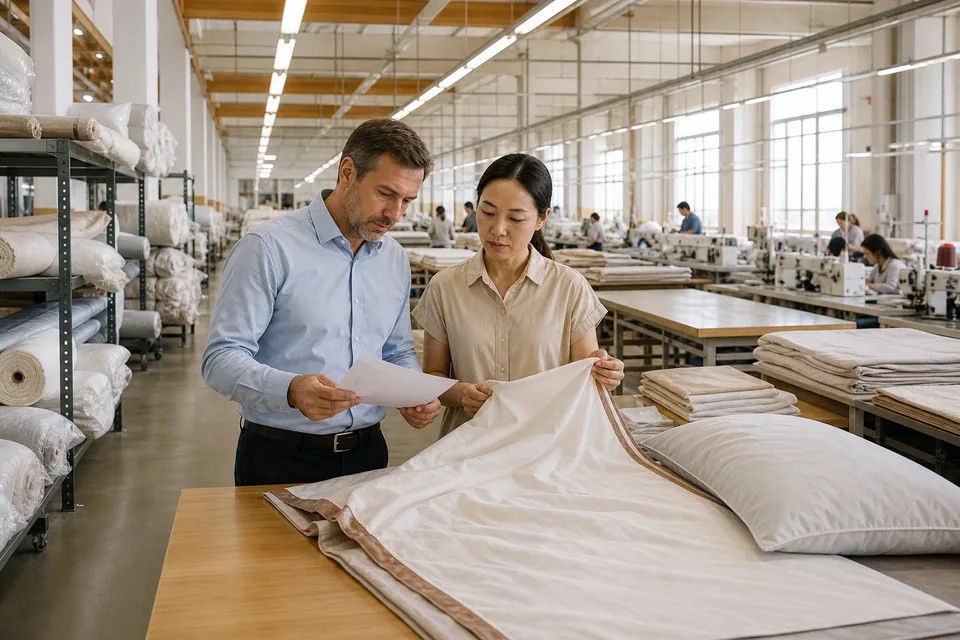
A factory visit is most useful when it tests a defined sourcing decision. Walking past machines and taking photographs does not establish whether a manufacturer can control the buyer's specific bedding program. Prepare a product-focused route, follow real records through the process and close observations with named evidence and actions.
Prepare the scope before arriving
Send the product family, materials, constructions, size range, annual and opening quantities, destination markets and expected customization in advance. Ask the factory to identify which operations are performed at the visited site and which are subcontracted. Name the people needed from development, production, quality, compliance and commercial teams so the visit does not depend on one sales representative.
Bring a focused question list based on the bedding manufacturer evaluation guide. Request permission for relevant records and production areas, but respect confidentiality and safety rules. Select one representative SKU or process to trace; a bounded example produces stronger evidence than trying to inspect every product in a few hours.
Follow material and product flow in order
Start at receiving and material quarantine, then follow storage, relaxation, spreading, cutting, bundling, sewing, filling or quilting, inline control, finishing, packing and finished-goods release as applicable. Observe how accepted, pending and rejected materials are separated. Compare the described workflow with what operators and records show at each stage.
Use the incoming fabric inspection guide to ask how rolls, shade, width and defects are recorded. Trace a lot or bundle reference forward into production. The purpose is not to demand a particular software system; it is to confirm that the factory can identify what entered an order and isolate material when a problem appears.
Review development and change control
Visit the sample room and examine how briefs, patterns, color standards, bill of materials, artwork and comments are versioned. Ask staff to show the current released file for the chosen example and explain how obsolete versions are blocked. Check whether approved samples are labeled, protected and available to production and inspectors.
Map sample decisions through the bedding approval-gate framework. Ask what happens when bulk fabric, a zipper, label or packaging differs from the approved reference. A reliable answer identifies review authority and affected gates; an informal promise that the change is similar is not sufficient product control.
Test quality controls and realistic capacity
At key operations, ask what is checked, by whom, at what frequency, with which tool or sample and how failures are contained. Review measurement, seam, fill, shade, needle, metal, label and packing controls relevant to the proposed product. Examine a recent corrective-action example without requesting unrelated customer-confidential information.
Separate system evidence from finished-lot decisions using factory audit versus product inspection. For capacity, review the bottleneck process, shift pattern, maintenance, seasonal loading and subcontracted steps. Compare current loading with the production critical path instead of accepting only a total monthly piece figure.
Close the visit with evidence and next steps
Before leaving, summarize confirmed facts, open questions, requested documents and any mismatch between presentation and observed practice. Distinguish critical product risks from improvement ideas. Assign an owner and date to every follow-up, and confirm which evidence is needed before sample approval, purchase order, material booking or production release.
A visit does not replace a controlled sample or order. Use the pre-production sample approval guide and a representative trial to test the actual working relationship. Keep the visit record with supplier evaluation, then revisit material changes, major corrective actions, new sites or expanding product categories before assuming the first assessment remains current.
A productive factory visit traces one relevant product through real people, materials, records and controls. Convert observations into evidence-backed actions before increasing commercial exposure.