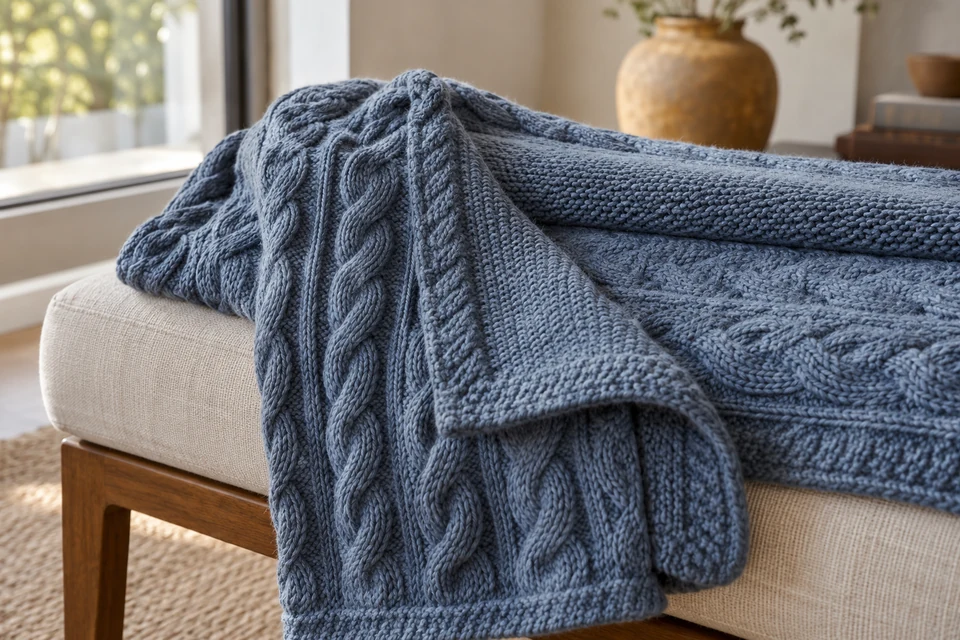
A cable-knit throw invites a shopper to notice surface depth before noticing dimensions or construction. That makes a close-up an appealing starting point, but a weak purchasing reference. The buyer also needs to know how the pattern runs across a complete throw, what the reverse looks like, where joins appear and how the item will be folded for sale. This guide concerns a retail furnishing throw, not infant bedding, a protective product or a warmth rating. The objective is a coherent purchased article whose tactile and visual presentation can be reviewed without assuming that a prominent cable or heavy appearance proves performance.
Start with the whole cable layout
A texture swatch cannot show the complete design
Request a full-layout view and an identified sample large enough to show the proposed repeat, borders and endings. Note cable direction, the relationship between wide and narrow motifs and whether the design is centered or intentionally asymmetric. Confirm the actual proposed knitted construction instead of relying on a rope-like image that might show a different technique. A DROPS cable-blanket example demonstrates that a cable design can be assembled from separate squares; it is a design example, not a pattern for commercial copying or evidence of another maker's construction.
Discuss the selected design's ownership and permitted use through the brand's normal approval route. Keep any reference photograph distinct from the supplier's original proposed layout. The technical-pack guide can hold that proposed design, dimensions and version. Ask whether the sample was made using the intended production arrangement. A hand-developed presentation sample may be useful for design discussion, but it should not be treated as proof that another knitting route will reproduce every crossing, join or border in bulk.
- Request the complete motif and border map.
- Identify the actual knit construction.
- Separate inspiration from released artwork and permissions.
Approve the reverse deliberately
Two visible sides need not be identical
Open the sample and view both surfaces in a relaxed state. Decide whether the throw is intended to have one presentation face or to be marketed as reversible. If the reverse has a different pattern, seam appearance or finish, review that honestly rather than cropping it out of product photography. The two-face approval guide provides a related record structure, but the cable throw needs its own agreed presentation. Reversibility is an offer description to substantiate, not a conclusion drawn from being able to turn any textile over.
Check how the reverse appears when the throw is draped over a chair arm or turned at its upper edge. Some retail displays expose it even when the hero photograph shows only the cable face. Locate visible joins, sewing ends and labels, and decide what may remain visible in ordinary use. Keep workmanship corrections separate from a design decision to show a contrasting reverse. A buyer should not accept avoidable loose ends as artisanal character without an explicit, justified product standard and the relevant technical review.
- State one-face or two-face merchandising intent.
- Review the reverse in a realistic drape.
- Map joins, ends and label visibility.
Choose the retail hand and drape
Compare completed throws under the same handling
Review the actual yarn description, fiber composition and finishing proposed for the sample. Do not infer a cotton, wool or blended identity from its color or thickness. Compare hand feel with identified alternatives under a consistent method, using the hand-feel review to keep sample conditioning and finishing differences visible. An appealing first touch can be one reason to choose a throw, but it should not support an unmeasured claim about warmth, breathability or skin suitability.
Drape the complete throw on the intended display furniture and fold it as a customer is likely to use it. Observe whether the intended cable area remains visible, whether the borders lie as expected and whether the article needs repeated adjustment for the photographed result. Record observations rather than inventing a universal stretch or recovery requirement. If the store wants a neatly folded shelf presentation while the online image shows a loose chair drape, approve both. Those are two merchandising states of the same finished article, not interchangeable evidence.
- Compare yarn identity and conditioning.
- Approve the shelf fold and room drape separately.
- Do not translate touch into a thermal claim.
Inspect borders and any assembly joins
Surface relief can conceal an unfinished junction
Examine each edge, corner and joined area with the throw opened. Identify how borders start and finish, where any assembled sections meet, and how yarn ends are secured in the offered construction. Ask the maker to explain its proposed workmanship standard without turning a buying review into knitting instructions. The seam specification guide is useful where sewing joins are present, but it does not substitute for the particular knitted junction. Retain photographs that show both appearance and location rather than an anonymous macro close-up.
Review the surface after the agreed care process and in the display states already selected. Note new distortion, exposed ends or a change in the apparent border relationship. Relevant surface-damage evidence should be requested according to the intended use, with methods and criteria defined by the responsible technical owner. Do not perform destructive improvised pulling in a showroom and label it a passing test. An observation can trigger a proper assessment; it cannot create a numerical durability claim by itself.
- Check every border ending and joined area.
- Document locations as well as close-up appearance.
- Keep informal handling apart from technical testing.
Package without losing the design story
The opened item must match the retail offer
Approve a pack fold that reveals enough of the cable structure to explain the product while fitting the actual shelf or delivery unit. Review the folded dimensions, label position and any bands or ties on the packed sample. The shelf-ready packing guide helps prevent a visually attractive fold from becoming an unrealistic bulk instruction. If the throw is compressed or tightly wrapped for transport, inspect its appearance after the agreed unpacking and settling method before promising instant display readiness.
Compare quotations for the same full-size construction, yarn identity, border work, joins, packaging and color assortment. Confirm actual minima instead of assuming all knitted throws can share one production constraint. Buyers can submit a cable-throw retail brief that shows the layout, two-face decision and display method. A sourcing discussion still needs confirmation of design permissions, supply availability and the offered route. Keep final product images attached to the accepted version so a later simpler border or altered reverse does not inherit approval from the original cable close-up.
- Approve the actual folded sold unit.
- Inspect post-transport presentation when relevant.
- Quote layout, yarn, borders and packing together.
Buy the complete cable-knit throw, not only its most attractive texture crop. Agree the layout, reverse, border workmanship and retail states, then compare offers for that exact finished construction without unsupported warmth or durability claims.
Method references: DROPS Design: Example of a cable blanket assembled from squares.