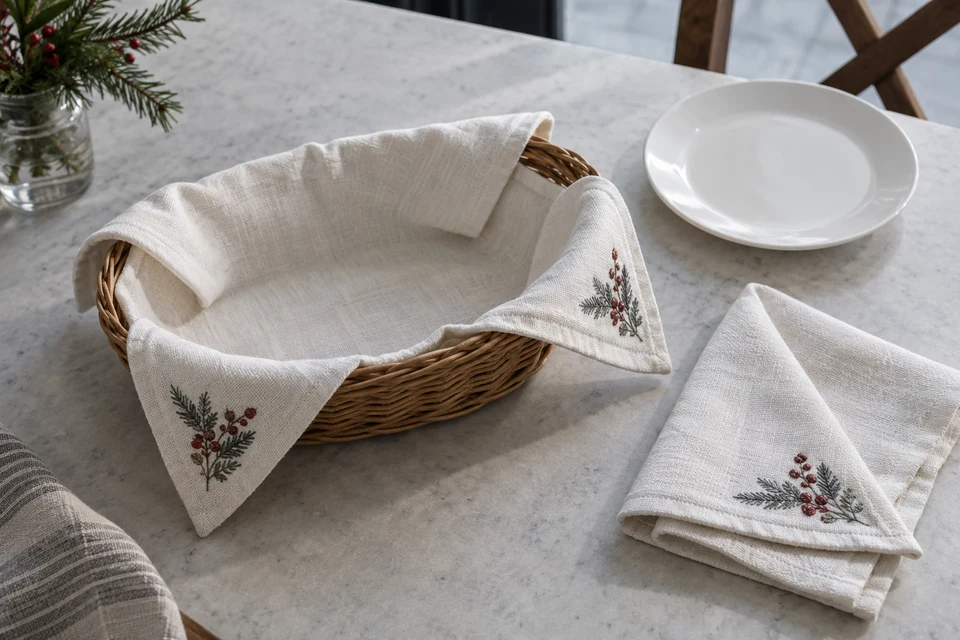
A fold-over basket cloth changes shape during service. Its corners can frame an open basket, overlap above the contents or fall into an inconvenient position when reopened. For a Christmas tabletop program, that movement matters as much as the embroidered sprig seen in the catalogue. Approve the cloth against the actual basket and operating method. This article does not establish food-contact suitability or hygiene performance; those require a separate review for the intended use.
Start with the basket and service sequence
An attractive square is not yet a working basket cloth
Identify the basket opening, depth, rim profile and interior shape. Ask the hospitality operator to describe the approved sequence for preparing, presenting, opening and removing the cloth. Use an empty basket and clean representative mock contents for development where appropriate. The goal is to understand the geometry without implying that a visual sample has been cleared for food contact.
Connect the basket reference to the table-textile brief. State whether the cloth is supplied alone or with the basket, and identify who approves container substitutions. A shallower replacement basket can change how much cloth hangs outside even when its opening looks similar. Keep the actual basket sample available through approval rather than asking the supplier to work from a generic oval outline.
- Identify the exact basket and proposed service sequence.
- Keep food-contact assessment outside visual fit approval.
Choose the overlap deliberately
Open display and closed coverage need different views
Lay the cloth in the basket without forcing the corners into a styled arrangement. Show the intended open position and then the agreed closed or partly closed presentation. Mark which corners fold first and which remain visible. Too little overlap may miss the desired appearance; excess overlap may create an unexpectedly bulky center. Neither observation establishes heat retention or protective performance.
Record the cloth dimensions, orientation and overlap with the sample documentation. If the operator wants several basket sizes, decide whether each needs a separate pattern. Do not market one cloth as universally fitting because it can be folded into every basket. Compare the ordinary sequence and resulting visible area for each included container reference.
- Photograph open and closed positions separately.
- Record the fold order and visible overlap.
Place embroidery where it remains visible
The same corner can face inward or outward
Map the Christmas sprig, small star or border to the cloth's actual fold positions. A motif centered on the flat cloth may disappear inside the basket. A corner motif may turn upside down after the chosen fold. Approve the visible orientation in each required state rather than selecting decoration from an isolated swatch. Use the placement guide for the general artwork record.
Inspect the reverse where embroidery or seams may contact the basket interior. Ask the technical owner to evaluate the actual construction for the intended use; do not hide backing or stitch ends beneath mock contents. If decoration changes the corner's flexibility or bulk, repeat the open-and-close review. A signed color sample does not approve the behavior of the finished embroidered cloth.
- Map decoration to both open and closed views.
- Review the decorated reverse and corner bulk.
Review handling and care with the operator
Procurement should not invent the service procedure
Have trained staff perform the permitted opening and removal steps using the identified sample. Note where the cloth must be grasped and whether corners interfere with adjacent tableware. Keep those observations about presentation separate from the operator's hygiene controls. The napkin service-trial guide offers a related approach to documenting an actual operating reference, not a substitute procedure for this basket.
Confirm the proposed care route for the whole cloth with the responsible reviewers. After the agreed care assessment, compare the same basket, fold sequence and embroidery positions. Record dimensional and appearance changes independently. Do not prescribe an unapproved pressing treatment merely to restore the original photograph, and do not advertise a service life from a brief sample demonstration.
- Observe only the operator’s permitted handling route.
- Repeat the same fit review in the agreed post-care state.
Count cloths against the actual service plan
Replacement stock needs an identifiable reference
Ask the operator to establish quantities from its verified service and rotation plan. Separate active cloths, replacements and any display-only samples rather than applying a universal multiplier. Keep each cloth associated with its basket reference and decoration version. For mixed festive tables, confirm whether all baskets use the same size before consolidating a color order.
When requesting a basket-cloth sample, share the container, fold sequence, intended use, care expectations and quantity split. Confirm the supply route and required evidence before accepting a schedule. List basket exclusions clearly if buying textile-only units. The finished purchase record should allow another staff member to reproduce the accepted presentation without guessing which corner or basket was used.
- Base quantities on the operator’s own rotation plan.
- Identify replacement cloths by basket and artwork revision.
Approve the cloth through its open, overlapping and reopened positions on the named basket. Keep embroidery placement, operating procedure, care assessment and food-contact evidence as distinct decisions.