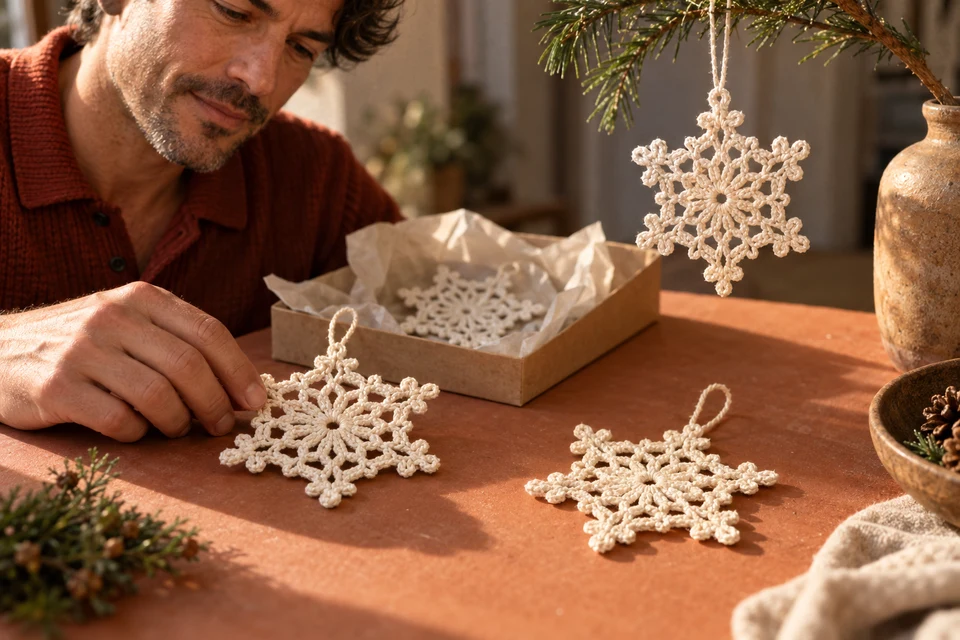
Crocheted snowflakes are bought for the open spaces and points that make the shape readable. A sample arranged carefully on a board can look very different after it has been packed and hung. Buyers should define the intended finished form, any shaping treatment and the ordinary unpacking result before approving a seasonal assortment. Do not confuse a decorative reference with evidence that every piece will hold an identical rigid outline.
Describe the point geometry and measurement method
A diameter needs a defined pair of endpoints
Choose the approved motif and state how its finished size is measured. For a six-point design, identify whether the reference is opposite point tips or another repeatable dimension. Record the intended open areas and the relative length of the points. A loose overall diameter alone may allow a noticeably different lace pattern to pass a receiving check.
The technical brief should include a clear flat reference and a hanging view. Ask the supplier to explain the proposed construction and realistic consistency for that design. Do not label normal handmade character as a defect without agreement, but do not use handmade wording to excuse an unapproved motif or missing point either.
- Define the endpoints used for finished-size measurement.
- Keep the motif structure distinct from permitted variation.
Identify yarn and shaping treatment
Appearance may depend on more than crochet stitches
Request the proposed yarn composition, color and construction reference. Ask whether the sample has been washed, blocked, pressed or treated with any stiffening material before presentation. These are different finishing conditions and should not remain hidden behind a general description of cotton crochet. The supplied ornament should match the condition that was actually approved and described to the buyer.
Use the sample identity and evidence guide when requesting documentation for the exact components or finish. This article does not assert a fiber content, chemical treatment or compliance result for a supplier's product. If the finishing route changes, review its effect on touch, open holes, point shape and the intended care information before accepting the substitution.
- Record the finishing condition of the approved sample.
- Ask separately about any stiffening material or treatment.
Hang the ornament from the intended loop
The top point determines the displayed orientation
Specify where the hanging loop attaches and how the snowflake should face when suspended. Review the attachment on the actual finished piece, including the reverse. A loop that works for a flat photograph may pull a narrow point into a different shape. Decide whether the loop is supplied attached, supplied loose or excluded, and keep this distinction visible in the quotation.
The stitch specification framework can help document an attachment detail without assuming a universal load rating. Have the responsible party assess suitability for the planned display. Keep the ornament away from unsupported claims about child use or toy suitability merely because a holiday decoration is small and appealing.
- Approve hanging orientation and loop inclusion explicitly.
- Inspect the attachment rather than judging only the flat face.
Open the actual pack before arranging the points
Record the ordinary recovery requirement
Trial the proposed tray, card or tissue arrangement, then remove the ornaments and photograph their initial condition. Note which points have folded inward and whether open spaces have collapsed. If gentle reshaping is part of the intended customer experience, define the action and review the result. Do not use heavy styling to create a retail image that the supplied item cannot reasonably reproduce.
The retained sample framework is useful for keeping packed and unpacked references linked. Agree any duration or handling conditions for the packaging trial rather than inventing a guaranteed recovery time. Compare the same ornament before packing and after opening so differences are not confused with ordinary variation between pieces.
- Capture immediate unpacking before any reshaping.
- Retain the pack and its corresponding ornament reference.
Control motif mixes and minimums
Count each design instead of relying on a group photograph
List the motifs, sizes, colors and quantities included in each selling unit. A six-piece pack can contain six matching snowflakes or an assortment; neither interpretation should be left to the packing team. Identify any permitted variation and keep unapproved designs outside the bulk release. Ask suppliers to confirm minimums and sampling requirements by actual motif and finish.
Use the mixed-assortment guide to plan the packing reference and count checks. Confirm which display accessories are included and whether spare hanging loops are part of the offer. Establish the feasible production and shipping sequence after sample approval, without promising holiday arrival from the appearance or small size of the product.
- State counts by motif, size and finishing condition.
- Release only the designs represented in the approved assortment.
Send FY Bedding the crochet motif references, finished-size method and intended pack. Ask for yarn and finishing disclosure, hanging samples and an unpacking trial. Approve the actual assortment and ordinary point recovery before committing the Christmas decoration order.