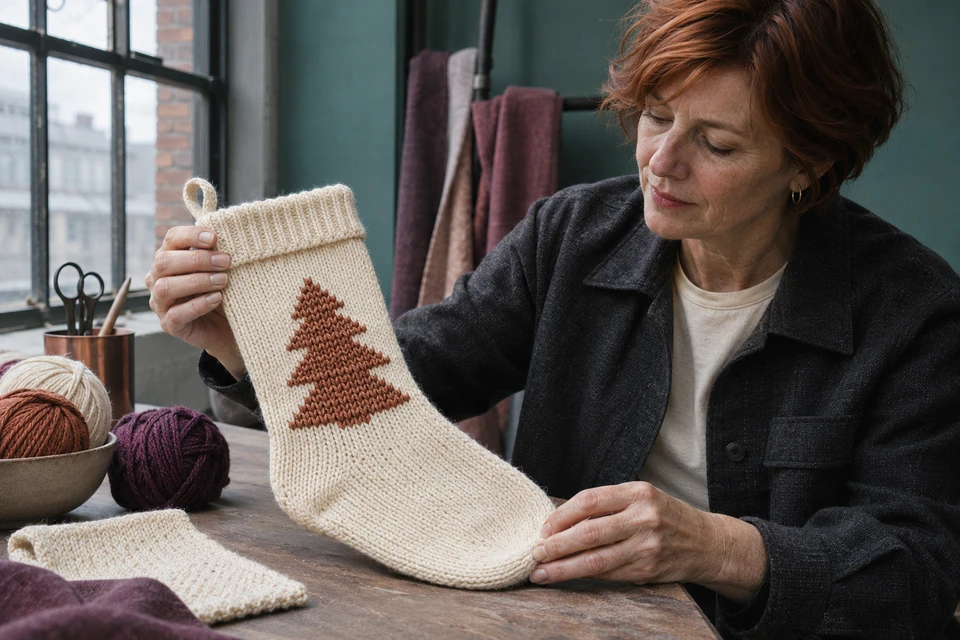
A tree can look convincing on a stocking photograph while the ground yarn shows through quite differently on the physical sample. Duplicate-stitch development therefore needs an approval of the added yarn over the actual knitted loops, not only an attractive Christmas drawing.
Identify the added decoration
Separate duplicate stitch from a knitted colour area
Purl Soho describes duplicate stitch, also called Swiss darning, as following existing knit stitches with additional yarn. That distinction matters in a quotation. A supplier may propose knitting the tree into the stocking, printing an imitation stitch pattern, or adding yarn after knitting. Those routes can share a silhouette but do not produce the same construction. Put the requested route beside the drawing and ask the supplier to confirm any proposed alternative before pricing it as equivalent.
Retain a plain piece of the intended stocking ground with the decorated sample. It lets the buyer see what the decorative yarn is covering and whether the ground itself changed during development. A sample made on a convenient substitute knit is useful for discussing the motif, but it is not approval of the final stocking. Record the ground yarn, knit description, sample size and decoration yarn separately. Unknown details should stay marked as pending rather than being inferred from a soft, thick appearance.
Translate the tree into knitted units
Approve the stepped outline at usable scale
A smooth tree illustration must become a route across knitted loops. Review the resulting stepped branches at the stocking's intended display size. Ask for a marked photograph or working chart that identifies the approved arrangement, but keep the physical sample as the appearance reference. A smaller stocking may not accommodate the same number of knitted units without making the tree disproportionately large. Decide whether a size change keeps the motif's dimensions, its stitch arrangement, or its proportion to the stocking.
The tip, the widest branch and the trunk are useful recognition points. Compare them first with the stocking laid flat, then hanging as the customer is likely to see it. Do not approve a narrow tree solely because it fits inside a drawing box if it leans toward the heel on the actual product. Record its relationship to the cuff, leg and toe direction. For left-facing and right-facing retail presentations, clarify whether both stockings use the same motif orientation or require separately approved layouts.
Judge coverage without hiding the ground
Look at individual V shapes and the whole motif
The buyer's decision is how much ground-colour visibility is acceptable, not whether every imaginable gap can be eliminated. Examine the copper or red yarn over the cream knitted V shapes under consistent light. Uneven coverage concentrated at the tree edge can make its outline look ragged even when the centre appears solid. Excessively bulky coverage may give a different relief and hand from the approved concept. Ask for comparable samples when changing the decorative yarn rather than accepting a colour swatch alone.
Keep close photographs and a normal viewing-distance photograph of the same sample. The close views help a technician understand a local concern; the wider view shows whether it changes the Christmas motif. Do not use a flash-lit macro as the only rejection reference, or a distant styled photograph as the only acceptance reference. Mark which areas are intentional ground openings and which are unintended exposure. This prevents a later inspector from treating every visible cream stitch as a fault or overlooking a genuinely inconsistent section.
Review the stocking in its intended condition
Separate hanging appearance from unsupported load claims
Arrange a practical handling review around the product brief. A decorative stocking intended to hang empty needs a different discussion from one marketed for holding gifts. If the buyer intends to show a lightly filled sample, agree the contents and handling conditions in advance and record them with the photographs. The resulting observation applies to that sample and condition; it is not evidence of a general load rating. The hanging loop and stocking body also require their own approval, outside the tree's stitch coverage.
Look for changes in the tree when the leg opens naturally, when the cuff folds, and when the stocking is returned to its flat presentation. Inspect the inside for decoration ends or carried yarn that may interfere with the agreed use. Do not prescribe a universal tension adjustment or finishing method to the maker. Describe the observed difference, identify the location, and request a revised sample plus an explanation of the controlled change. This keeps the buyer responsible for the acceptance decision without pretending to direct an unfamiliar production process.
Keep personalisation separate from the tree
Prevent a late name option from changing the approved field
Retail projects often add a name area after the tree has been approved. A cuff name, monogram or additional star can change the visual balance and the amount of decorated ground. Treat that as an additional layout decision, not a harmless text edit. Ask for the longest permitted name or other agreed boundary example on the intended cuff. Confirm whether its yarn and construction match the tree or use a different technique. A photograph of the tree alone cannot approve the personalisation system.
The order schedule should identify stocking ground colour, tree colour, facing direction and personalisation option as separate attributes. If quantities are split among combinations, request the proposed minimum quantities and sample charges for those combinations without assuming they can be pooled. Reserve time for physical approval and any revision before confirming a delivery plan. Do not promise Christmas arrival based on a finished prototype: production, packing, transport and the buyer's receiving arrangements still need written confirmation for the actual order.
Build an approval that can travel with the order
Retain a readable sample record and receiving reference
Keep one approved decorated stocking and a matching undecorated ground sample, identified by revision. Attach a short record of the motif route, placement, coverage expectations and agreed handling condition. Where the buyer has accepted a visible variation, include a photograph that shows its extent. A statement such as 'neat embroidery' is too broad to resolve whether the ground may show at a branch tip. Equally, a long list of arbitrary measurements is unhelpful if nobody has agreed how they will be checked.
At receiving, compare equivalent configurations before judging the whole shipment. A cream stocking with a copper tree should not be assessed against a green-ground approval simply because both share the same SKU family. Select the inspection scope and escalation process with the supplier, then document deviations against the retained reference. FY Bedding can discuss a development brief containing the intended stocking, motif direction, quantities and market requirements. Availability, construction feasibility, sample timing and commercial terms remain project-specific questions to confirm, not assumptions supplied by this article.
Before ordering, confirm the added-stitch route, retained ground sample, tree layout, visible-ground limits, facing direction and handling condition. Send these decisions with your sample enquiry so the maker can respond to one defined stocking rather than an ambiguous seasonal photograph.
Method references: Purl Soho: duplicate stitch follows existing knitted stitches.