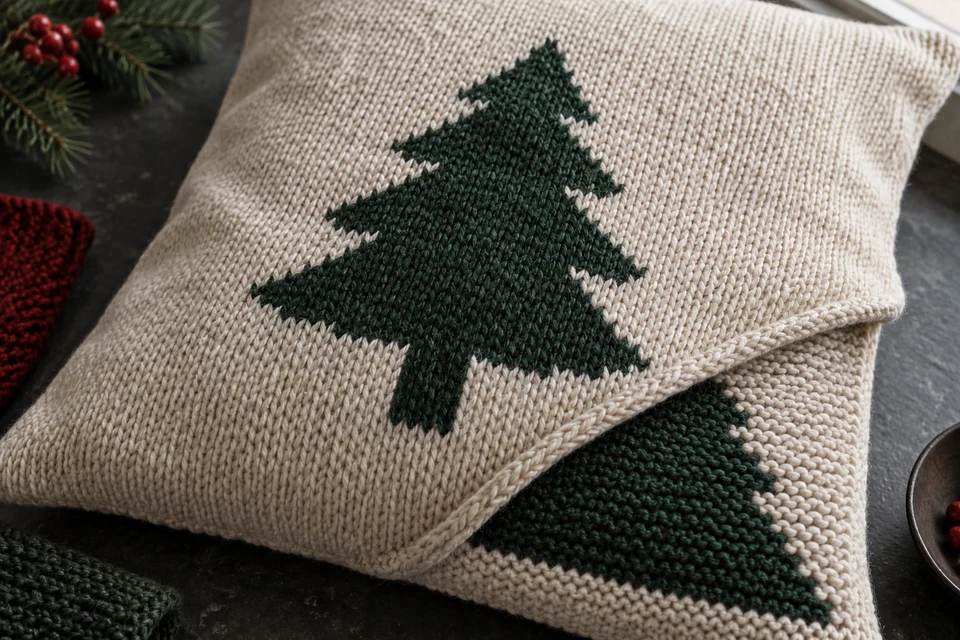
A knitted Christmas tree on a cushion may be formed within the knitting, added afterward or merely printed to resemble stitches. These routes can look similar in a small catalog image but should not be treated as the same specification. Intarsia uses distinct color areas within the knitted fabric; the reverse and the boundaries between those areas are important buying references. This guide helps a buyer discuss that construction with a qualified knitter. It does not assume that FY Bedding owns a particular knitting machine or that a decorative sample proves durability.
Confirm the actual decoration route
Name the construction before discussing the motif
Ask the maker whether the tree is intarsia, another knitted colorwork structure, embroidery, applique or printing. Request front and reverse sample views with that explanation. SHIMA SEIKI describes intarsia as incorporating differently colored areas without carrying the background color through the backing of those areas. This distinction is useful for identifying the proposal, not for assuming a performance advantage or a particular machine requirement.
Record the declared yarns, face construction, back panel and closure in the bill of materials. If a supplier proposes an alternative route to simplify development, compare it as an alternate construction with its own sample. Do not approve it under the original intarsia description merely because the tree remains green and the ground remains cream.
- Obtain a construction statement and both fabric faces.
- Treat another decoration route as an explicit alternative.
Translate the motif into the offered stitch scale
A digital outline is not a finished knitted edge
Review a knitted swatch large enough to include the full tree outline and surrounding ground. Inspect how the branch steps, narrow trunk and top point read at the offered stitch scale. Decide which design features are essential and which may be simplified with the buyer's approval. Keep the accepted knitted interpretation beside the original artwork in the revision record.
View the swatch at normal room distance as well as close up. A small detail that is important in a drawing may become visually noisy or disappear after knitting and filling. Do not change yarn thickness or stitch scale solely to recover one detail without reviewing the rest of the cover. Record the new reference when an adjustment changes motif size, surface or proportions.
- Approve the full knitted motif, not only the artwork.
- Recheck the complete cover after stitch-scale changes.
Inspect color boundaries and the reverse
Join quality needs more than a front photograph
Examine the boundaries between the tree and its background in the relaxed sample. Look for visible gaps, distorted stitches or unwanted ridges relative to the agreed reference. Ask the knitter to explain the proposed joins and finishing. The buyer's role is to define the required appearance and evidence, not to prescribe an unverified machine setting from a photograph.
Turn the sample over and inspect yarn ends and any exposed loose lengths. Keep observations tied to the actual construction; not every colored knit should have the same reverse. Use the snagging discussion guide to identify use concerns for a technical review rather than assigning a strength result by eye. A neat reverse is helpful, but it is not a substitute for agreed performance testing.
- Review relaxed joins and reverse finishing together.
- Separate visual acceptance from performance evidence.
Approve the motif on the filled cover
The insert can alter the tree proportions
Fit the offered cover on its specified insert and observe the tree from the intended display direction. Compare top point, trunk and side branches with the relaxed swatch. Check whether the closure or back panel pulls the front off center. The insert-to-cover guide helps structure fit discussion without assuming one ratio is correct for every knitted fabric.
Agree the care procedure for the finished assembly and inspect the same landmarks afterward. Record drying or reshaping used before the final image. Do not transfer a fabric-only result to a complete cover if the back, closure or decorative joins differ. For multiple sizes, decide whether each motif scales or stays a fixed size, then review the resulting balance physically where necessary.
- Compare relaxed and filled motif proportions.
- Record post-care preparation and size-specific layouts.
Release yarn colors and references as a linked set
Repeat orders need more than a seasonal color name
Keep the approved yarn identification, physical color samples and finished cover reference together. Ask the supplier which yarns can be shared across motifs and what minima apply to each actual color or construction. A Christmas collection name should not hide differences between cream grounds or green motifs from separate offers. Record proposed substitutions before they become changes in the delivered assortment.
Use the reorder-control record for retained references and revisions. Quote cover-only or insert-included scope explicitly, including care information and the retail pack. Share the motif, preferred texture, sizes and target quantities with FY Bedding for a scoped sourcing and development discussion. Confirm the offered supply route and sample gates before making assumptions about production capacity, stock or Christmas delivery.
- Link yarn and finished-cover references under one revision.
- Confirm offered construction and quantities before scheduling.
Buy the declared knitted construction, not a knit-look photograph. Approve the motif at stitch scale, its relaxed joins, reverse finishing and appearance on the specified filled cover.
Method references: SHIMA SEIKI glossary: intarsia and knitted structures.