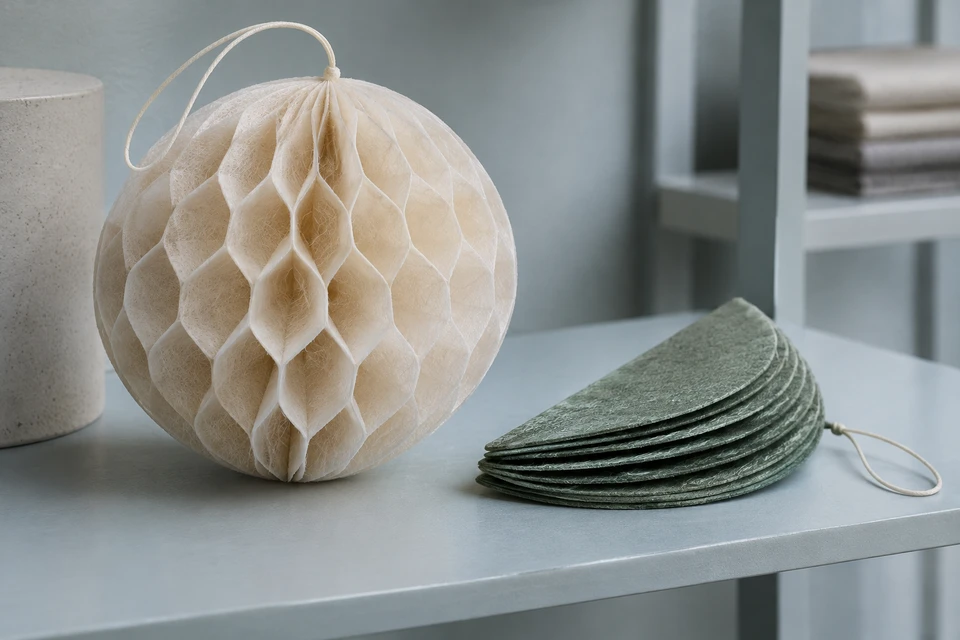
A collapsible honeycomb ornament is purchased in one shape and displayed in another. The buyer therefore needs a sample that can travel from flat storage to its open Christmas display form and back again without relying on a hidden repair.
Confirm that the proposed material is actually textile
A similar silhouette can hide a different product
Request the supplier's material description and construction proposal before comparing prices. Paper honeycomb and textile or nonwoven honeycomb can look similar in photographs, but appearance alone cannot establish their composition, care or performance. Identify the cell-forming material, end panels, hanging component and any closure or bonding materials. Do not write fabric, washable or reusable into retail copy merely because the reference looks soft.
Choose the intended display outline, such as a sphere or another agreed profile, and define both the closed and open dimensions. A flat package width is not the displayed diameter. Include a side view in the brief so the sampler understands the depth and central axis. Where the supplier proposes a different outline for practical manufacture, record it as a design alternative rather than accepting an unexplained departure from the reference.
Find the intended stopping point when opening
The end-panel meeting should not require guesswork
Ask the maker to demonstrate the opening sequence on a complete sample. Identify where the user holds the end panels, which direction they move and how the open position is secured. An ornament that looks satisfactory only while someone holds it in place has not demonstrated its displayed configuration. Review the proposed closure in the position where it will actually sit, including its visibility from the back and sides.
Observe whether the end panels meet without distorting adjacent cells. If they overlap or leave an intentional gap, document that design choice and its effect on the silhouette. Do not force a stiff sample past its intended stop to obtain a rounder photograph. When magnets, clips or other small components are offered, refer their suitability and required evidence to the responsible product-safety reviewer for the actual market and display use.
Read the open cells across the whole form
One attractive face does not prove consistent expansion
Turn the opened sample slowly and examine the cell pattern around its circumference. Look for areas that remain compressed, unevenly opened connections, local tearing or visible bonding that falls outside the accepted appearance. Record the observations under a consistent light and viewing distance. Some variation may be intrinsic to the selected material and design; establish its acceptable range through an approved sample rather than a general claim of handcrafted character.
Inspect the upper and lower ends as well as the broad middle. A clean central band can conceal a poorly resolved tip or a hanging attachment that pulls the nearby structure out of shape. Keep the shape review separate from any formal strength or environmental testing. The sample's ability to stand or hang for a photograph is not evidence of suitability for every venue, and it should never be used around heat or electrical equipment without an appropriate assessment.
Close and reopen using the supplied instructions
Storage should be a repeatable action, not a reconstruction
Have someone who did not make the sample follow the proposed instructions, close it and place it into the intended pack. Note confusing steps, snagging at the closure and locations where cells must be manually rearranged. Reopen the same sample and compare its profile with the first display. Agree the number and conditions of development cycles with the technical owner; a buyer-led demonstration is not a standardized durability claim.
If a component must be removed for storage, include its storage location in the pack plan. Loose closures can become separated from the ornament, while leaving them attached may create pressure points. Review both risks with the actual sample. Retain the observations from failed attempts rather than documenting only the final successful demonstration, because an awkward closure can be a practical issue for store staff even when a skilled sampler can manage it.
Quote the pack and display scope together
Flat shipment does not automatically mean simpler handling
Confirm the quantity per inner pack and the protection needed at the folded edges. Reopen a sample after the agreed packing trial to check cell separation, face marks and closure operation. Record the stored orientation if it affects the result. Compare quotations using the same pack scope, including whether instructions and hanging accessories are supplied, instead of comparing only a nominal ornament diameter.
Ask about minimum quantities for each material, colour and size, and which sample decisions must be closed before production planning. A shared outline does not prove that all colourways use the same material route. Request delivery dates against a confirmed approval schedule. For a seasonal retail launch, keep an alternative merchandising plan until the supplier has confirmed feasibility; do not describe unverified goods as in stock or promise holiday arrival.
Keep the approval usable after the sample room
Retain the closed state as well as the hero view
Store photographs of the flat pack, the opening sequence, the secured open form and the returned flat state with the approved physical sample. Add a short list of permitted reset actions and conditions that require review. Receiving staff should be able to distinguish a normal opening adjustment from a broken connection or a missing component without inventing a repair procedure.
Send FY Bedding the target display shape, dimensions in both states, quantity by colour and the intended sales channel through the project enquiry. Ask for a material-specific proposal before choosing a sample route. The purpose is a controlled collapsible decoration brief, not an assumption that a particular honeycomb material, certification or manufacturing process has already been confirmed for the project.
Approve the complete flat-to-open-to-flat sequence with the actual closure and pack. Keep material identity, display appearance and market-specific safety evidence as distinct release requirements.