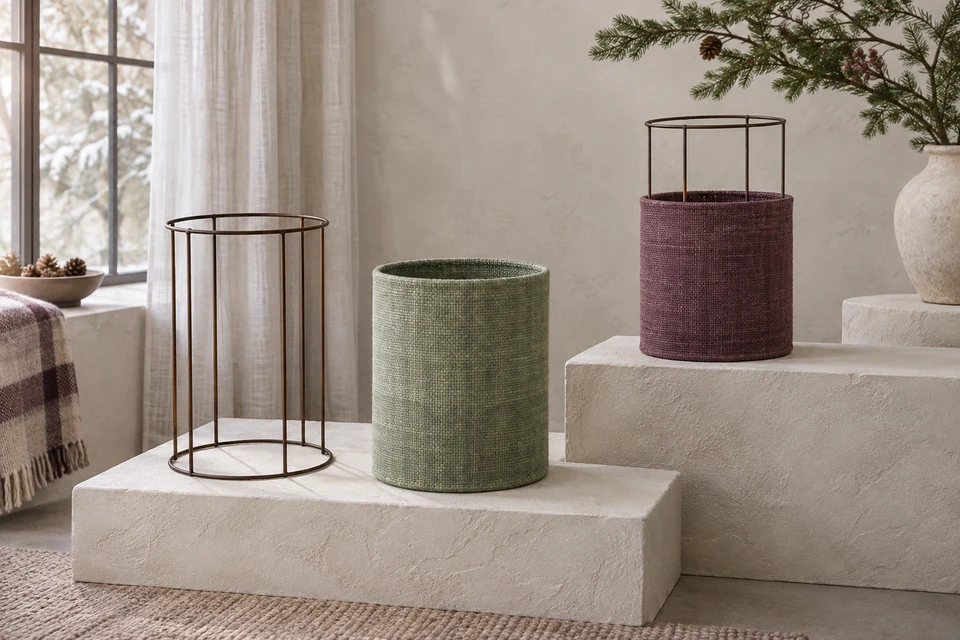
The word lantern can describe a decorative silhouette as well as a functioning light, and that ambiguity matters when commissioning a textile cover. This project scope is deliberately narrower: a cover for an empty, unlit display frame, with no candle, lamp, electrical component or heat source inside it. A Christmas retail display may use such a form to repeat a colour or textile texture across different plinths. The buyer must define that non-lighting purpose before discussing fabric, frame access or seasonal styling. A successful fit trial is not permission to convert the display into a lighting product.
Set the non-lighting boundary first
Use an accurate project name
Name the item as an unlit decorative frame cover in the purchase brief, sample label and approval record. Include a drawing showing the empty frame and its intended position in the display. If a reference photograph contains a candle or lamp, remove that function from the development brief explicitly rather than assuming the supplier will infer the distinction. Any proposal involving illumination requires a separate design and evidence review outside this cover-only scope.
Decide which party supplies the frame and which party assembles the finished display. The textile supplier needs the exact reference frame or a controlled equivalent, not just an approximate diameter. Record the intended venue and placement so the responsible buyer can review applicable display requirements separately. Do not describe the cover as flame resistant, heat safe or suitable for lighting unless those claims have their own valid evidence for the complete proposed use.
Measure the frame along the insertion route
The opening is not the only restriction
Identify the direction in which the textile cover will be installed and removed. A continuous sleeve might pass over the top ring, while an opening shell can wrap around the side. Examine any projecting joins, feet or upper rings along that route. The finished textile must clear the actual structure without being pulled across sharp or rough points. Ask the frame supplier to address unsuitable edges rather than treating extra fabric as a solution to a frame defect.
Mark the intended coverage height and the portion of the frame that remains visible. Measure with the frame resting in its display position. A cover that appears level when held in the air may sit unevenly when its lower edge meets a plinth. Record the sample's installed position in photographs from several sides, including the opening or closure. This gives the sewing team a reference for both pattern dimensions and the visual boundary of the cover.
Balance shell support with removability
Inspect the sample without the frame
Remove the textile shell and observe whether it is designed to hold its own shape or rely on the frame. Either approach can be appropriate, but the quotation and acceptance record should describe the intended construction. Ask for the proposed face fabric, lining and any supporting layer. Do not infer these materials from a photograph. A firm sample may use a temporary development insert that is not included in the production quote.
Reinstall the shell using the agreed method and check the seam location. If a closure is required, decide whether it should face a wall or remain acceptable in a fully walk-around display. Evaluate how the opening edge lies against the frame and whether it creates an unintended ridge. Avoid approving a smooth front view while leaving the rear construction undecided. The whole object may become visible when a store changes its layout.
Review the Christmas display as a composition
Keep decoration outside the access route
Place the covered frames with the intended neighbouring products and seasonal foliage. Examine colour balance and the visible textile area at the actual viewing distance. Small samples can exaggerate the importance of a fine weave that becomes almost invisible across a shop floor. Conversely, a large pale shell can dominate a compact display. Use a complete mock-up to decide the role of each size rather than selecting every colour in isolation.
Keep any decorative additions separate from the cover's removal route. A tied branch or ribbon may prevent the shell from sliding off even if the original sample worked well. Record whether such additions are supplied with the item or belong to store styling only. All display arrangements must remain within the explicitly unlit scope. Do not add candles or lights for a more atmospheric approval photograph, since that image could communicate a use that has not been evaluated.
Plan storage and the next seasonal reset
Approve access after packing
Agree whether the cover is stored on its frame, folded separately or supported inside the pack. Trial the chosen method using a finished sample and assess it after unpacking. Check that the opening remains accessible, the lower edge still sits as approved and any recovery instructions are realistic for store staff. A different storage method can alter the visible result even when the sewing dimensions have not changed.
Send FY Bedding the empty-frame reference, coverage drawing and intended reset method when requesting development support. Obtain a written scope for the textile components, sample revisions, minimum quantities and delivery planning. Retain an approved installed sample and an uninstalled shell so future checks can distinguish frame fit from sewing construction. The final release decision should confirm a removable decorative cover for the defined empty frame, without extending that approval to lighting, heat or unspecified venue use.
Keep the entire development, photography and sale description within the empty, unlit display scope; approve frame access and textile construction as separate checks.