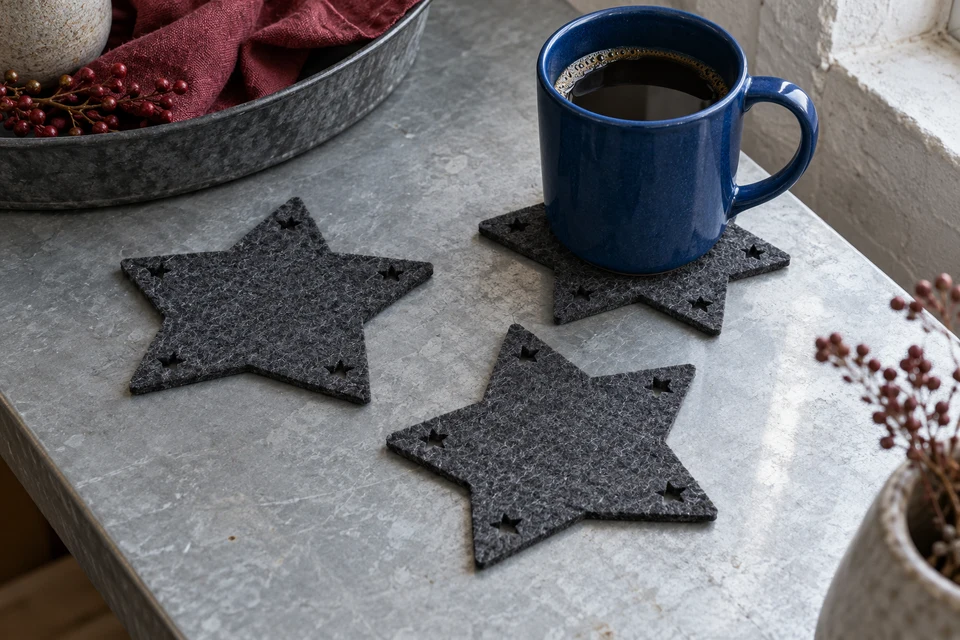
Cut-out stars and snowflakes make felt coasters easy to merchandise as Christmas gifts, but the decorative outline is not the same as the surface supporting a cup. Buyers need a clear relationship between the intended vessel base, the solid centre and the ornamental openings. Approve that relationship on physical samples before choosing pack counts or releasing seasonal artwork.
Draw the solid centre before the star points
Use the intended vessel bases
Ask the retail team which cups or glasses will be shown with the coaster. Measure their contact footprints and compare them with the continuous felt area, not the maximum tip-to-tip dimension. A large star can still have a small centre. Record whether a vessel sits fully on a continuous surface or crosses cutouts, narrow bridges or layered decorations. Do not use a styled photograph as a stability test.
If several coaster shapes share one gift pack, check each shape with the same vessel references. A round coaster, a tree and a snowflake can have different usable centres even when their overall widths match. Include a top-view outline and an actual vessel placement photo in the sample approval record, with the measurement points adapted to this small product.
- Specify outer dimensions and solid-centre dimensions separately.
- Do not place decorative openings inside the agreed supporting footprint.
Describe the felt rather than guessing its composition
Approve thickness and handle together
Specify the proposed fibre composition, nominal thickness, finished colour and whether the item is single-layer or assembled from layers. Felt appearance alone does not establish wool content, recycled content or any certification. Ask the supplier to identify the material actually proposed for this order and to keep the material reference with the physical approval sample. Do not convert a generic material story into a finished-product claim.
Evaluate edge definition, surface fibres, compressibility and how the coaster sits on the intended flat surface. A thicker sample is not automatically the better choice: it may alter the vessel position, cutting detail or pack height. Use the evidence scope checklist for any composition or certification language, and keep unsupported claims off the gift-band artwork.
- Retain an uncut material swatch with the finished sample.
- Identify any adhesive or backing layer in the construction.
Keep narrow bridges and points under review
Inspect every motif, not one representative
Ask for the finished cutting file and identify the minimum bridges between openings and the outer edge. Compare the sample against that file, paying attention to inward corners, pointed tips and small removed pieces. Check for partially detached cutouts, loose fragments and uneven edges. A design with many tiny openings may need simplification before the production pattern is approved.
Arrange samples from the proposed assortment side by side. Verify that the cutting process has not visibly compressed or discoloured one design differently. Keep the accepted edge appearance in the golden sample record. If the supplier proposes a different cutting route or material thickness, request a new finished sample rather than accepting the old artwork approval as sufficient.
Agree the evaluation without inventing protection claims
Document actual conditions and observations
Decide what the retail description promises. A decorative coaster should not be advertised as heatproof, waterproof, stainproof or protective of every furniture finish without appropriate supporting evidence. Ask the responsible reviewer to define the relevant evaluation for the intended use. Where a buyer performs an appearance trial, record the vessel, surface, contact conditions and observations so the result is not generalized beyond what was checked.
For colour concerns, the colourfastness planning guide can help structure questions for a qualified laboratory; it does not turn an informal mug demonstration into a standardized test. Evaluate the proposed care instructions on finished samples and review whether layers separate, tips curl or the surface changes. Keep failed or altered samples available for comparison when approving a revision.
- Separate decorative appearance checks from supported performance claims.
- Record the actual sample, method and decision owner.
Approve the pack as a counted assortment
Protect the shape through distribution
Define whether the pack contains identical pieces or a mixed motif sequence, and whether colour options are mixed or sold separately. Count the pieces in the packed sample, inspect the visible front design and check how tightly the band or box compresses the points. Open the pack after the agreed storage trial and confirm that the coasters can be laid flat without an undocumented recovery process.
Use the retail pack-dimension checklist to record the presentation and unit dimensions, adapting it to a flat coaster stack. Quote artwork, cutting setup, materials and packing explicitly; do not assume a small item has a negligible minimum order. Share the desired motif family, vessel references, destination and pack count with FY Bedding to define a practical development brief and confirm milestones before seasonal commitments.
- Count each design by sales unit and carton.
- Retain a packed and an unpacked approval sample.
The approved outline must show both the decorative silhouette and the continuous area beneath the intended cup. Release the cutting file, material and retail pack as one version.