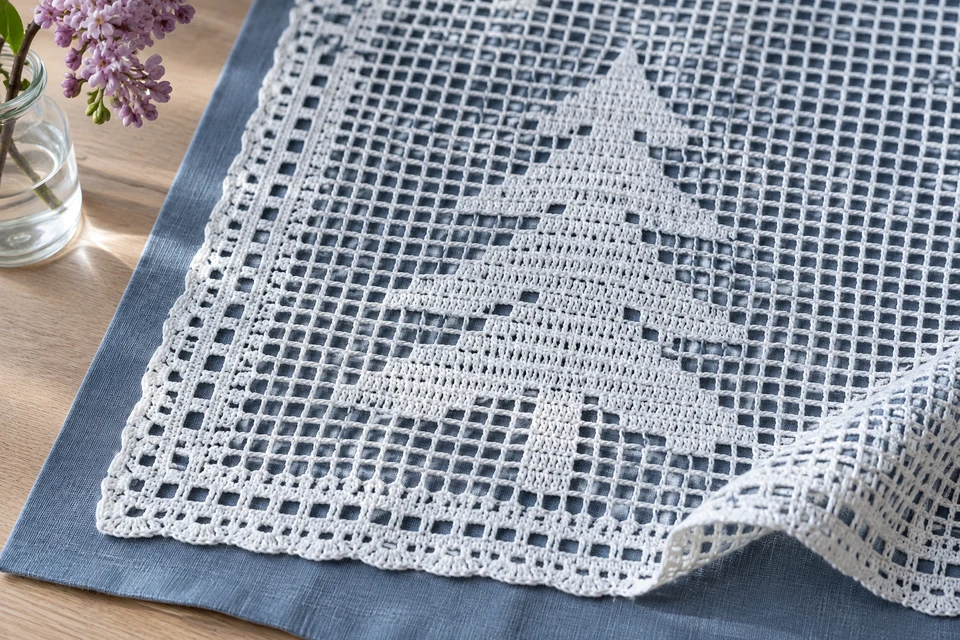
A Christmas tree drawn on a square grid is not yet a crochet specification. In filet crochet, the picture depends on the relationship between open mesh and filled cells. A buyer who approves the drawing without its working legend may receive a different silhouette even when the supplier believes the chart was followed. Start with the meaning of the cells, then approve the worked interpretation.
Establish what each cell means
A square is a pattern unit, not necessarily one stitch
Ask the maker to attach a legend to the proposed chart. It should identify open cells, filled cells and any additional symbols used at the border or turning edge. Crochet.com's filet guidance explains the visual chart through open and filled squares. Use that basic distinction to ask better questions, not to impose a stitch recipe taken from another pattern. The maker should explain the method actually offered for the overlay.
A seasonal buyer may receive a shaded drawing that was prepared as general artwork rather than as a working crochet chart. Keep those records separate. Mark which one communicates appearance and which one controls construction. Before requesting several sizes, have the maker work a small section containing both kinds of cell and a change between them. A sample of open mesh alone cannot confirm how the tree branches will be interpreted.
Read the tree as a silhouette
Protect the few cells that carry recognition
View the proposed chart at a modest scale so the overall picture is visible. Identify the tree tip, the stepped branch ends and the trunk. These are useful landmarks because a small change can alter the Christmas motif more noticeably than a change in a broad filled area. Ask the designer to flag deliberate gaps rather than allowing the maker to fill any space that appears inconvenient.
Then compare the worked section against those landmarks. Distinguish a chart interpretation error from a deliberate design revision. If the offered yarn and construction cannot retain a narrow interruption, decide whether the motif should be simplified and approve that new drawing. Do not let an undocumented practical adjustment become the first version that reaches a retail customer. Keep the superseded chart for the project record, clearly identified as no longer controlling production.
Check adjacency between cells
Shared boundaries need a consistent convention
Have the maker explain how adjacent cells share their boundaries within the chosen method. The buyer does not need to calculate the full stitch sequence, but should recognise when two charts use different conventions. A shaded block in one supplier's document may not translate directly into the same instructions in another supplier's document. Record the terminology and whether the chart is read differently on alternate worked rows.
Choose a trial section that includes a filled run, an isolated filled cell and an open space surrounded by filled areas. Compare their relative proportions after the maker's proposed finishing procedure. If one region grows wider than expected, ask the technical owner to investigate the actual construction rather than stretching the photograph to match the drawing. Preserve a physical reference that shows the intended transitions, not just the easiest repeated part of the mesh.
Expand the chart into a complete overlay
Decide what happens beyond the central motif
Show the complete perimeter, the number of motif repeats and the relationship between the main tree and the surrounding mesh. An approved central sample does not determine how a larger rectangle will finish at its corners. Ask whether a size change adds cells, changes yarn or construction, or revises the motif itself. Each route changes a different part of the specification and should be visible in the quotation.
Review an actual full-size overlay on the proposed table. The purpose here is to verify the agreed chart and finished outline, not to make claims about protection, heat resistance or universal suitability for dining. Confirm whether the order includes only the crochet article or any cloth shown beneath it. Keep display accessories out of the product count, and avoid using an attractive styled image as the only record of the completed textile.
Retain the worked state used for approval
Finishing can change how the cells read
Ask the supplier to identify the condition in which dimensions and appearance are being approved. The freshly worked piece, a carefully arranged display sample and the ordinarily unpacked article may not look identical. Compare the approved motif after the proposed care and packing procedures, using the same table and viewing distance. Record whether the tip, trunk and open spaces remain recognisable under those agreed conditions.
If the presentation requires a particular preparation step, make that requirement explicit and consider whether the retail channel can realistically perform it. Do not approve a manually perfected sample while leaving the ordinary delivered state undefined. Any care wording must be supported for the actual yarn and construction. A single attractive post-care photograph should not be presented as a general durability result or as evidence for an untested alternative material.
Close the order around a named chart revision
Keep motif changes separate from quantity changes
The purchase brief should connect the appearance drawing, working legend, chart revision, yarn proposal, completed dimensions and packed unit. Ask which minimums depend on the design and which depend on material or assortment. A larger quantity does not authorise a different mesh interpretation. If the maker proposes a revision to improve production consistency, review its effect on the seasonal silhouette before accepting a new price or schedule.
Send FY Bedding the authorised motif and the intended overlay format when discussing development. Request a proposed construction and a representative worked sample before treating the concept as an available product. Confirm sampling and delivery milestones individually; neither a Christmas theme nor a finished chart establishes stock or arrival before a holiday. The decisive reference is the complete textile whose open and filled cells both buyer and maker can read the same way.
Approve the chart legend and a worked transition between open and filled cells. Freeze the tree's critical landmarks, the finished state and the complete perimeter before turning the design into an order.
Method references: Crochet.com: open and filled filet-crochet cells.