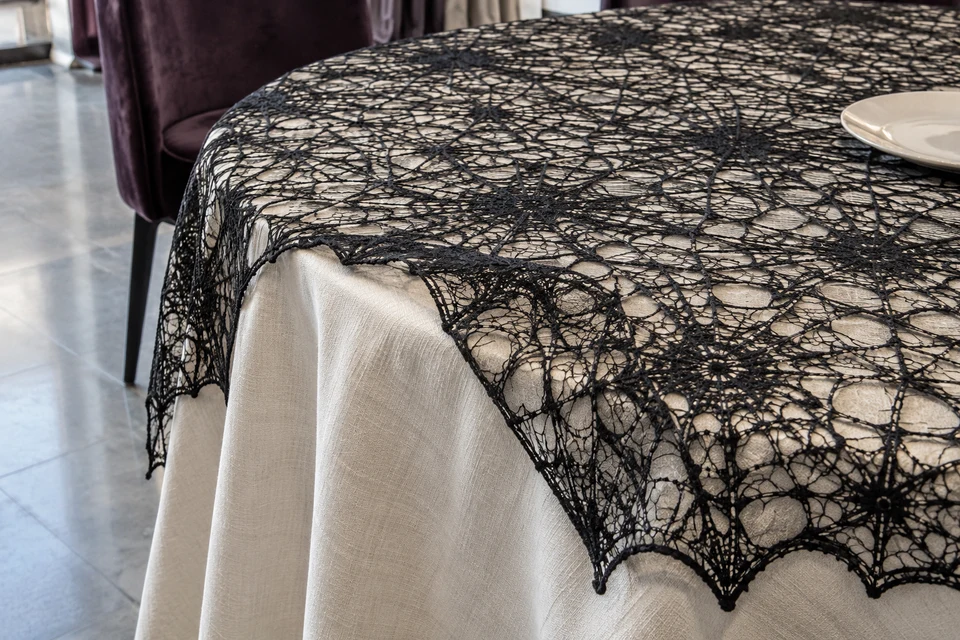
Black spiderweb lace can look striking against ivory and nearly disappear on a dark table. Its buying specification therefore includes the surface seen through it, not only the lace itself. The same openwork pattern may also look quite different spread flat and draped over a table edge. This guide helps retailers and hospitality buyers develop a decorative Halloween overlay with a repeatable visual result. It does not treat lace as a protective barrier, a spill-resistant cloth or evidence of suitability near heat. Those functions require their own design and evidence.
Specify the visible pairing
Approve lace and undercloth together
Choose the intended undercloth or table surface before judging the web motif. Photograph the sample over that surface in the actual display arrangement, with an additional close view of the open spaces. Record the undercloth color and texture in the material board. The underlying cloth need not be supplied with the overlay, but the presentation should make the product contents clear.
Compare a light and dark alternative only where both are real proposed selling configurations. Do not approve the black lace on white paper and assume equal readability on a deep plum cloth. Texture below the openings can compete with the web lines. Decide whether the design needs quiet contrast or a layered, busy effect, then preserve that decision in the sample reference.
- Name the surface underneath the lace.
- Distinguish included textiles from display-only undercloths.
Read the full web at table scale
A small swatch cannot show the radial composition
Lay the complete overlay on the proposed table. Note where the main web centers fall relative to the tabletop center and where the pattern crosses the edge. A repeat designed for a long rectangular runner may produce a very different result when cut into a round overlay. Show the finished outline and the intended pattern position together in the placement record.
Review how partial motifs terminate at the perimeter. If a scalloped edge is intended, check its relationship to the web rather than judging the scallops as an unrelated trim. Agree which visual landmarks must remain consistent between units. Avoid a generic instruction to center the print when the material is actually an openwork construction with its own repeat and cutting constraints.
- Approve the complete cut shape on its intended table.
- Record edge motifs and main web centers together.
Inspect connected threads and edge continuity
Open spaces are design; broken connections are a separate question
Ask the supplier to identify the offered construction and fiber composition. The word lace describes appearance broadly and does not settle the production method. Compare the sample with its approved pattern to distinguish intentional openings from interrupted connections or unfinished edge areas. Use magnified photographs for discussion, but keep the full-size sample available so isolated details are not judged without context.
The defect-classification guide can help turn agreed observations into inspection language. Record examples of unacceptable breaks and edge changes using the actual offered lace. Do not invent a strength rating from the apparent thickness of a web line. If snagging or durability evidence is needed for the intended use, agree the assessment separately with a qualified technical owner.
- Identify the construction behind the lace description.
- Keep intentional openings separate from broken connections.
Try the intended place setting
Visual effect and practical contact should be reviewed together
Arrange the real plates, glass bases and flatware in their intended positions without adding hidden supports. Observe where items sit on lace, undercloth or an opening. Ask the operating team whether the layered arrangement works for its service routine and whether decorative material needs to remain outside certain contact areas. This is a practical layout review, not a substitute for any product-safety or venue assessment.
Use the place-setting planning guide to document the complete layout. If the overlay is intended only as a central decoration, show that clearly instead of photographing it as a universal table covering. Record any separate solid placemats or protective elements as distinct products. The buyer should not discover after delivery that the approved photo depended on components absent from the order.
- Review ordinary contact points with the operating team.
- State when the overlay is central decoration only.
Validate care and the first opening
Fine edges need a realistic retail presentation
Agree the care instructions and trial appropriate to the declared material and finished construction. Inspect the web geometry and edge shape after that process, using the same undercloth and table as the first review. Do not infer wash suitability from fiber name alone. A shaped overlay must still present the intended design after the process claimed on its packaging, subject to the agreed acceptance criteria.
Try the actual folding arrangement and reopen the pack without carefully separating every thread for a staged photograph. Record tangling, trapped scallops or unacceptable crease lines. Refer to the retail fold approval for pack dimensions and displayed contents. Share the table format, paired surface, motif scale and quantity mix with FY Bedding before requesting a sample plan. Keep quotation and delivery assumptions tied to confirmed construction and approvals.
- Recheck the pattern after agreed care and unpacking.
- Confirm the supplied piece count and visible pairing.
Approve web lace as a layered table presentation: actual undercloth, complete motif, finished edge and service layout. A high-contrast close-up alone cannot approve the finished overlay.