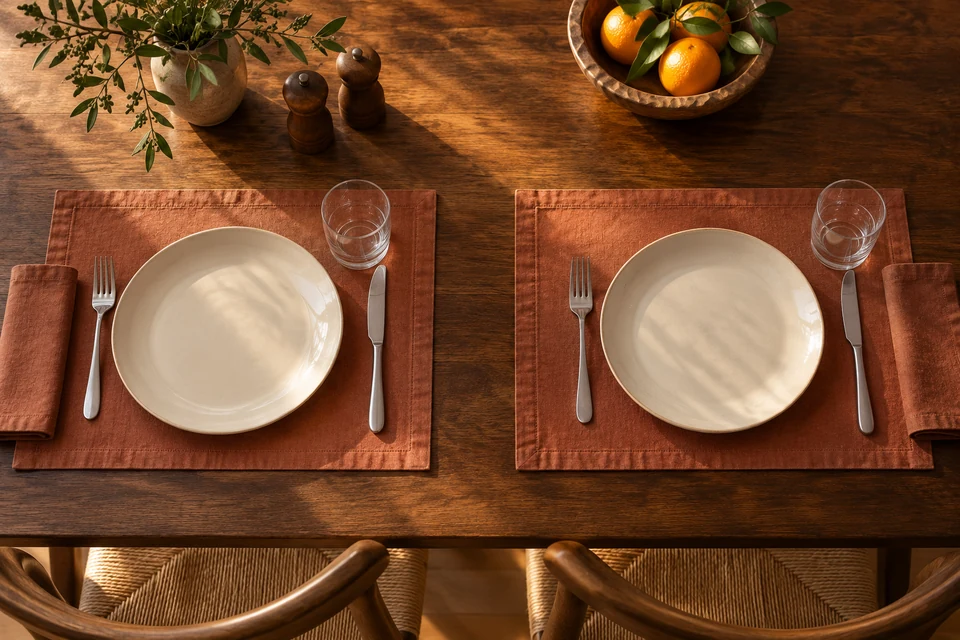
Fabric placemats organize a smaller area than a tablecloth, but that makes the details of each place setting more visible. A mat chosen from an empty table can be too narrow for the full dinner service or too large for two adjacent diners. The useful starting point is the restaurant's actual tabletop, crockery and service routine. Only after that arrangement works should the buyer settle color, material and pack count.
Assemble the service before measuring the placemat
Include the pieces that arrive after the opening photograph
Gather the plates, bowls, cutlery, glasses and napkin arrangement used for the relevant menu. Place them as the restaurant intends to serve them, including any side plate or shared item that changes the available space. Decide which pieces should rest on the mat and which should sit directly on the table. Mark that decision in the trial record so another team does not measure a different arrangement.
CBI's table-and-kitchen-linen study lists placemats within table linen and notes that items can be sold individually or in coordinated sets. It does not define a universal restaurant placemat size. Use the broader table-linen buying framework for the venue context, then work from the real service footprint. Avoid enlarging the mat until every object fits without first checking the neighboring diner and table edge.
- Build the complete setting, not only a plate and fork.
- State which objects belong on and off the mat.
Test neighboring settings on every relevant table shape
An individual rectangle becomes a room-planning decision
Set at least the adjacent places on a representative table, then include the head position where it differs. A shape that works along a long table may meet another mat awkwardly on a compact round table. Review corner overlap, cutlery access and how servers place or remove dishes. Do not force all furniture layouts into one textile size merely because purchasing prefers a single SKU.
Record the agreed mat position relative to the table edge and to fixed service items. If runners or centerpieces are used, review them together through the runner and centerpiece clearance guide. A reduced mat may solve overlap but leave part of the setting outside the intended visual field. Show both consequences before choosing separate formats or changing the service arrangement.
- Compare side-by-side and head-of-table positions.
- Approve round, square and rectangular table arrangements separately when needed.
Compare fabric options under the actual crockery
Appearance alone does not establish tabletop suitability
Request the proposed material declaration and identify any backing, interlining, coating or padding. Place the finished mat on the intended table surface, not a conveniently textured sample board. Look for curled edges, bulky seams, local ridges and visible distortion beneath plates or glassware. A thick textile may create the desired visual weight, but that does not automatically make it the more practical restaurant choice.
Have the service team observe normal placement and removal of the identified tableware. This is an operational observation, not a standardized slip or stability test. Where a project requires measured performance or protection of a particular tabletop finish, ask the responsible technical owner to define the evidence needed. Do not market an ordinary textile placemat as heat-resistant or as a protective barrier for hot cookware without applicable support.
Consider the visual border after tableware is placed. If the mat's design depends on a frame or contrast edge, confirm that enough remains visible without taking space from another diner. A coordinating napkin needs its own folding and corner review; the napkin finishing guide is a related reference, not evidence that a mat made from the same cloth will lie flat.
Follow the mat from cleared table to next service
The operating burden appears between meals
Ask staff to clear, sort and prepare sample mats using the proposed service routine. Decide whether mats are stored flat, folded or rolled and check the condition when they return to the table. Record the steps needed to restore the approved surface. A sample carefully hand-pressed for approval may create a different workload from the normal restaurant turnaround, especially when several table formats must be ready together.
Agree the actual care and finishing route for the complete mat. After processing, measure the finished outline and repeat the same loaded place setting. Use the dimensional-stability approach to keep preparation and measurement consistent. Inspect corners, backing alignment if present and any edge that now sits beneath a glass or utensil. Keep stain observations and any separate laboratory results tied to the identified construction rather than a general easy-clean description.
Retain a reference showing the accepted service-ready condition, including any permitted creasing. If the team changes folding, storage or finishing to achieve that condition, revise the operational record as well as the sample approval. The goal is a reproducible restaurant setup, not a textile that only looks correct on the day of the presentation.
- Review the stored mat after normal preparation.
- Refit the same place setting after care.
- Keep appearance approval separate from protective claims.
Buy service-ready quantities, not isolated pieces
The order must reconcile table layouts, care and replacement
Count mats by approved layout and simultaneous covers, then add the property's agreed processing and replacement allowance. Keep this calculation separate from supplier minimums. A useful allocation sheet shows mat size, color, table group, quantity and pack unit. If mats are coordinated with napkins, verify the actual component counts rather than assuming one set definition matches every service format.
Ask the source to separate material and color commitments from finished size and packaging minimums. Review a delivery pack that can be identified without unfolding every mat; the opening team needs to distinguish similar formats promptly. Send FY Bedding the place-setting photographs, table dimensions and care expectations through a sample request. Explore table-textile directions as a starting point, while requesting confirmation of the particular construction and schedule.
Before issuing the final buying brief, check that the approved drawing, cared-for sample and carton allocation use the same names. Specify whether later small replacements must match an existing room set and ask how that will be controlled. A pleasant individual placemat becomes a workable restaurant program only when its footprint, reset condition and replenishment identity stay aligned.
Release the fabric placemat after a complete adjacent-place-setting trial, a care-and-storage review and a reconciled size and quantity allocation. Never infer heat protection from a textile's appearance or thickness.
Method references: CBI: placemats within the table-linen category and individual or coordinated selling formats.