Shrinkage is not just a fabric percentage. Finished bedding dimensions reflect fabric relaxation, laundering, drying, construction, seam behavior, quilting or fill and the measurement procedure. Buyers need a test plan that represents the labeled care route and connects laboratory results to usable fit after care.
Define the product question and acceptance point
State whether the test supports material selection, pattern allowance, care-label validation, bulk approval or a complaint investigation. Identify the product and characteristics at risk: sheet fit, duvet-cover pairing, pillowcase closure, sham shape, quilt alignment or dimensional claim. The purpose determines whether fabric specimens, sewn components or complete products are required.
Set finished dimensions and tolerances through the bedding dimension and shrinkage planning guide. A buyer may control both percentage change and final usable size. Passing one number is not sufficient if a fitted sheet no longer reaches the mattress or a cared-for cover distorts its insert.
Control specimen identity and conditioning
Record fiber, yarn, construction, finish, color, fabric lot, direction, product SKU and sample stage. Mark measurement locations and warp or length direction without changing fabric behavior. Condition specimens and measuring equipment according to the selected method before initial readings, then preserve traceability through every wash and dry cycle.
Link specimen identity to the incoming fabric inspection process. Shade, width, skew and finish variation can accompany dimensional differences. Test representative lots and colors when processing varies rather than assuming one convenient cutting describes all material released for the order.
Specify washing, drying and cycle count
Name the applicable test method or agreed procedure, machine type, load, detergent, water temperature, wash program, extraction, drying method, temperature, end point and number of cycles. Match the intended care label or commercial laundry route. Small changes in drying severity can alter relaxation and make results incomparable.
Use the hotel linen care guide for hospitality programs and document the actual laundry parameters used in trials. If buyers need both consumer and institutional care, evaluate each relevant route separately. Do not average incompatible procedures into one shrinkage claim or apply a laboratory result to an untested drying process.
Measure consistently and interpret direction
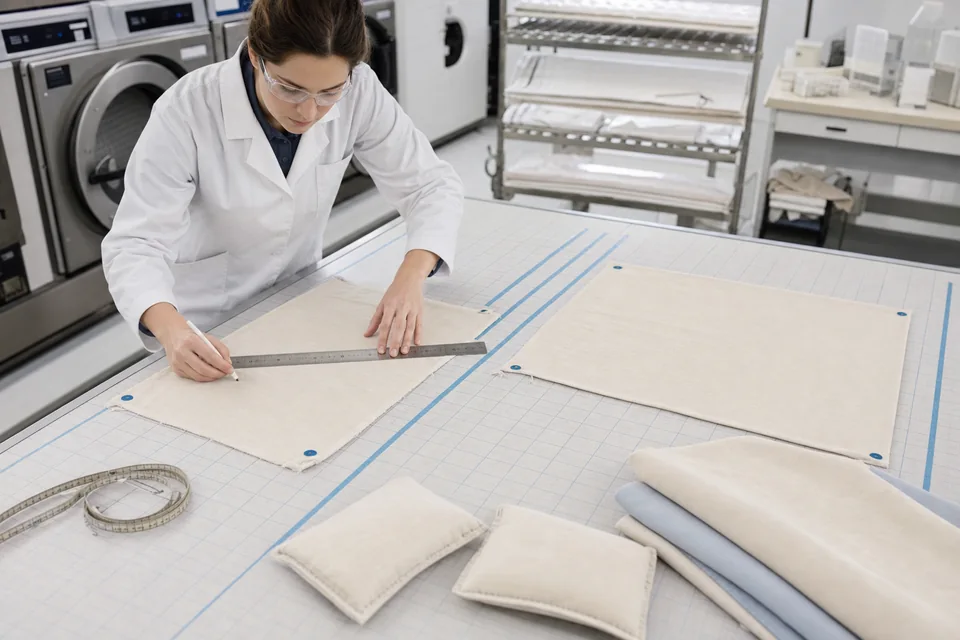
Use calibrated tools, a flat relaxed specimen and the same defined points before and after care. Take multiple readings where the method requires them and calculate change by direction. Report negative and positive change clearly, because extension can also affect fit. Photograph puckering, twisting or uneven edges that a percentage alone cannot explain.
For complete products, apply the measurement rules in the finished dimension and shrinkage planning guide. Quilting, elastic, filling and seam construction can make results location-dependent. Record whether the item was smoothed, tensioned, filled or installed, so another inspector can reproduce the assessment.
Use results in patterns, inspection and reorders
Compare results with acceptance limits, cared-for appearance and functional fit. Investigate direction-specific failure through fabric finishing, pattern allowance, thread or seam tension, quilting, washing and drying. Correct the process or specification; do not simply enlarge every pattern if distortion, variation or an unsuitable care route is the true cause.
Transfer approved allowances and finished limits to production files and the final inspection checklist. Retain tested samples and reports by lot. On reorders, review changes in mill, construction, finish, color process or care instruction and repeat relevant testing before assuming the original dimensional behavior still applies.
Accept dimensional stability only when the specimen, care route, measurement method and usable finished fit are all defined. Carry the result into patterns, tolerances and repeat-order change control.