An open Christmas runner may be assembled from long-loop strips rather than worked as a grid of small crochet cells. Hairpin lace makes the joining arrangement central to the finished appearance. A buyer who approves only one loose strip has not yet approved the runner. The useful development question is how those strips are joined, spaced and finished into the table piece that will be sold or used.
- 1. Identify the strip before discussing the overall pattern
- 2. Decide how the loops are grouped at each join
- 3. Establish the complete runner from strip count and boundaries
- 4. Review the lace on its actual background
- 5. Inspect repeated joins and the finished care state
- 6. Price the finished assembly rather than a length of lace
Identify the strip before discussing the overall pattern
Long loops and a central spine define the proposal
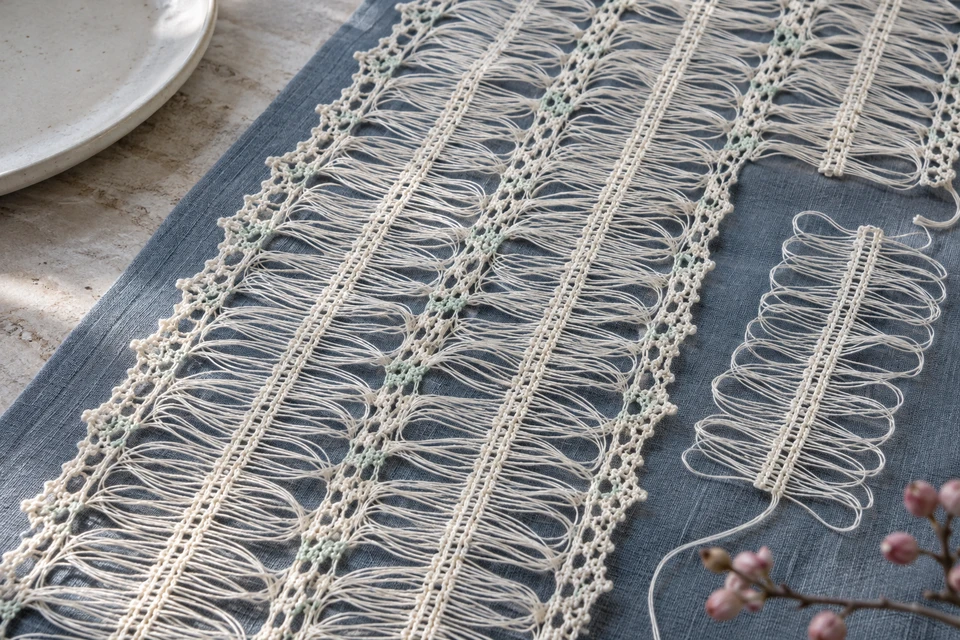
Yarnspirations' hairpin-lace guide describes strips with long loops held by a central crocheted section, then joined into a larger piece. That construction is different from a filet-crochet chart of filled and open cells. Ask for the supplier's actual strip sample and its description. Do not infer the process from a photograph of an airy textile, since other techniques can produce similarly open decorative effects at a distance.
Place the unfinished strip beside a joined section. Identify the central spine, the loops at each side and the way the proposed join takes hold of them. Record the thread reference and the intended face. If the supplier offers several loop widths or spine patterns, retain separate identities rather than describing them all as the same lace. The buying reference should show what will be connected, not just the approximate width of an attractive ribbon.
Decide how the loops are grouped at each join
The connection changes the visible rhythm
Ask the maker to present the proposed joining arrangement over enough length to show its repeat. Note whether loops are taken individually or in groups, where groups converge and what open spaces remain between them. Use a marked photograph or drawing to show the accepted sequence, with a physical joined sample as the controlling visual reference. The buyer is specifying the desired result, not providing a substitute for the maker's working instructions.
Compare alternatives side by side over the same plain background. A denser join can change the appearance of the gaps even when the original strips are unchanged. Decide which version supports the intended Christmas table setting and whether a contrasting joining thread is deliberate. Keep that colour and its route in the sample record. An unrecorded change at the joining stage should not be dismissed as a minor assembly detail when it alters the design's main rhythm.
Establish the complete runner from strip count and boundaries
A nominal width can conceal different constructions
Lay out the proposed number of strips and show the side edges as well as the internal joins. Measure the finished runner in an agreed relaxed state, using a consistent method that does not stretch the loops to reach a target. Record the full width, length and visible strip count. If two offers have the same nominal dimensions but use different loop lengths or joining groups, compare those differences explicitly rather than assuming the articles are equivalent.
Resolve the ends of the runner before approving the middle. Ask how the long loops terminate, how loose ends are secured and whether an added border is included in the quoted unit. Inspect the corners where an end treatment meets a side treatment. A development sample photographed with its ends out of frame leaves an important part of the finished product undecided. For different length variants, identify whether the joining repeat ends in the same way or requires another approved finish.
Review the lace on its actual background
Open areas make the supporting surface part of the display
Place the finished sample over the proposed table or undercloth and examine it from above and from a seated position. The background visible through the long loops can change the apparent contrast and delicacy. Record whether a coordinating undercloth is included, offered separately or merely used in photography. A retail buyer should not accidentally approve a two-layer display while ordering only the upper lace piece without a clear explanation to the customer.
Use the intended ordinary table arrangement to inspect the visual and handling result. Look for areas where the runner bunches, twists or becomes displaced during the agreed review. If plates or serving pieces are part of the intended use, assess that arrangement specifically rather than inferring stability from a flat sample photograph. This is not a heat-protection or spill-barrier specification. Keep any claimed function beyond decoration separate and supported by appropriate product evidence.
Inspect repeated joins and the finished care state
One neat connection does not represent the whole length
Review a representative completed runner along its entire length, paying attention to changes in loop grouping, missed connections and visibly uneven tension. Agree the reference condition with the supplier so a natural textile variation is not confused with an unintended interruption. Record the location of any discrepancy and compare it with the approved joining sequence. The aim is a consistent design decision, not an unsupported claim that every loop must have a numerically identical shape.
Where care is proposed, review the same article after the agreed procedure and preparation for display. Observe the strips, joins and boundaries separately. If the runner needs a specific reshaping step, establish whether that instruction is suitable for the intended user and supported for the offered material. Do not publish machine-wash, ironing or permanent-shape promises from the name hairpin lace. A revised thread or finishing route should return to the complete joined sample, not be approved solely as a loose strip.
Price the finished assembly rather than a length of lace
Make sampling and packing scope visible
Ask quotations to identify the strip construction, number of strips, joining arrangement, boundaries, finished dimensions and pack presentation. Clarify whether sample development covers only the strip or also the full assembly. A low quotation for a narrow unjoined lace length is not comparable with a finished retail runner. Request the actual minimum quantities and any colour-specific commitments for the project; there is no universal minimum supplied by this technique description.
For packing approval, unfold the proposed unit and check whether the joins can be understood and displayed without confusing tangles or an unexplained setup. Keep packaging from hiding the very construction the buyer selected. Share the intended table setting, preferred strip sample and variant quantities with FY Bedding to discuss a development brief. Confirm sample milestones and delivery separately. The accepted order should identify the joined runner and its presentation, not rely on the seasonal name to fill in missing assembly decisions.
Approve a full joined runner showing loop groups, strip count, side and end finishes, relaxed measurements and the intended background; keep care, packing and confirmed delivery scope attached to that exact sample.
Method references: Yarnspirations: hairpin-lace strips and joining.