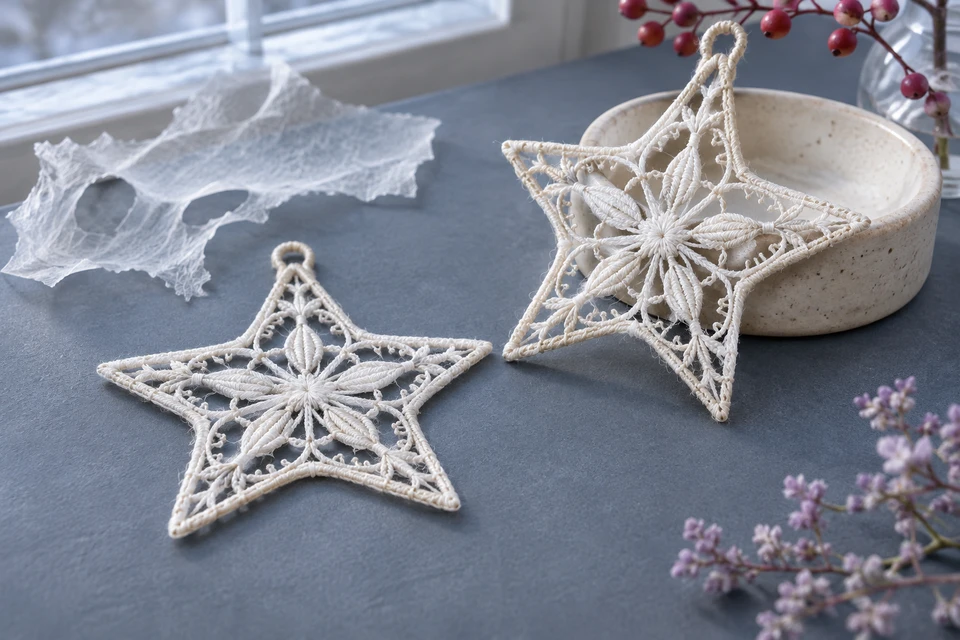
An embroidered Christmas star can look complete while it is still attached to temporary support. That is the wrong stage for approving freestanding lace. The sold ornament should be assessed after the intended support-removal and finishing process, when the thread structure has to hold its own design. The procurement question is what remains in the delivered object, not how tidy the embroidery looks in the hoop.
Confirm that the design is intended to stand alone
Ordinary embroidery files are not interchangeable
Ask whether the offered design was developed specifically as freestanding lace or as embroidery on a permanent fabric ground. Embroidery Library distinguishes lace files prepared for water-soluble stabilizer from ordinary fabric embroidery. This explains the need for a purpose-designed structure; it does not prove that any particular file, machine or thread combination will produce an acceptable ornament. Request a sample made by the proposed route.
Identify the temporary support separately from every component intended to remain. A transparent sheet beneath the stitches can be hard to see in a sales photograph. Ask for the sample's production stage in writing and request both sides of the finished article. Do not approve a design solely because a supplied image appears to show open spaces. Establish whether those spaces are actually open in the article the buyer will receive.
Inspect the connections after support removal
The visual motif needs a continuous thread structure
Choose the points where separate-looking design elements meet: the tip of a star, an internal crossing or the bridge between a small decorative ring and the body. Compare these areas with the approved design after the maker has completed its stated removal and finishing procedure. Keep intentional openings distinct from unintended separations. A magnified image helps locate an issue, but the complete sample shows its consequence for the ornament.
Record broken or disconnected regions without prescribing an improvised digitizing correction. Adding more stitches everywhere can change the appearance, weight and flexibility of the design without addressing the actual weak connection. Ask the embroidery specialist to identify the proposed revision, provide a new finished sample and explain which part of the structure changed. Keep both versions so the buyer can verify the correction rather than relying on a reassuring process description.
Define the final handle and shape
Residual support is not an invisible purchasing detail
Ask the maker to describe the intended finished condition, including whether any supporting or finishing material remains. The removal procedure should follow the actual material supplier's instructions and the maker's validated process; procurement should not invent a universal water temperature or soaking time. Compare samples only after they have reached the agreed dry, finished state. A wet or incompletely finished piece is not the retail reference.
Some buyers want a soft lace accent; others want a more defined hanging shape. Name that preference and require the supplier to explain how it is achieved. Do not use the word freestanding as a substitute for a stiffness specification. If the appearance depends on a retained finish, identify it as part of the proposal and request appropriate care and use evidence. A hard-feeling sample alone does not establish durable shape retention.
Review the ornament from both sides
The reverse is visible in ordinary display
Suspend the sample using the proposed attachment, then allow it to settle naturally. Observe its front, reverse and edge without fixing it flat against a board. Record whether the intended shape remains legible and whether the attachment introduces an unwanted twist. A tree decoration can rotate during display, so a face-only approval may miss thread differences or unfinished details that are visible to a customer.
Keep the hanging connection and any added trim within the complete product review. State whether the order is thread lace only or includes loops, ribbons and other parts. The responsible product owner should determine the evidence needed for the intended market and use. This appearance review is not a toy assessment, a load rating or permission to describe the ornament as suitable for every location. Do not infer those claims from a neat stitched loop.
Test the unpacked presentation
Packaging must not become a hidden support frame
Place the finished ornaments in the proposed retail pack and open them using the ordinary intended method. Look for points caught in neighbouring lace, distorted outlines and an attachment loop trapped across the face. Record the condition immediately after unpacking as well as after any preparation that the instructions actually permit. A studio sample carefully separated by hand does not establish how a multi-piece assortment will open.
If a backing card is needed, identify whether it merely presents the ornament or is necessary to keep it intact during handling. Photograph the supplied unit with and without that card for internal approval. Confirm piece counts and design mix separately from the number of compartments in the pack. When the assortment changes, review contact between the actual shapes rather than assuming every lace design will behave like the first star sample.
Release the finished construction
Retain evidence from the last meaningful stage
The approval file should name the design revision, thread proposal, temporary support, removal route, final finish and supplied components. Keep the accepted dry ornament as the physical reference. Ask the maker to identify which changes would require renewed sampling, especially changes to connection paths, support material or finishing. The final receiving comparison should use completed units, not work-in-progress embroidery that has yet to pass through the defining stage.
For an FY Bedding enquiry, provide the seasonal motif, proposed hanging format, target quantities and retail presentation. Ask for a development assessment and a finished sample before accepting a production offer. The discussion does not confirm equipment ownership, an existing freestanding-lace capability, available stock or a Christmas delivery promise. Close the order only when the finished thread structure and the commercial plan have each been confirmed for the actual project.
Do not approve freestanding lace while temporary support still carries the design. Inspect the dry finished connections, both faces, hanging behaviour and unpacked unit, then retain that exact construction as the reference.
Method references: Embroidery Library: purpose-designed freestanding lace and removable support.