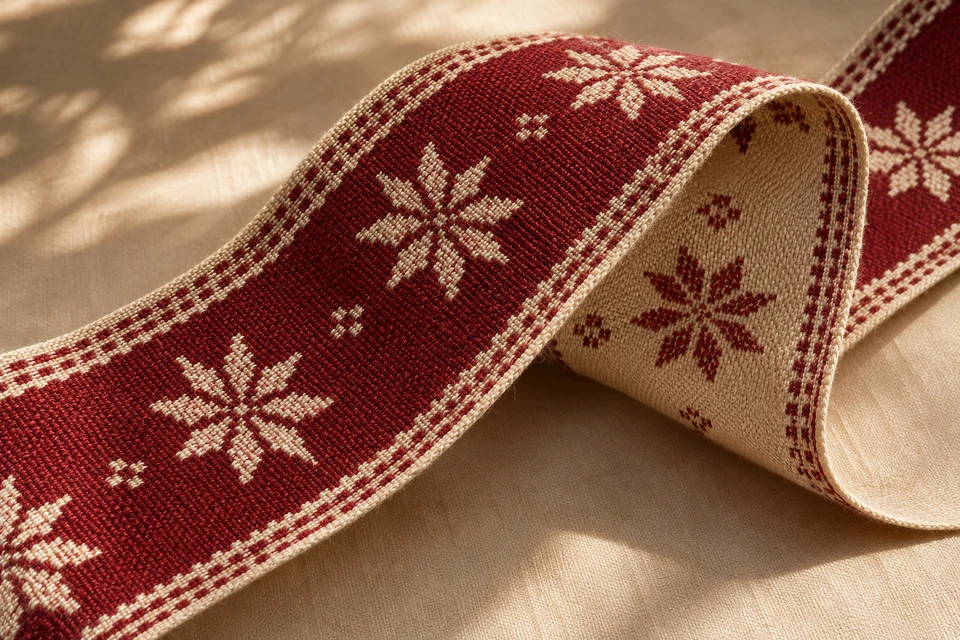
A Christmas bow can expose both sides of its ribbon even when the packaging photograph appears to show only one. With jacquard ribbon, the reverse may carry a different colour balance or visible yarn arrangement. The buyer must decide whether that reverse belongs in the finished presentation. A woven pattern on the front does not automatically make a ribbon acceptable as a two-sided decorative component.
Ask what the supplier means by reversible
Two visible surfaces are not necessarily two approved faces
Request a sample long enough to turn over and fold without concealing its edges. Identify the front and reverse in the supplier's description and ask whether both are intended for display. KING YOUNG's published reversible-dot ribbon is an example of a woven product offered with two colour presentations. It demonstrates that a deliberate reversible construction exists, not that every jacquard ribbon or an FY Bedding proposal has the same feature.
Keep the requested appearance separate from the technical term. A buyer may want the same colour dominant on both sides, an intentionally reversed colourway or a reverse that will remain hidden. Those are different briefs. If a supplier describes the back as acceptable, ask for the physical reference that defines acceptable. Avoid approving a single face photograph and later treating the opposite colour balance as either an obvious defect or an automatically authorised alternative.
Mark the exposed surfaces in the actual assembly
The fold determines which side the customer sees
Make the proposed bow, band or tie using the submitted ribbon. Identify the loops, tails and turns that expose its reverse. Photograph the arrangement from the intended retail viewing directions, including the side where a folded tail may turn over. Do not force every surface to face the camera if that is not how the ordinary packed unit will sit. The assembly trial should reveal the component's real presentation requirements.
For a gift pack containing bedding, show the bow against the actual pack dimensions and textile colours. A small loose bow on the sampling table may not twist in the same way as a longer band around a folded set. Decide whether an exposed reverse is part of the design, must be limited to certain locations or requires another ribbon proposal. Keep that decision with the assembly reference rather than relying on a packing operator to hide every unwanted surface.
Compare the pattern in both directions
A reversed colourway can change the seasonal reading
View the ribbon along its length and after a simple fold. Check the orientation of directional trees, bells or other original Christmas motifs. A balanced geometric snowflake and a directional tree do not create the same folding problem. Identify the intended face of each tail and whether a motif may appear inverted in the finished bow. Where the design is intentionally non-directional, record that decision rather than leaving it implicit.
Review the relative amount of light and dark colour on each side against the packaging background. A pale reverse may be welcome contrast, or it may interrupt a planned dark band. Keep this visual choice separate from colour matching between component lots. The buyer is deciding which pattern presentation is approved, not establishing colourfastness or yarn composition from a photograph. Retain both side references under the same lighting so the comparison is meaningful.
Inspect the reverse as a surface, not only a colour
Yarn arrangement can matter during handling
Look closely at the reverse, selvedges and any areas that contact the packed textile. Ask the maker to identify the offered weave and finish if the visible yarn arrangement differs from the front. Note loose or protruding elements and refer uncertain findings to the responsible technical team. Do not treat every visible float as a defect, but do not ignore an unintended condition simply because it sits on a side called the back.
Define any handling assessment needed for the actual pack. A decorative ribbon may contact soft fabric, tissue, a carton edge or another trim, and the relevant requirements should follow that combination. A casual hand check does not establish resistance to snagging, abrasion or colour transfer. If those properties matter, request appropriate evidence for the named component and assembly. Keep the attractive reverse photograph separate from the record used to support a performance claim.
Preserve the face choice through packing
Written instructions should match a repeatable bow
Ask the packing team to reproduce the accepted arrangement from the proposed instructions and component reference. Observe whether the same side appears in the agreed places without extra hidden fasteners or improvised twisting. If the result depends on special preparation, disclose it and decide whether it belongs in the production method. A complex bow that only one sample maker can arrange may need a simpler approved assembly rather than a vague instruction to keep the front visible.
Trial the ordinary pack and unpack sequence. Record whether the tails turn, the reverse becomes more exposed or the bow needs permitted adjustment. Keep component cutting length, usable reel length and splice rules in their own purchasing fields; they do not replace the two-face appearance decision. If a different ribbon construction is proposed to improve packing, compare both its front and reverse before carrying the original approval forward.
Quote the complete two-face requirement
A similar front is not an equivalent substitute
Send the supplier the named ribbon reference, front and reverse photographs, intended assembly and permitted exposure map. Ask it to identify any alternative that changes the back even when the front closely matches. Separate material minimums, colour minimums and any design-specific setup in the commercial response. The buyer should be able to compare the actual component scope without assuming that the least expensive front-face match will also satisfy the reverse requirement.
When discussing a Christmas packaging project with FY Bedding, provide the pack format and ordinary assembly view alongside the ribbon sample. Request feasibility and sample confirmation before treating the concept as available. Establish the real material, packing and dispatch milestones; a seasonal pattern does not establish holiday arrival. The final approval should survive a simple turn of the ribbon: both buyer and supplier should know exactly which second surface may appear and where.
Turn the ribbon over, then make the real bow. Approve both the pattern and surface of every exposed side, and keep the reverse requirement visible when comparing substitute components.
Method references: KING YOUNG: an example of deliberately reversible woven ribbon.